This article is presented as a unique insight from BEEATS, based on a report contributed to the fashion business media "Oui Speak Fashion® Japan" and incorporating perspectives from our overseas observation team, including President and CEO Mitsuhiro Kashiwagi and Executive Officer Kanta Nishimura.
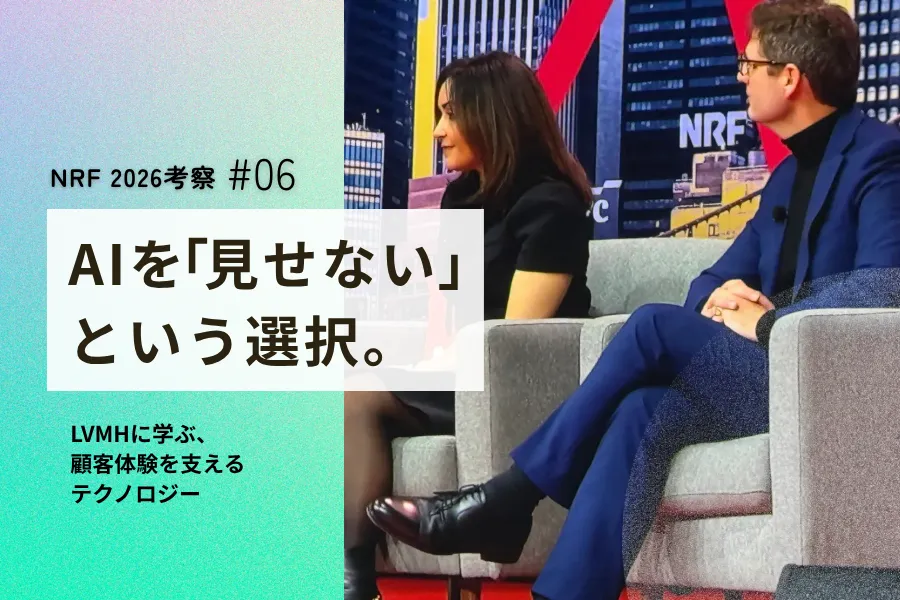
In this article, we consider how technology supports human sensibility, customer service, and brand experience, based on LVMH's AI strategy.
"Quiet Technology" Advocated by LVMH
A key concept to consider in LVMH's AI strategy is "Quiet Technology."
This is a philosophy of having technology function quietly behind the scenes rather than pushing it to the forefront of the customer experience. For LVMH, the value of luxury is built upon human elements such as artistic creativity, exceptional craftsmanship, and intimate relationships with each individual customer.
Therefore, AI is positioned not as a replacement for human work, but as a supporter for enhancing such human-centric values.
In other words, technology is not the protagonist.
It is utilized as a presence that supports the experience from behind the scenes to enrich the brand's worldview, human sensibilities, and relationships with customers.
Comparison axis
Common AI adoption approach
LVMH's "Quiet Technology"
Main objectives
Replacement of work, automation, cost reduction
Expansion and support of human creativity and customer service capabilities
The positioning of technology
The leading role of the experience; pushing it to the forefront
Behind the scenes of the experience, functioning quietly
Points of contact with customers
Streamlined/standardized service
Human dialogue and the brand's unique atmosphere
AI does not replace creativity, but expands it
What is impressive about the LVMH case study is that they do not treat AI as a substitute for creativity.
By having AI analyze vast amounts of data to present preferences, designers can focus on more essential creative work. Additionally, client advisors (sales staff) in stores can instantly grasp a customer's purchase history and preferences, allowing them to focus on "human-centric service," such as selecting words tailored to the customer's situation and building deep relationships.
This is an important perspective to keep in mind when considering product development and experience design in the AI era.
AI excels at organizing large amounts of information, expanding possibilities, and presenting options. On the other hand, what to choose from among them, what kind of meaning to have, and what kind of experience to deliver it as are left to human sensibility and judgment.
Utilizing technology does not mean human creativity becomes unnecessary.
Rather, it is a question of how to use technology to focus on the value creation that humans should originally be addressing.
AI utilization to enhance the value of customer service
LVMH's use of AI extends not only to designers but also to client advisors who face customers in stores.
The OSF article introduces how AI analyzes customer purchase history and preferences to provide insights for personalized suggestions, allowing advisors to focus on dialogue and relationship-building with customers.
What is important here is that AI is used to support the quality of customer service, not to automate it.
Understanding customer preferences. Making proposals based on past interactions. Choosing words according to the situation.
For such actions, human-unique judgment and the ability to read the atmosphere are indispensable. It can be said that AI is being utilized not to eliminate those human touchpoints, but to make them deeper and more accurate.
It can be said that AI is being used not to eliminate human contact, but to make it deeper and more precise.
How to balance consistency with brand individuality
LVMH is a group that holds diverse Maisons, such as Louis Vuitton, Loewe, and Tiffany.
This is a perspective that can be a reference for many companies introducing AI and digital tools.
This is a perspective that is also useful for many companies introducing AI and digital tools.
The more efficiency and standardization are promoted, the more the experience tends to become uniform. However, convenience is not the only reason customers are attracted to a brand.
Words, atmosphere, service, and presentation that reflect the brand. Such subtle differences create the impression of the experience.
This is why it is important to discern what can be standardized and what must be preserved for each brand.
BEEATS VIEW: Insights from the LVMH case study
What becomes clear from the LVMH case is that even in the customer experience of the AI era, the center is people.
Technology can expand creativity. It can also deepen customer understanding. And it can support customer service and operations.
However, it is brand philosophy and human sensibility that decide what kind of experience to deliver it as. If the purpose becomes making technology stand out, the experience tends toward explaining functions. On the other hand, if technology is designed to blend in naturally and support human judgment and communication, customers can accept the brand's value without a sense of incongruity.
If the goal becomes making technology stand out, the experience tends to focus on explaining functions. On the other hand, if technology is designed to blend in naturally and support human judgment and communication, customers can accept the brand's value without any sense of incongruity.
The human touch in the AI era does not mean not using technology.
It means designing while using technology without compromising human sensibility or relationships.
Creating Brand Experiences Together
Various technologies are embedded in the points of contact where consumers and brands meet, such as stores, sales floors, events, exhibitions, and digital signage.
However, what is important is not just what technology is used.
What will visitors feel through that technology? How will it make staff move more easily? How will the brand's worldview be conveyed? How will relationships with customers be deepened?
Designing with this in mind is what will be required for creating brand experiences in the future.
BEEATS CO.,LTD. takes the latest retail trends obtained from this visit and shapes them to the context of the Japanese market, supporting the creation of new brand experience venues.
If you have challenges in next-generation store development, such as wanting to naturally incorporate digital initiatives into store spaces or sales floors, delivering brand-like experiences while utilizing signage or data, or considering space creation that leverages human service and operations, please feel free to consult us.
NRF2026 Report Now Available: "The Dawn of Agent Commerce"
We have released a digest report of "NRF 2026." Please download and use this 29-page report, which includes detailed explanations of the main sessions and solution analyses of 12 featured companies.※ Materials are available in Japanese only.
About this Joint Overseas Report Editorial Project
The original report forming the basis of this series is a joint editorial project between BEEATS CO., LTD. and World Mode Holdings Co., Ltd.
Detailed reports covering the event in New York by our President and CEO Mitsuhiro Kashiwagi and Executive Officer Kanta Nishimura are being published sequentially on the fashion business media "Oui Speak Fashion® Japan." Along with this insight, please be sure to read the main report, which is packed with both companies' perspectives.