Introduction
This article is presented as a unique insight from BEEATS, based on a report contributed to the fashion business media "Oui Speak Fashion® Japan" and incorporating perspectives from our overseas observation team, including President and CEO Mitsuhiro Kashiwagi and Executive Officer Kanta Nishimura.
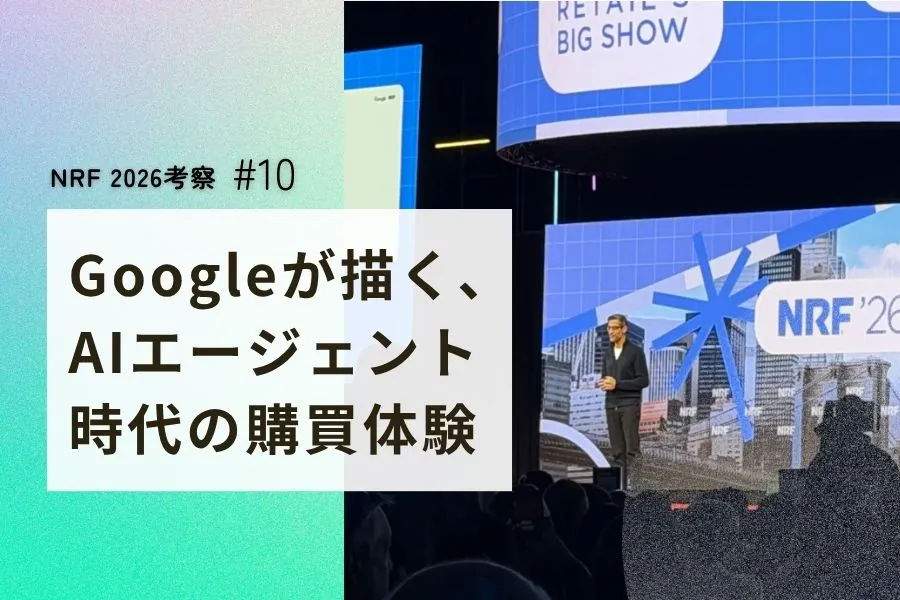
In this article, we will organize how the journey from product discovery to purchase and delivery is about to change, based on the retail AI infrastructure shown by Google at NRF 2026 and the changes in purchasing experiences brought by AI agents.
A New Stage of Retail AI as Shown by Google
At NRF 2026, Google launched a new foundation for AI utilization in the retail industry.
At the center of this is the "Universal Commerce Protocol" (UCP), a common standard designed for e-commerce by AI agents, and the retail-focused AI foundation "Gemini Enterprise for Customer Experience."
Furthermore, the expansion of the partnership between the drone delivery company "Wing" (a subsidiary of "Alphabet") and "Walmart" was also announced.
What these initiatives show is that AI is becoming more than just a tool to make product searches convenient; it is becoming an entity that supports the entire process from discovery, comparison, and purchase to delivery.
The use of Google's AI by retailers is also rapidly expanding. Data processing volume through Google's APIs is said to have increased more than 11-fold year-on-year, growing from 8.3 trillion operations in December 2024 to over 90 trillion a year later.
How We Encounter Products is Expanding from Search to Conversation
Google has placed "Discovery" and "Decision Making" as the two pillars of retail transformation.
The foundation of discovery is Google's product information database, "Shopping Graph." The Shopping Graph contains over 50 billion product listings including inventory, price, and reviews, and is updated in real-time more than 2 billion times per hour.
Against the backdrop of this vast amount of product information, the AI mode integrated into Google Search is changing from traditional keyword-based search to a shopping experience closer to natural conversation.
Users are beginning to be able to encounter products not only by entering short keywords for product names or categories, but also by conveying their own preferences and conditions in words.
Moreover, not only Google Search but also touchpoints such as the conversational AI "Gemini," the image search service "Google Lens," and "YouTube" are expanding as gateways that support product discovery.
AI Agents Connect the Flow to Purchase
In the area of "decision making" that follows discovery, Google has presented UCP.
UCP is a common standard designed for the next generation of e-commerce where AI agents perform product comparisons, suggestions, and purchasing procedures.
What UCP aims for is an experience where you can proceed to purchase in the flow of conversation on Google Search's AI mode or the Gemini screen.
Furthermore, a concept is also being presented to integrate touchpoints for search, purchase, and customer support into a single customer experience through "Gemini Enterprise for Customer Experience."
Searching for products, comparing, purchasing, and inquiring.
Experiences that existed separately until now are becoming continuous through AI agents.
Purchasing Experience in the Age of AI, Expanding to Delivery
The changes in purchasing experience that Google envisions go beyond just discovery and purchase.
Through the expansion of the partnership between Alphabet's Wing and Walmart, 150 new drone delivery locations have been added, bringing the total to 270. A delivery network spanning the United States from Los Angeles to Miami has been realized, with an estimated 40 million people now eligible for the delivery service.
In other words, not only are product discovery and purchase changing due to AI, but the retail structure itself is starting to change, including the "delivery" experience that follows.
The purchasing experience is being redesigned not just for the moment of discovering and buying a product, but as a continuous flow until it is received.
BEEATS VIEW: How to Deepen the Experiential Value of Physical Spaces in an Era of Seamless Purchasing
What Google's initiatives imply is a future where the consumer's purchasing process, from product discovery and comparison via AI to purchase and delivery, becomes increasingly seamless through technology.
Physical stores, pop-ups, and events are no longer just places for purchasing; they have become touchpoints that deliver appeal that is difficult to convey online alone, through experiencing the brand's worldview and trying out products.
Furthermore, in an era where the online purchasing experience becomes even more convenient, it is thought that the "quality" and "meaning" of experiences in physical spaces will be called into question even more.
From now on, it will become increasingly important to consider how that experience connects to brand understanding and touchpoints before and after purchase, and what kind of satisfaction and memories can be left for the consumer.
With AI and e-commerce, product information and purchasing pathways are becoming clearer and smoother.
On the other hand, in physical stores, pop-ups, and events, it is necessary to deepen their role as places where people can experience textures, ambiance, human interaction, and the brand's philosophy—things that cannot be fully conveyed online.
Digital convenience and the value of experiences in physical spaces.
Designing these two not as separate entities, but as mutually reinforcing customer touchpoints, may be the key to brand experience in the AI era.
Creating Brand Experiences Together
The purchasing experience in the AI agent era that Google envisions shows a future where the process from product discovery to purchase and delivery becomes more continuous.
In the midst of these changes, what is required of brands is not just simply adapting to new technology.
Conveying the appeal of products and services clearly at every touchpoint where customers encounter them.
Designing a consistent brand experience without disconnecting physical experiences from digital information.
BEEATS CO., LTD. supports the creation of touchpoints between brands and consumers by combining physical and digital experiences.
If you have any challenges in next-generation store development—such as wanting to enhance brand experience through stores, pop-ups, and events, wanting to design customer touchpoints linked with signage, the Web, or social media, or wanting to rethink purchasing experiences that bridge physical and digital—please feel free to consult us.
NRF2026 Report Now Available: "The Dawn of Agent Commerce"
We have released a digest report of "NRF 2026." Please download and use this 29-page report, which includes detailed explanations of the main sessions and solution analyses of 12 featured companies.※ Materials are available in Japanese only.
About this Joint Overseas Report Editorial Project
The original report forming the basis of this series is a joint editorial project between BEEATS CO., LTD. and World Mode Holdings Co., Ltd.
Detailed reports covering the event in New York by our President and CEO Mitsuhiro Kashiwagi and Executive Officer Kanta Nishimura are being published sequentially on the fashion business media "Oui Speak Fashion® Japan." Along with this insight, please be sure to read the main report, which is packed with both companies' perspectives.
Original Article
Part 11: The Overall Structure of Retail Redesigned by Google: AI Agents Integrate Everything from "Discovery to Delivery"
For more details on this joint editorial project, please see the following page.
Oui Speak Fashion® Japanhttps://ouispeakfashion.com/jp/