Introduction
This article is presented as a unique insight from BEEATS, based on a report contributed to the fashion business media "Oui Speak Fashion® Japan" and incorporating perspectives from our overseas observation team, including President and CEO Mitsuhiro Kashiwagi and Executive Officer Kanta Nishimura.
In our previous article (#03 Welcoming youth as "co-creators" rather than "buyers". Thinking about future sales floor creation based on Pacsun's case), we examined how to build relationships with next-generation consumers based on Pacsun's case.
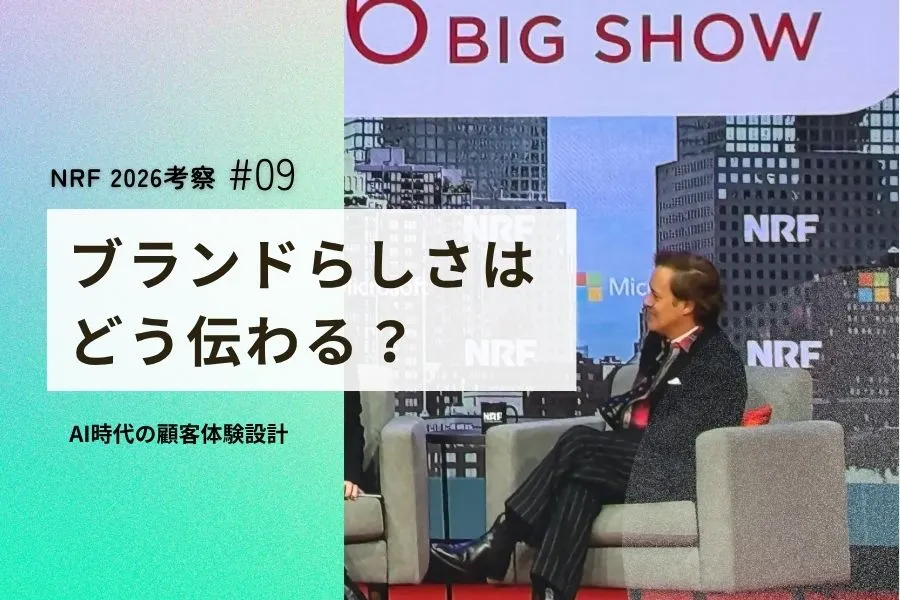
In this article, based on the content of a session featuring the CEOs of AI search platform "Daydream", H&M Group brand "COS", and apparel brand "Zadig & Voltaire", we will think about the challenges of "discovery" in fashion e-commerce and the potential of AI utilization.
"Searching" in fashion is not enough with just spec search
The act of "searching" in fashion is slightly different from general product searching.
It is not always the case that you can reach your target product by inputting model numbers or specs, as you might with appliances or daily necessities. In fashion, complex elements that are hard to put into words are intertwined, such as the mood of the day, the event you are attending, the impression you want to project, and anxieties about fit or comfort.
For example, requests like "a dress for my daughter's graduation, with sleeves and floral patterns, but that doesn't tighten the waist too much" are sometimes hard to capture well with conventional keyword searches.
What is expected of AI is to understand such ambiguous, context-inclusive needs and guide customers to options that suit them.
AI search also requires design that guides usage
On the other hand, introducing AI does not immediately change the search experience significantly.
During the session, while it was expected that the advent of ChatGPT would cause consumers to naturally input sophisticated prompts, it was noted that in reality, many users struggle in front of the search bar, not knowing what or how to input.
Therefore, Daydream says they shifted their policy from simply installing a chat function to developing functions that allow users to gain inspiration and search hints.
What this reveals is the importance of design that guides users to naturally use the power of AI, not just the performance of the AI itself.
What is needed in the AI era is data infrastructure, not flashy features
For brands, realistic preparation for AI utilization is also necessary.
For AI to correctly understand and appropriately propose products, steady efforts such as structuring catalog data, feed integration, and maintenance of press and creator content are essential.
In the Zadig & Voltaire case, it is introduced that they are renewing their website with content structures suitable for AI in anticipation of future AI utilization.
Even if you introduce a high-performance AI "engine," if the data or content to bring out its performance is not ready, it will not lead to a customer experience.
"Discovery" by AI alone does not lead to purchase
Even if AI becomes able to suggest products to customers, that alone does not complete a purchase.
Especially for products like fashion, where not only price and function but also brand empathy, trust, and conviction regarding the wearing occasion are involved in decision-making, prior brand awareness and image formation are important.
Even if AI presents products as "recommendations," it may be difficult to lead to a final purchase if the customer does not know the brand or does not have a reason to trust it.
That is why, even in the AI era, it is essential to build up touchpoints with the brand through PR, SNS, influencers, store experiences, and events.
Discovery by AI is only one trigger for a customer to encounter a brand. To connect that encounter to purchase or relationship, experience design that helps customers understand and be convinced of the brand's appeal is necessary.
AI as a collaborator supporting "discovery" in fashion e-commerce
What we can see from this session is that AI is not a magical existence that solves the challenges of fashion e-commerce all at once.
On the other hand, if it can nestle into the customer's mood or scene and grasp needs that are difficult to put into words, AI can become a collaborator supporting an unprecedented discovery experience.
The important thing is not the introduction of AI itself, but ensuring customers don't get lost and can reach the options that suit them.
BEEATS VIEW: Toward information design that doesn't confuse customers
While this theme centers on e-commerce, there are perspectives that also apply to real sales floor creation.
Simply lining up the charm of products or services is sometimes not enough for customers to find what suits them. From the perspective of customer experience on the sales floor, which information, in what order, and with what presentation should you deliver it? Design that guides customers so they can understand without getting lost and choose with conviction is important.
As customer touchpoints increase, such as store space, fixtures, signage, Web, and SNS, how you present and connect information affects the value of the experience.
Creating Brand Experiences Together
What emerges from the challenge of "discovery" in fashion e-commerce is that for customers to find what suits them and choose with conviction, it is necessary to design the very way information is presented.
This is the same for physical sales floors and store spaces.
In what order and how should you deliver the appeal of products and the world view of the brand? How do you create flow lines that allow visitors to understand without getting lost and naturally deepen their interest?
BEEATS supports the creation of customer experiences that convey the charm of a brand while traversing the interface between real and digital.
If you have challenges in next-generation store creation, such as wanting to deepen product understanding by utilizing store spaces, fixtures, or signage, wanting to design brand experiences linked with Web and SNS, or wanting to consider sales floor creation that makes it easier for customers to choose naturally, please feel free to consult us.
NRF2026 Report Now Available: "The Dawn of Agent Commerce"
We have released a digest report of "NRF 2026." Please download and use this 29-page report, which includes detailed explanations of the main sessions and solution analyses of 12 featured companies.※ Materials are available in Japanese only.
About this Joint Overseas Report Editorial Project
The original report forming the basis of this series is a joint editorial project between BEEATS CO., LTD. and World Mode Holdings Co., Ltd.
Detailed reports covering the event in New York by our President and CEO Mitsuhiro Kashiwagi and Executive Officer Kanta Nishimura are being published sequentially on the fashion business media "Oui Speak Fashion® Japan." Along with this insight, please be sure to read the main report, which is packed with both companies' perspectives.
Original article
Part 4: Can AI redefine "discovery" in fashion e-commerce? Insights from the front lines
For more details on this joint editorial project, please see the following page.
Oui Speak Fashion® Japanhttps://ouispeakfashion.com/jp/