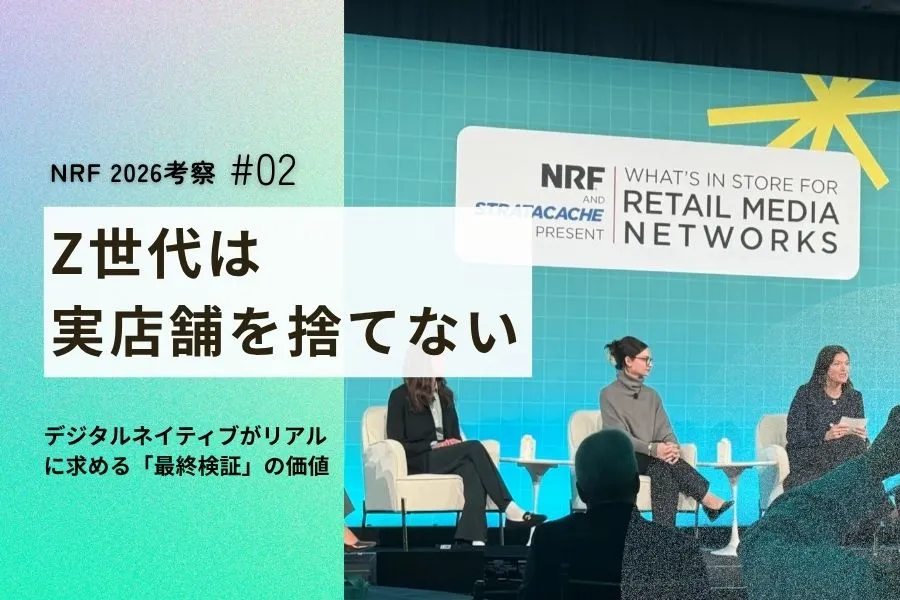
At "NRF 2026," one of the world's largest retail exhibitions, "Gen Z insights" were a topic of heated discussion alongside AI.
This article is presented as a unique insight from BEEATS, based on a report contributed to the fashion business media "Oui Speak Fashion® Japan" and incorporating perspectives from our overseas observation team, including President and CEO Mitsuhiro Kashiwagi and Executive Officer Kanta Nishimura.
This article focuses on the content of the panel discussion "The Z Suite Meets the CMO," featuring university students who are leading the next generation of consumption, and gets to the bottom of why they—as digital natives—now need "physical stores."
Believe only in the "authentic." Gen Z's rigorous trust standards
A major turning point is currently arriving in Gen Z marketing. They hold unprecedented skepticism toward overly crafted advertisements and one-sided sponsored content.
What the panelist students emphasized was their overwhelming trust in "UGC (User Generated Content)." Content based on real experiences, lacking commercial intent, from ordinary users with values similar to theirs, is what moves them.
Also, unexpectedly, "in-store audio advertising" gathered attention. According to an IAB survey, surprising data has been reported that 60% of consumers who heard in-store audio advertising considered a purchase, and 58% actually reached a purchase. This data supports the possibility that content appealing to hearing can become a new channel of trust in a world saturated with visual information.
What they seek from AI is "utility," not novelty
For Gen Z, AI is by no means just a "novel gimmick." What they are seeking from AI is "utility" to essentially enhance the shopping experience. From the cases presented by the panelists, it is clear that they are evaluating AI's "efficiency" and "personalization" extremely calmly.
AI application cases
Values evaluated by Gen Z
Personalized experiences
The ability to accurately and efficiently find what consumers truly want from among an enormous number of options
Automation of monotonous tasks
Creation of time for humans to focus on more creative and strategic tasks by being freed from inventory management and data entry
Visual search technology
Convenience that doesn't let moments escape, allowing products seen in town to be added directly to an online store cart just by taking a photo
Product summarization feature
Efficiency that extracts key points from hundreds of reviews and product descriptions, enabling smart purchasing decisions even in busy times
BEEATS VIEW: Sales floor design as an experience hub that generates Gen Z "conviction"
The insight that "physical stores are a place for final verification," as spoken by the panelist students, will become an extremely important guideline for future store creation. We believe the following perspectives are necessary to maximize store value as an "experience hub" as mentioned in the article.
Textures of fixtures and spaces that support "information gathering through touch"
To turn information gathering online into "conviction," an environment where the texture and weight of products can be checked without stress and in the best condition is essential. Not just simply lining up products, but the structure of fixtures that encourages the action of actually "touching and trying," and the selection of interior materials that physically convey the brand's values. The texture of the entire space boosts the product's persuasiveness.
Dialog-based layouts that accelerate "emotional connection"
Regarding the point that dialogue with staff creates a sense of closeness to the brand, spatial composition that shortens psychological distance is the key. The arrangement of customer service spaces where dialogue is easily born, such as where expert staff and customers can naturally surround products and talk while seeing each other's expressions. We support positive interactions that deepen understanding of the brand from the aspect of spatial design.
"Spatial spaciousness" for comfortable "social experiences"
To have them enjoy the process of choosing while exchanging opinions with friends as entertainment, "spatial spaciousness" that makes it easy for multiple people to stay is important. Designing spaces where friends can consult with each other, "How about this?" and deepen their mutual sense of conviction. Consideration for this "experience of sharing the process" which cannot be obtained digitally, becomes the biggest motive for visiting the store.
Creating Brand Experiences Together
For Gen Z, who are flooded with information online, stores are places for "final verification." BEEATS supports the creation of spaces that make that moment of verification the best it can be.
The subtle texture of products that cannot be conveyed through a screen, the design of fixtures that correctly communicate the warmth of a brand, and spatial production that makes one want to share it with someone. We use the power of fixtures, digital, and space to shape experiences that allow consumers to be convinced, "This is what I wanted."
How should we design the "place of verification" that captures the hearts of Gen Z? If you have challenges in next-generation store creation, please feel free to consult with us.
NRF 2026 report now available: "The Dawn of Agent Commerce"
We have published a digest report of "NRF 2026". This year's NRF marked a historic turning point, as Google's CEO made his first appearance and announced "UCP," a common standard that allows AI to complete everything from product selection to purchase, indicating a shift in the starting point of shopping from "search" to "conversation with AI". This document includes concrete measures for integrating AI into practical business operations, such as the ability of AI chat to achieve a 2-3 times higher conversion rate compared to conventional methods, and the case of Hugo Boss, which reduced in-store tasks by 25% and reinvested that time into customer service. Please download and utilize the detailed explanations of the main sessions and the solution analysis of 12 featured companies, spanning 29 pages.※ Materials are available in Japanese only.
About this Joint Overseas Report Editorial Project
The original report forming the basis of this series is a joint editorial project between BEEATS CO., LTD. and World Mode Holdings Co., Ltd.
Detailed reports from on-site coverage in New York by our President and CEO, Matahiro Kashiwagi, and Executive Officer, Kanta Nishimura, are being released sequentially on the fashion business media "Oui Speak Fashion® Japan." Along with this analysis, please check out the full reports packed with insights from both companies.