Previously, this media reported on the "true nature of 'Korean-style' supported by Gen Z." Looking back a little over a year since its publication, a certain positive change has occurred in the market. Don't you feel that recently, there are fewer occasions where the term "Korean-style" is intentionally emphasized compared to before? Although brands originating from Korea are overflowing on social media and in the city, the expression is becoming more restrained. In fact, this is not because the boom has passed, but proof that the Korean trend has become "so common that it is no longer specifically singled out," showing it has firmly taken root.
What supports this establishment is the "experience" in a real-world setting.
Currently, areas in Seoul like Seongsu-dong and Yeouido are called "meccas for pop-ups," and new brands create unique spaces every week. What Korean consumers seek is not just shopping, but an "immersive experience" where they dive deep into the brand's worldview. This frenzied method is now being brought into the Japanese market.
This time, while pursuing what lies beyond "Korean-style," we will introduce the latest trends in 2026 and the latest pop-up case studies of Korean brands handled by BEEATS.
◆ Click here for the previous article explaining "Korean-style"
Why did "Korean-style" evolve into a "New Normal" in 2026?
◆◆◆
From "Boom" to "Infrastructure"
From 2024 to 2025, the term "Korean-esque" was at the peak of a boom, with the #Korean-esque tag recording over 360,000 posts on Instagram (as of December 2024). However, as of 2026, the situation has completely changed. According to 2025 data from the Korean fashion platform MUSINSA, it is analyzed that "Korean fashion has gone beyond a temporary trend and has become a 'new normal' (new standard) that is deeply rooted in the daily lives of Japanese consumers."
Having finished the phase of enjoying them as "rare items from outside," they are now being naturally chosen as "high-quality options that fit one's own style."
◆◆◆
Brand Selection in the "Attention Detox" Era
The 2026 trend keyword: "Attention Detox (information decluttering)." Tired of the massive amount of information streaming from social media, Gen Z is seeking "essential values" that bring balance to themselves, rather than excessive "Instagrammable" content.
It can be said that Korean brands continue to be supported because they excel at sophisticated designs that meet their needs, and spatial presentations that strip away information noise, such as "places where your mind is reset just by going there."
Seeing it in numbers: The reality of the "entrenchment" of Korean brands in the Japanese market
The fact that Korean brands have escaped "transient trends" and become strong "daily choices" can be seen in the published data of various companies driving the market. Here, we unravel the reality from three perspectives: market size, continuity, and degree of penetration.
❶
[Market Size] From explosive growth to a stable, massive market
According to the official report released in January 2026 by MUSINSA, one of Korea's largest fashion platforms, the company's growth in the Japanese market goes beyond the scope of a mere boom.
The report shows that the annual transaction volume grew by approximately 2.4 times compared to the previous year, and in October 2025, the monthly transaction volume exceeded approximately 1.1 billion yen (10 billion won). It has solidified its position as a major category in the Japanese market.
❷
[Sustainability] From "one-time" to "repeat," deepening trust
Data that is particularly noteworthy is "sustainability," which shows that consumers trust and continue to use the brand. MUSINSA's "Report on Trends in Re-purchase Rates in the Japanese Market (2025)" shows an astonishing figure that the re-purchase rate (repeat rate) surged by about 6 times compared to 2023.
This proves that consumers have ended the "trial because it's rare" phase and have transitioned to the "fan" phase, where they repeatedly choose Korean brands as part of their daily wardrobe.
❸
[Degree of penetration] Infrastructure from "urban areas" to "nationwide"
Korean culture is no longer just for those sensitive to trends in big cities like Shibuya and Shinsaibashi. The announcement in the MUSINSA Press Release on January 30, 2025, that "orders were recorded in all 47 prefectures in Japan" was a symbolic event. With an environment in place where Korean brands can be enjoyed daily anywhere in Japan, coupled with pop-up rollouts in regional cities, it can be said that it is literally beginning to function as "nationwide infrastructure."
Furthermore, an article published by the JoongAng Ilbo (June 16, 2025) reported on "Korean Wave becoming a part of the daily life of Japanese Gen Z" beyond a passing trend, highlighting the current reality where the boundaries between Japan and Korea are melting at the level of consumer sensibility.
A new perspective called the "Korean POP filter"
The essential reason why the charm of "Korean-esque" does not fade is not simply "because it was made in Korea." Intervening here is an advanced editorial ability called "the POP filter known as Korea," as advocated by publications such as Dentsu-ho.
◆◆◆
Sublimating world trends into "our own style"
The "Korean POP Filter" refers to a structure that filters diverse cultures and materials from around the world, such as the West, Brazil, Greece, and the Middle East, with a uniquely Korean sensibility, and reconstructs them into "pop products that generate the most enthusiasm right now" to deliver to Japan.
For example, "Greek yogurt (Greece)," "Dubai chocolate (Middle East)," and "Acai (Brazil)," which have recently become very popular in Japan, were not originally from Korea. However, as a result of Korean creators adding "visual enjoyment (VMD)" and "narrative quality on social media," they became explosive hits in Japan as well.
◆◆◆
The standard is "sense," not "nationality"
As of 2026, what consumers are supporting is not so much "Korea itself" as it is "pop sense from Korea," which edits the best things from around the world in the most exciting way.
This is also true for spatial design in fashion and cosmetics. Korean brands take universal themes like "vintage," "modern," and "minimal" and transform them into "something new and desirable" through their own unique interpretation. Because this "technology of using a filter" has been established, Korean brands continue to reign as the new normal (a new standard) in Japan, not because of "where they are from," but because of the "high quality of their design and culture."
[Case Study Introduction] Pop-up stores for Korean brands managed by BEEATS
Against the backdrop of the pop-up frenzy in South Korea, the key to success in Japan is also "how to reproduce the home country's worldview and make visitors immerse themselves." Here are four case studies that BEEATS supported at the forefront.
Case Study ❶
"nugu" PRESSROOM (Shibuya, Tokyo)
Driving Korean fashion led by influencers is "nugu." BEEATS was in charge of the design and construction of its press base (press room) in Japan. While this facility is a showroom introducing items from multiple brands, it was designed not just for display, but as a place (hub) where media and influencers can actually touch the products and connect them to their posts.
Through a minimal spatial composition with suppressed decorations, we have prepared an environment where the appeal of each brand stands out naturally.
BEEATS handled the construction for nugu's first permanent store in Japan. If the press room in Case Study 1 is the "core of communication," this place is the "core of experience" where consumers interact directly with the brand. We designed it into a physical space with texture, maintaining the momentum from online. In the trend center of Shinjuku, we embodied the materiality and brand atmosphere that cannot be conveyed by EC alone, and dissolved the brand into the "daily lives" of many Gen Z individuals.
A bag & fashion brand that means "yours alone." To reproduce the classic and modern worldview that the Korean flagship store possesses in Japan, we were in charge of construction, focusing on details down to the texture of the fixtures and the selection of vintage furniture. It is a case study that succeeded in embodiment without losing the brand's "weight" under the constraints of a department store event space.
The official pop-up store for the global hit drama "Lovely Runner." BEEATS supported the space direction and construction at Shibuya PARCO. We reproduced iconic scenes that evoke the excitement of the drama within the space, configuring an "immersive" exhibition that allows fans to enter the world of the work. By combining the latest Korean trends (K-content) with real retail, we created a space overflowing with live energy that generated explosive traffic and buzz in a short period.
The "K-Beauty Select Store" is organized by "Leferi," one of South Korea's largest beauty MCNs. This store, which gathers brands carefully selected by beauty influencers, has been held repeatedly within South Korea and is attracting a great deal of attention. As this notable project makes its debut in Japan, BEEATS participated as a partner to bring its domestic expansion to life. We supported the creation of a space where people can realistically experience the latest Korean trends.
Summary: What is necessary for Korean brands to establish themselves in Japan
In 2026, the key to a brand's survival is not just the presentation of trends, but the "sharing of brand philosophy" that aligns with the consumer's daily life. BEEATS' strength lies in "construction with translation skills" that synchronizes the sensibility held by Korean brands with Japan's strict commercial facility rules and legal regulations at a high level. To everyone considering a Korean brand's expansion into Japan or a pop-up store opening, please consult with BEEATS as a partner that can turn fleeting frenzy into a "daily life that lasts for 10 years."
For spatial design & promotions for Gen Z, leave it to BEEATS!
As introduced in this article, BEEATS has handled numerous pop-up stores for Korean brands that are popular with Gen Z.
While making the most of the brand's worldview, we have supported space creation that cherishes the points that Gen Z feels are "cute!" such as simple and stylish designs and unique objects that look great on social media.
Furthermore, BEEATS can provide total support, from planning and execution of promotions utilizing the space, not just spatial design and construction. We will draw out the brand's appeal to the maximum with plans that incorporate the elements Gen Z finds attractive!
Companies considering "spatial design or promotions for Gen Z," please feel free to consult with BEEATS. We will help you capture the hearts of Gen Z with designs and promotions that incorporate trends!
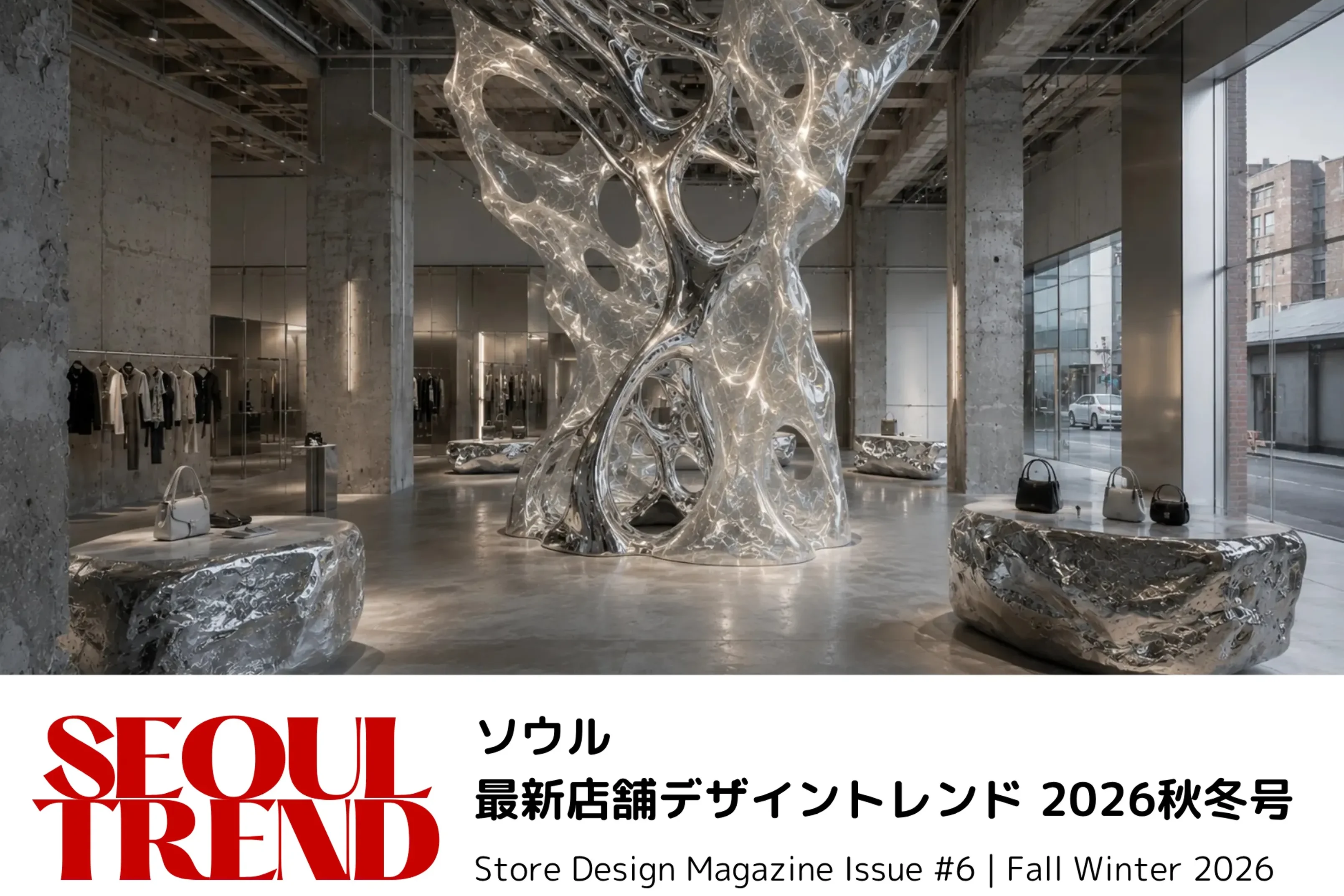
An explanation of the spatial design of Seoul, South Korea, where brands popular with Gen Z gather!
We have released a report that thoroughly investigates trending stores in the most cutting-edge fashion areas and analyzes the latest trends in spatial design. For more details, please visit the Seoul Latest Store Design Trends 2026 Autumn/Winter Issue page. ※ Materials are available in Japanese only.
과거 실적을 정리한 자료를 다운로드하실 수 있습니다!
BEEATS가 진행한 한국 브랜드 팝업 스토어의 공간 디자인 사례를 자료로 정리했습니다. 이 자료에서는 구체적인 시공 사례와 팝업 스토어 성공 포인트를 자세히 소개하고 있습니다.
'Z세대 대상 공간 디자인을 검토 중이다', '한국 브랜드의 트렌드를 알고 싶다' 하시는 분들은 꼭 이 자료를 활용해 보세요!
FAQ: Frequently Asked Questions regarding the expansion and pop-up stores of Korean brands in Japan
Q. Is the "Korean-style" boom over?
A. The boom has not faded; rather, it has entered a stage of entrenchment where Korean trends have become the "norm" and are no longer viewed as something special. Market data also shows growth in annual transaction volume, an increase in repurchase rates, and penetration across all 47 prefectures in Japan, indicating that it has taken root not as a passing fad but as a "new normal."
Q. Why do Korean brands continue to be supported in Japan?
A. The essence of the support lies in the editing ability called the "Korean POP Filter," which does not just mean "made in Korea," but re-edits diverse cultures from around the world with a uniquely Korean sensibility. Consumers are starting to choose brands based on the high quality of design and culture rather than origin.
Q. What is important for making a Korean brand pop-up successful?
A. The fork in the road to success is how well you can reproduce the worldview of the domestic brand and make visitors "immerse" themselves in it. At the same time, it is necessary to comply with Japanese commercial facility rules and legal regulations, requiring a space design that balances the brand's sensibility with local rules at a high level.
Q. Can I consult on Korean brand expansion into Japan or pop-up store openings?
A. Yes. BEEATS has handled numerous pop-up stores for Korean brands, and we provide total support from planning and execution of promotions to spatial design and construction. Companies considering expanding into Japan or opening pop-up stores are welcome to consult with us.