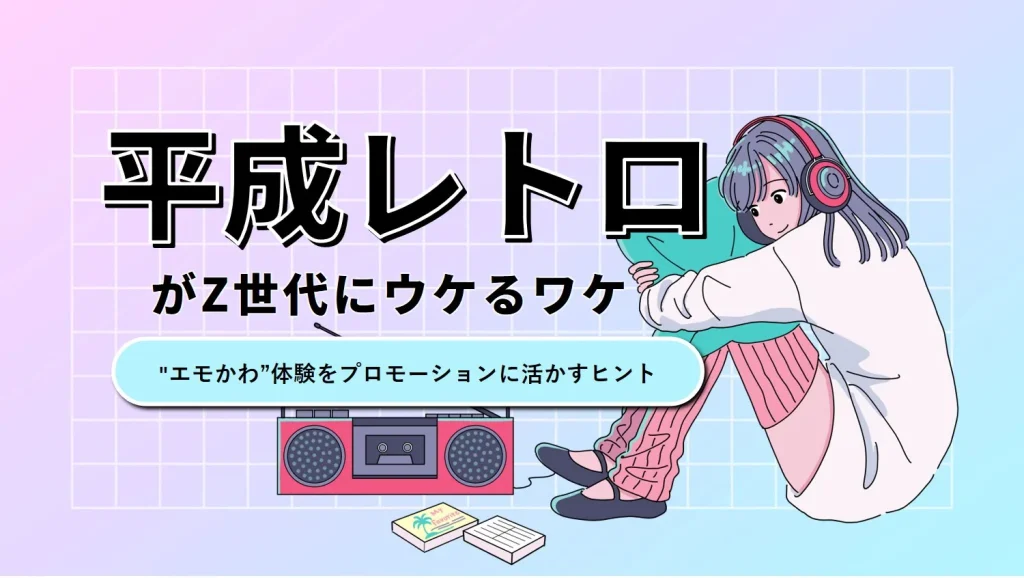
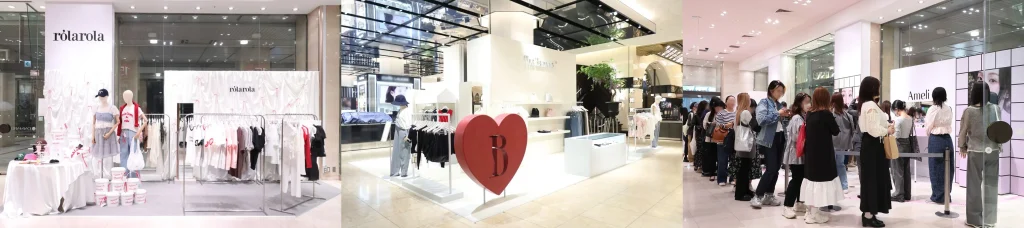
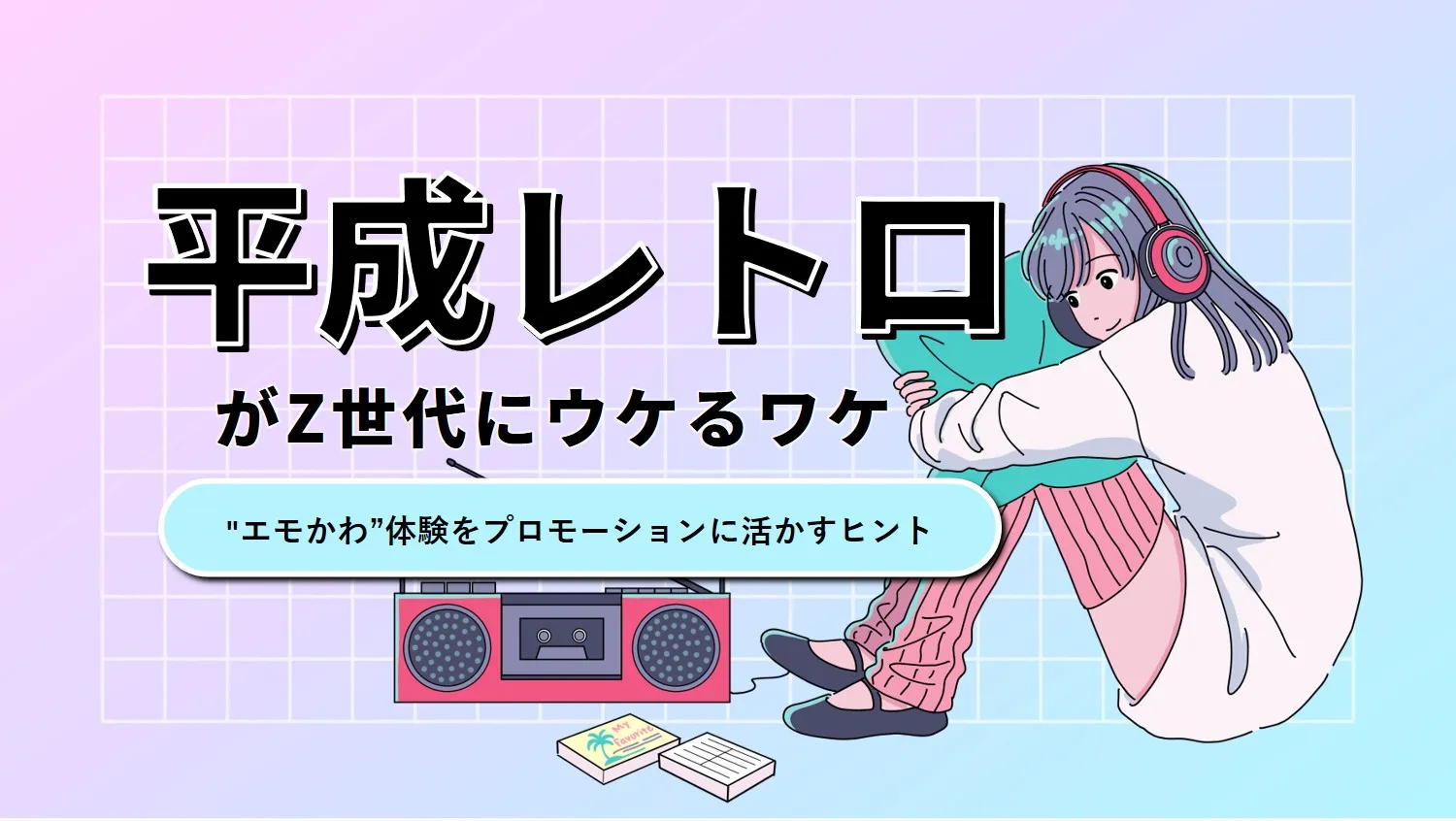
"Heisei Retro" has been booming among Generation Z for several years. Print club photos, feature phones, loose socks, glittery accessories... For Gen Z, Heisei culture is something that, even though they don't know it in real-time, somehow tickles their hearts. This feeling of "nostalgic for something I don't know" is spreading as a new experiential value through social media. At Retail Voice, we have previously featured trends that resonate with the sensibilities of Gen Z, such as "Heisei Girls," a boom centered on girls' culture from the early Heisei period, and "Y2K," which re-evaluates 2000s fashion. This "Heisei Retro" is also one of the notable themes on that same extension. In this article, we will unravel why this trend captures the hearts of Gen Z, while exploring hints for utilizing it in brand experiences and sales promotion projects.
There are increasing opportunities to see the term "Heisei Retro" in the scenes of SNS, music, and fashion. Elements reminiscent of teen culture and street fashion from the 1990s to the early 2000s, such as purikura, feature phones, loose socks, gal characters, glittery accessories, and gacha-gacha, are being re-focused on, especially among Gen Z.
"Retro = nostalgia" is not the only impression; Heisei Retro possesses a unique pop style, high tension, and quirky cuteness. By overlapping with today's sensibilities, it is perceived as "conversely new" or "a bit strange and cute," and has become established as a trend.
Like this "Heisei Retro," there are other movements to enjoy past culture with today's sensibilities. Representative of this is "Newtro" (new-tro) from Korea.
Newtro is a coined word combining "new" and "retro." It is a trend to remake and enjoy culture and design from the 1970s-90s in today's style. With a balance of "nostalgic but not too old" such as CRT TVs, old-fashioned coffee shops, neon signs, and retro fonts, it became popular among young people starting from Korea around 2018, and has recently become frequently seen in Japan as well. The K-POP group NewJeans has also been attracting attention as a representative example of "Newtro" that incorporates video production and fashion from the 90s-2000s.
On the other hand, Heisei Retro is closer to the sensation of "making it look like the atmosphere of that time was reproduced as it is, and enjoying its flashiness and cheapness," rather than "remaking it." Gen Z perceives elements such as gal characters, chain mail, decorative characters, and purikura—which are a bit uncool and cheap, but flashy and fun—as "cute" and "unique." If Newtro is "carefully refined nostalgia," Heisei Retro is a "culture that enjoys the slightly flashy and quirky Heisei tension with today's sensibilities." Both are supported, but even though they are the same "retro," there is a difference in how they are enjoyed.
The reason why Heisei Retro resonates with Gen Z, not "nostalgia" but "newness"
For Gen Z, Heisei Retro is accepted not as "nostalgia" but as "newness." Precisely because they haven't experienced it in real-time, it is enjoyed as a "new game" that is "interesting even though I've never seen it" or "I want to try it." The culture and items of that time are viewed not as nostalgia but as "current and cute experiences," and are reinterpreted as a culture that can be enjoyed freely.
Such sensations are also compatible with self-expression on social media, and "slightly extraordinary and fun" experiences are more likely to lead to UGC (user-generated content). The fact that experience and sharing are set together is a feature that is easy to utilize in promotion design.
Why "Retro Pop" visuals are trendy now
Indispensable to the Heisei Retro worldview is the emo and flashy "Retro Pop" design. Vivid color schemes, glitter, decorative characters, and glittery backgrounds appear at first glance to be mismatched and excessive, but to the current Gen Z, they look "conversely cute." Part of the background is that after several years of simple and minimalist expressions, attention is also gathering on "design with noise" and "aesthetics that are a bit uncool." This retro-pop visual is friendly to the viewer and easy for the sender to imitate. That is why it is easy to create an experience that makes people "want to imitate" or "want to take pictures" on SNS, and it is a perfect match for promotions.
The flow of Heisei retro is spreading not only to fashion and miscellaneous goods but also to the character domain. The background behind why昭和 (Showa) and Heisei-born characters like Tamagotchi and Monchhichi are receiving renewed attention from Gen Z is also introduced in this article.
Examples of companies launching "Heisei Retro" now
Heisei Retro, which is accepted by Gen Z as "new and cute," is also spreading in corporate promotions. Here are three actual examples.
Case 1
McDonald's "Heisei Burger" Revival Campaign
Revived hamburgers popular in the early Heisei era for a limited time in 2023. The CM featuring Eliza Ikeda became a hot topic for its worldview that paid homage to Heisei buzzwords and fashion. A sequel was also developed in 2024, attracting attention as a promotion that delivers "Heisei-ness" to the current generation.
Case 2
Short drama "It Looks Like Heisei"
In August 2025, WOWOW and studio15 teamed up to release a vertical short drama "It Looks Like Heisei" on TikTok. Reconstructing the music, conversation, and visual expressions of the Showa-Heisei era with "today's sensibilities," it gathered sympathy from Gen Z, saying "it's nostalgic yet new." It has also spread on SNS, supporting the flow of intuitively enjoying "Heisei Retro."
Case 3
Seibu Shibuya "NEO Heisei Retro Exhibition"
Exhibition event held by TBS and Seibu Shibuya from July to August 2025. Approximately 300 items were exhibited, including feature phones, profile books, and gal fashion. Designed to allow even the "generation that doesn't know" to realistically experience Heisei culture through nine experience areas, it became a hot topic.
Common to all these cases is that even if they look like "Heisei of that time" at first glance, they are actually edited to suit the current generation. Mechanisms are incorporated that Gen Z wants to receive with their own sensibilities and share.
Topics | Heisei Music also "Resonates" with Gen Z
Even in the field of music, Heisei culture is attracting attention again from Gen Z. For example, ORANGE RANGE's "Oshare Banchou feat. Soy Sauce," which was popular in the 2000s, surpassed 300 million plays triggered by a buzz on TikTok. The rhythm and tension overlap with the current atmosphere, and it is widely accepted by Gen Z. Furthermore, the MV for "Ikenai Taiyou (Reiwa ver.)" released in July 2025 recorded 13 million views in one month. The world view, which incorporates images like old TV image quality and productions of that time, became a hot topic as "conversely new." This style of enjoying songs and videos is not just about the song itself, but about "enjoying the context and atmosphere of the time as a whole." It is easy to fit Gen Z's sensibilities, and it leads to empathy and diffusion on SNS.
Hints for Incorporating Heisei Retro into Promotions
What Gen Z finds attractive is the unique air and tension that "Heisei-ness" has. Even if the appearance is "as it is," in reality, performances and ingenuity tailored to modern sensibilities are added.
To achieve a balance of "nostalgic yet current," editing and gimmicks that intentionally pass through a Reiwa filter are necessary. When companies incorporate Heisei Retro into promotions and brand experiences, it is effective to be aware of the following three points.
1. Do not use "Heisei as it is," but reconstruct it with a "Reiwa filter" Heisei motifs such as purikura, feature phones, and gal fashion may look old if used as they are. What is reaching Gen Z is a style that has been seasoned with "today's tension." Inclusion into visuals, language, and worldview that looks good on SNS is important.
2. Drop it into an experience that makes you "want to do it" and "want to take pictures" Making it a form where you can "experience" Heisei-ness leads to participation and UGC. For example, POP made of glittery materials, instax-style purikura booths, profile book-style posting campaigns, etc., are gimmicks that make you want to share.
3. Utilize the "gap" By intentionally including elements that "do not suit the current era," uniqueness and interest are highlighted. Old video production, hard-to-read gal characters, poem-like copy, etc. There is a tendency for "a bit uncool" to easily fit into Gen Z's sensibilities.
Leave promotions that resonate with Gen Z to BEEATS
"Heisei Retro" and other experiential designs and space creation that fit Gen Z's sensibilities are key to the success or failure of a promotion. However, just tracing trends will not lead to empathy or UGC. What is important is to carefully unravel "how today's young people perceive it" and "how they want to enjoy it," and create gimmicks that pull out the feeling of "I want to try it."
BEEATS excels in promotion design that follows such Gen Z sensibilities. We can offer total proposals that match the brand's worldview and purpose, from experience production at stores and pop-up events to space design, and novelty/video production. For example, please leave it to us to create experiences that connect sensibilities and actions, such as store production that captures Gen Z's "Heisei Retro heat" and the design of photo spots that easily become hot topics on SNS.
"I don't know what kind of experience I should deliver to Gen Z" "I want to launch a pop-up that will become a topic" "I want to consult about everything from design to operation"
If you have such concerns, please feel free to consult BEEATS. We support the creation of brand experiences that generate empathy with promotions that bring out the true "likes" and "fun" of consumers!
A1. It is a trend in which elements of teen culture and street fashion from the 1990s to the early 2000s are being re-focused on, especially among Gen Z. It is characterized by enjoying the flashiness and cheapness of the time, such as purikura, feature phones, and loose socks, as "a bit strange and cute" with modern sensibilities.
Q2. What is the difference between Newtro and Heisei Retro?
A2. Newtro remakes past culture by refining it in today's style, whereas Heisei Retro differs in that it reproduces the atmosphere and flashiness of the time and enjoys it as is. Heisei Retro perceives elements that are a bit uncool and cheap, such as gal characters and purikura, as "unique and cute."
Q3. Why does Heisei Retro resonate with Gen Z?
A3. This is because for Gen Z, who did not experience it in real-time, Heisei culture is perceived not as "nostalgia" but as "newness." Interpreted as a new game of "interesting even though I've never seen it," it is highly compatible with self-expression on SNS, making it easier for sharing experiences to spread.
Q4. What are the points when companies incorporate Heisei retro into promotions?
A4. There are three main points. The first is to reconstruct it with the "Reiwa filter" to modern sensibilities instead of using Heisei motifs as they are, the second is to drop it into an experience that makes you want to share it, and the third is to actively incorporate elements that are inconsistent with the current era to utilize the "gap."