In-person events are events where people gather at an offline venue and perform in-person. Now that online information dissemination, such as SNS, has become the norm, the value of in-person events, which can deliver experiences using the five senses and direct communication, is being re-evaluated.
In this article, we will comprehensively explain information that those considering holding an event want to know, including the types, benefits, and disadvantages of in-person events, differences from online/hybrid events, how to proceed with planning, concrete planning examples, and how to think about venues and costs.
A real event refers to an event where people actually gather offline and carry it out face-to-face. Its types are various, such as concerts and music festivals, exhibitions and fashion shows, sports tournaments, and local festivals.
A Real Event, where participants share the same time, space, and content while communicating with each other to share the experience, is a promotional method that can offer a special experience with a sense of unity, as it is easy to feel the excitement of the moment.
In recent years, event formats have been broadly divided into three types: "in-person events," "online events," and "hybrid events" that combine both. First, let's understand the differences between each, and then look at the characteristics of in-person events.
Types of in-person events
Even though we simply call them Real Events, there are various types depending on the purpose and target of the event. Here, we organize them from two perspectives: "by purpose" and "by format."
■ Types by purpose
・Sales promotion events: Events aimed at expanding awareness or promoting the purchase of products or services. Includes pop-ups, sampling, and trial events.
・Recruitment events: Events aimed at creating touchpoints with job seekers. Company information sessions and joint company briefings are typical examples.
・Events for fans: Events to deepen relationships with existing customers and fans. Fan meetings and anniversary events apply.
・In-house events: Events aimed at employees to foster a sense of organizational unity or for internal branding.
■ Types by format
・Exhibition: A place where companies introduce products and services and connect them to business negotiations with visitors.
As described above, real events allow for diverse planning through the combination of purpose and format. Please also refer to articles with types close to your company's purpose.
Differences between in-person, online, and hybrid events
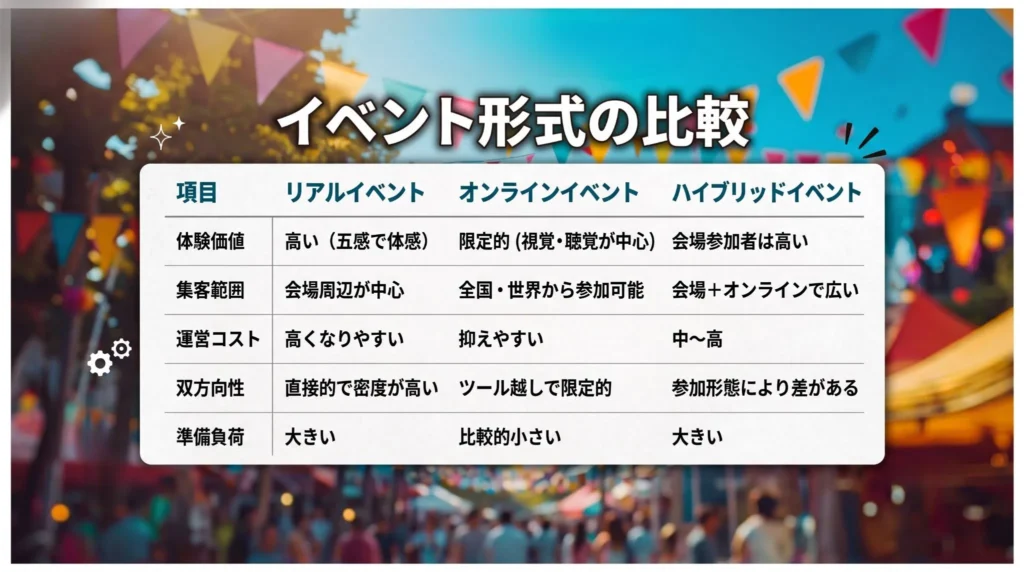
When considering an in-person event, it is important to understand the differences from online/hybrid. We have summarized the characteristics of each in a comparison table.
The difference between a real event and an online event can be expressed succinctly as "whether direct face-to-face interaction and experience using the five senses are possible." Hybrid events combine the merits of both, providing a real experience at the venue while allowing remote participants to join via online streaming.
The optimal format depends on the purpose of the event, the target audience, and the experience you wish to provide. The general rule is to choose "in-person" if you prioritize the "depth of experience," and to choose "online" or "hybrid" if you prioritize "maximizing the number of participants."
Benefits of In-Person Events
Real events have unique benefits that are difficult to obtain online. Here, we also explain "what kind of business results" each benefit leads to.
・Can share experiences with participants: By sharing the same place and time, a sense of unity is created, and favorable memories of the brand are easily retained. → It becomes easier for them to remember "that is that brand" even after time passes, which leads to fan creation.
・Can communicate directly... You can talk to participants face-to-face and get reactions and real intentions on the spot. → As you can directly grasp what the customer is looking for, it is useful for the next measure or acquisition of potential customers.
・Can strengthen branding: You can imprint the brand's worldview through space design and decorations at the venue using the five senses. → It leaves the impression of "this is what the brand feels like," which helps in building brand image.
・Provide real experiences using the five senses... Experiences like actually touching and tasting are easy to remain in memory and increase purchase motivation. → It becomes easier to draw out the feelings of "I want it" or "I want to try it."
Real Event Disadvantages and Measures
On the other hand, there are disadvantages to be careful about in real events. Let's grasp them as a set with measures in advance.
・Costs money... Operation costs such as venue fees, setup/decoration, and labor costs tend to become large. → Measure: Clarify the purpose and KPI, and design effect measurement as a set to enable verification of investment effectiveness.
・Geographical constraints... Only those who can visit the venue can participate. → Measure: Expand participation opportunities with hybridization by using online streaming concurrently.
・Time constraints... You cannot participate if the date and time do not match. → Measure: Consider archival distribution or holding the event over multiple days.
・Influenced by weather and external factors: Especially outdoor events are affected by weather and social conditions. → Countermeasure: Prepare alternative plans for rain and secure indoor venues in advance.
Purpose and effects of holding an in-person event
In-person events change significantly in design by clarifying their purpose. We have organized the representative holding purposes and the effects that can be expected from them.
・Awareness expansion: Hold it at a high-traffic venue to reach segments that have had no prior contact.
・Acquisition of potential customers (leads): Acquiring information about participants who became interested through experiences or surveys.
・Branding: Allowing people to experience the brand's worldview and leaving a strong impression of its brand image.
・Strengthening relationships with existing customers: Provide special experiences for fans to enhance loyalty.
・Sales Promotion: Encourage purchasing behavior with on-the-spot sales and coupon distribution.
Defining "what it is held for" first becomes the axis of the entire plan.
How to proceed with in-person event planning
To make an in-person event successful, it is important to plan step-by-step, from setting the purpose to the operations on the day. We have organized the basic flow into 7 steps.
① Purpose/KPI setting: Decide what you want to achieve, such as awareness expansion or lead acquisition, and the indicators for that.
② Target deep-dive: Clarify who the event is for, what they are interested in, and what kind of experience they are looking for.
③ Concept/experience design: Set a theme that resonates with the target, and design the flow of the experience from arrival to departure.
④ Venue/Date Selection: Select a venue and date that is easy for the target to gather and matches the theme.
⑤ Concrete contents and production: Embody the provided content such as exhibits, experiences, and photo spots.
⑥ Visitor Attraction/Notification Design: Combine notification methods that reach the target, such as SNS, flyers, and the Web.
⑦ On-the-day operations: Prepare reception, traffic flow, and staff placement, and anticipate trouble-shooting needs.
Particularly in step ③ experience design, the point is to add additional elements to the "experience you want to provide." For example, if it is a tasting of a new product, by not just stopping at a tasting but adding game elements such as riddle-solving or a voting contest, it leads to satisfaction and diffusion on SNS.
Real Event Planning and Production Idea Collection
Here, we introduce specific planning and production ideas that can be used in real events. Please combine them according to the event's purpose and target.
・Experience booth: A corner where you can actually try out products or services. Increases understanding and interest.
・Workshop: An experience where participants work with their hands to create something. Increases dwell time and engagement.
・Photo spot: Photography spots with a condensed worldview. This becomes a trigger for SNS diffusion.
・Sampling: Distribution of product samples. Creates a trigger for trial use.
・Gacha/Lottery: The "you don't know what you'll win" excitement encourages attendance and can also be used for novelty distribution.
・SNS posting campaign: Provide benefits on condition of posting, and have the visitors themselves spread the information.
・Live demos/demonstrations: Show how to use it and its appeal in front of them, promoting understanding and conviction.
・Collaboration project: Collaborate with other brands or influencers to reach new customer segments.
・Limited content: Produce a sense of "only now" specials with products and experiences limited to the venue and period.
How to choose a venue for an in-person event
Venue selection is an important element that determines the success or failure of an in-person event. Let's consider it from the following perspectives.
・Compatibility/Flow with target: Is it a location where the target customer layer is likely to gather, or is the flow easy for visitors to access?
・Capacity/Size: Whether there is room for the estimated number of visitors and if congestion can be avoided.
・Facilities/loading conditions: Whether the conditions to realize the plan are met, such as power supply, fixtures, and loading routes.
・Consistency with brand image: Whether the venue's atmosphere fits the world view of the event.
・Ease of booking: Popular venues fill up early, so inquire early once the candidates are decided.
There is a diverse range of options depending on the purpose, such as event spaces in commercial facilities, station concourses, and outdoor spaces.
Real Event Costs and Preparation Flow
Real event costs mainly consist of "venue fees," "setup/decoration fees," "labor costs," "production product fees," and "operation costs." As these vary greatly depending on scale and content, the basic approach is to first determine the purpose and priorities, and then allocate the budget accordingly.
Preparation takes a considerable amount of work. The items to be anticipated range widely from venue selection to on-the-day decoration, reception, flow design, and trouble response. If small-group operation is difficult, consulting with a partner with abundant event operation experience allows for smooth progress from preparation to on-the-day response.
Case study introduction! BEEATS in-person events
Here, we will introduce specific examples of real events by BEEATS.
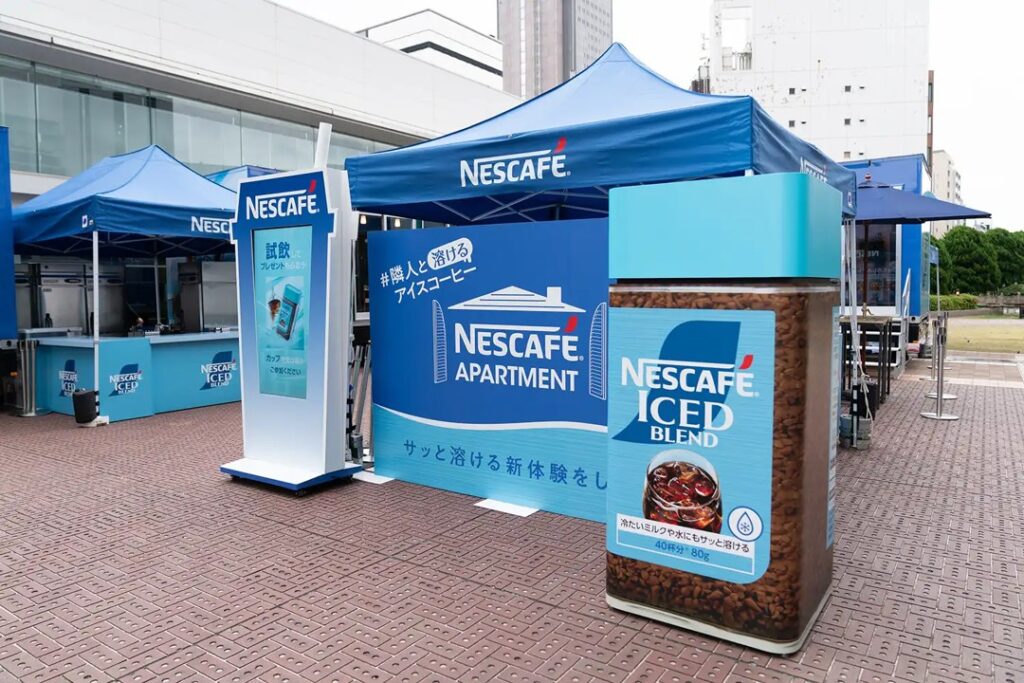
[Case Study 1] Nestlé Japan Ltd. "NESCAFÉ APARTMENT #Iced Coffee That Melts with Neighbors"
An experiential promotional event that delivered the "melts instantly in cold water" appeal of the ice-only coffee "Nescafé Ice Blend" as an experience, not just information. BEEATS supported everything from planning to space design, construction, and human resources operation.
■ Event Overview ・Event Name: NESCAFÉ APARTMENT #Iced Coffee That Melts with Neighbors ・Implementation Period: April 28, 2026 (Tue) – May 6, 2026 (Wed) ・Implementation Location: Shinjuku Southern Terrace Plaza ・Target Product: Nescafé Ice Blend
■ Initiatives Implemented This Time ・Proposed an drinking experience that aligns with living scenes by installing 4 rooms resembling a room in an apartment outdoors ・Appointed influencers as "special residents" to introduce arrangement recipes ・Dynamically visualized how it "melts in water" using a giant iced coffee-shaped monitor ・Developed free tasting and a giveaway project that can be entered via SNS posts
Please click on the case study page below for details.
[Case Study 2] Francfranc Corporation - "HANDY FAN STAND" Event
Francfranc Corporation, which handles a wide range of interior and miscellaneous goods sales and coordination. BEEATS CO.,LTD. was in charge of the "HANDY FAN STAND" event held in the Marunouchi/Yurakucho area.
■ Event Overview ・Event Name: HANDY FAN STAND ・Dates: July 1, 2024 (Mon) – July 7, 2024 (Sun) ・Venue: Marunouchi Happ. Stand & Gallery Marunouchi Happ. STORE Tokyo Kotsu Kaikan ・Featured Product: Fre Smart Handy Fan
■ Initiatives Implemented This Time ・Production of booth space design ※Utilizing visual creatives provided by Francfranc ・Space proposals (Proposed a sales event at the Tokyo Kotsu Kaikan in Yurakucho linked with rental initiatives in Marunouchi, and creating a return spot for fans who rented items) ・Sampling arrangements for full-scale leaflets ・LP production
Please click on the case study page below for details.
Panasonic Corporation, a leading Japanese home appliance manufacturer with a history of over 100 years since its founding. Since our founding, BEEATS CO.,LTD. has been supporting retail promotions for Panasonic, mainly in home appliance mass retailers. This time, we were in charge of the exhibition tools for the "LAMDASH PALM IN" experience event held at Tokyo Station.
■ Event Overview ・Event Name: Father's Day Special Event! Tokyo Station LAMDASH PALM IN Experience Session ・Dates: June 8, 2024 (Sat) – June 16, 2024 (Sun) ・Venue: Tokyo Station Event Space (Yaesu Concourse) ・Featured Product: Men's Shaver "LAMDASH PALM IN"
■ Implementation measures this time ・Production of a photo booth where visitors can take pictures with products ・Arrangement of event display tools
Please click on the case study page below for details.
Leave the planning and operation of your real-life events to BEEATS
BEEATS has planned and operated a variety of events, from events at home appliance retailers and shopping malls to in-person events in outdoor spaces. Based on our accumulated know-how, we provide total support from planning to operation on the day.
As for venue staff, we can also quickly assign the best talent nationwide. If you are considering holding an in-person event, please feel free to contact us.
An in-person event is an event where people actually gather offline and interact face-to-face. Since participants share the same time and space, and can enjoy experiences using the five senses and direct communication, it becomes a promotion with a sense of unity that is easy to remember.
Q2. What kinds of real events are there?
By purpose, there are sales promotion, recruitment, fan-oriented, and internal events, and by format, there are exhibitions, pop-ups, trial events, seminars/conferences, and anniversary events. Diverse planning is possible by combining purpose and format.
Q3. What is the difference between real events and online/hybrid events?
The biggest difference is "whether direct face-to-face interaction and experience using the five senses are possible." While online events allow participation from anywhere at a low cost, the depth of the experience is limited. Hybrid is a format that combines the advantages of both.
Q4. How much do in-person events cost?
Consists of venue costs, construction costs, labor costs, production costs, and operation costs, which vary greatly depending on the scale and content. The basics are to first decide the purpose and priority, and then allocate the budget.
Q5. What is the first thing to decide in in-person event planning?
It is the purpose of "what it is held for" and the KPI. With the purpose determined, the axis of subsequent design such as target, venue, and content is decided.