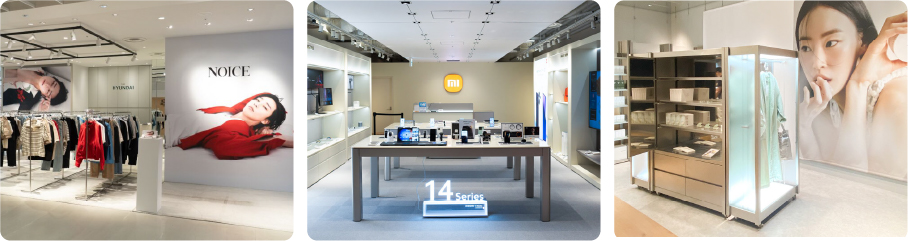
Pop-up stores for various genres such as apparel, cosmetics, food, characters, anime, idols, dramas, and games are held nationwide almost every day.
The number of cases where brands, products, or services with no previous experience in opening physical stores are doing so for the first time is increasing, and pop-up stores are attracting attention as an optimal method for improving brand awareness and test marketing new products.
This time, we will explain in detail the flow of pop-up store opening and the points of preparation so that corporate staff who are opening a pop-up store for the first time / considering opening can advance the opening plan while resolving anxieties. Because we will introduce useful tips such as how to make plans, points for location selection, and tricks for design, if you are considering a pop-up store opening, please by all means use it as a reference!
▼ We are also introducing pop-up store support cases for overseas brands and companies!
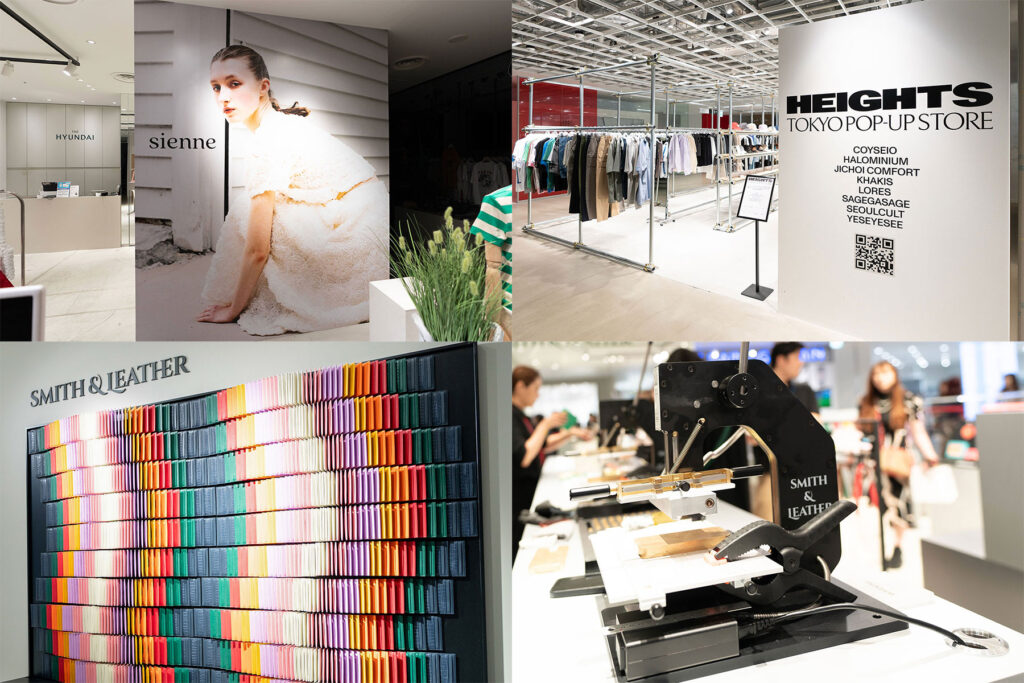
A case study of a pop-up store for a Korean apparel brand held at Shibuya PARCO, constructed by BEEATS
Tip 1. Clarify the purpose of opening your pop-up store
The first step to making a pop-up store a success is to clarify your objective.
What is the purpose of your company (product/brand) opening a pop-up store? If the purpose is clear, specific plans will proceed smoothly. While purposes differ depending on the company, if we summarize common pop-up opening purposes, they are contents such as the following, for example.
[Examples of pop-up store opening purposes]
◇ Purpose 1: Improvement of brand awareness ・Wanting to further expand new brands, overseas brands, etc. ・Wanting to revamp the image of an existing brand
◇ Purpose 2: Test marketing of new products ・Wanting to directly check the reaction of the market and target customer segments ・Wanting to find points for product improvement
◇ Purpose 3: Promotion of special campaigns and events ・Wanting to introduce seasonal items or collaboration products and create buzz ・Wanting to hold special events and deepen connections with customers
◇ Purpose 4: Approach to new markets and customer segments ・Wanting to approach regions or customer segments that could not be reached before ・Wanting to establish presence in a new market
For example, if a brand does not have an offline (physical) store, a pop-up store is a perfect opportunity to provide a real-world experience and expand awareness. By allowing customers to actually pick up products, they can directly feel the texture and usability that are difficult to convey online, which helps build trust in the brand. Opening a store in a location where many target customers gather can also be a catalyst for expanding brand awareness.
By organizing the "purpose of opening a pop-up store" in this way, let's proceed with the pop-up store opening plan.
Tip 2. Concretely imagine the target of your pop-up store
When opening a pop-up store, concretely imagine the customers who will be the target of your store. By considering who you are providing products or services to, whether the pop-up store target should be the same as existing stores or products, and setting a concrete target image, you can make venue selection, space design, and planning much more effective.
[Examples of concrete target setting]
Example 1: A working woman in her 30s who is highly interested in beauty and health, and who checks the latest trends utilizing social media. Example 2: A young businessman in his late 20s to early 30s who is looking for an efficient lifestyle.
By concretely setting not just age and gender, but also lifestyle, needs, and thoughts in this way, it becomes easier to advance pop-up store opening plans, such as providing experiences that the target likes or opening in places where the target gathers.
Once the purpose and target of your pop-up store are determined, let's consider the opening goal next.
Tip 3. Set goals (KPIs) that can measure effects numerically
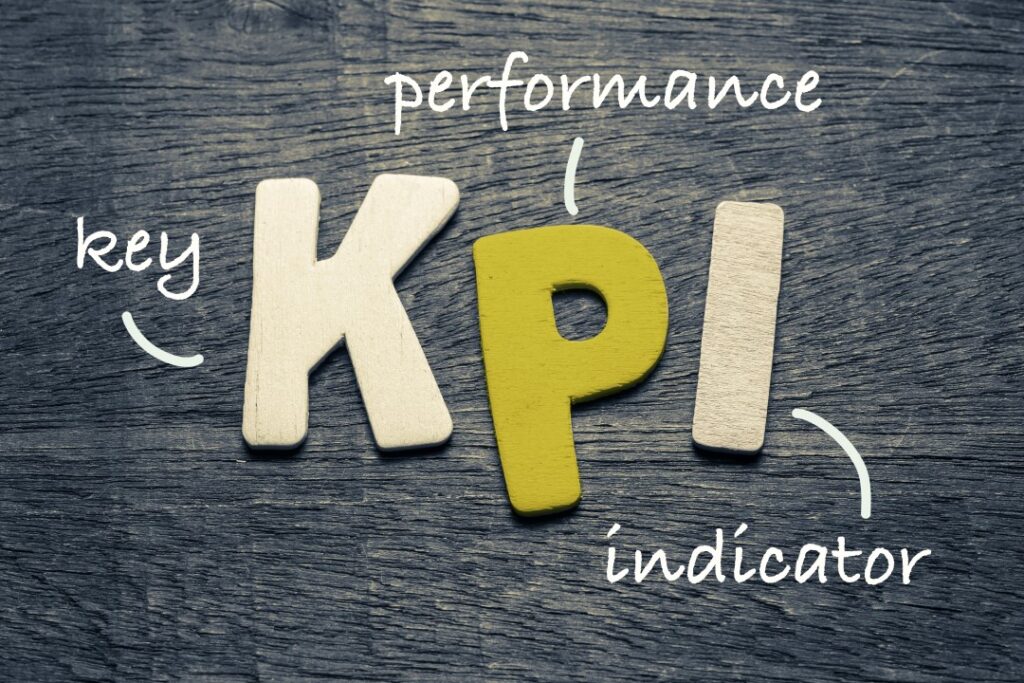
Setting goals (KPIs) to measure the results of the opening is also indispensable for pop-up store opening. The point when setting goals is to make them content that can be measured numerically.
[Examples of setting pop-up store opening goals]
・Sales target Example: "Achieve 3,000,000 yen in sales in 2 weeks"
・New customer acquisition Example: "Acquire 150 new members"
・Improvement of brand awareness Example: "Increase SNS account followers by 300"
・Collection of product feedback Example: "Collect 60 pieces of feedback from visitors"
Various goals may be set according to the purpose of the pop-up store, but for example, the contents above are often set. Also, it is not just one goal, but multiple goals may be combined. Rather than simply measuring effects only by sales at the store, let's consider indicators that can be evaluated from various perspectives.
Tip 4. Build a solid budget plan for your pop-up store
Next, let's plan the budget to achieve the established goals. Budget planning is an important element directly linked to the success of a pop-up store opening. Let's build a budget following the steps below.
◇◇◇
Clarify the main costs incurred in opening a store
Various costs will be incurred to open a pop-up store. First, grasp the overall picture of what costs will be required and plan your budget systematically. Necessary costs related to pop-up store openings can be broadly classified as follows.
[Main costs required for pop-up store opening]
・Venue rent Venue rental fee
・Design and decoration costs Production costs for store design, displays, fixtures, signage, and promotional materials
・Personnel costs Salary and training costs when hiring new staff for the pop-up store
・Marketing costs Costs for advertising, promotion, and social media campaigns
・Shipping costs Shipping costs for transporting products and inventory to be sold at the pop-up store to the venue
・Operation costs Electricity costs, internet communication fees, and costs for consumable goods
◇◇◇
Allocate budget to each cost item
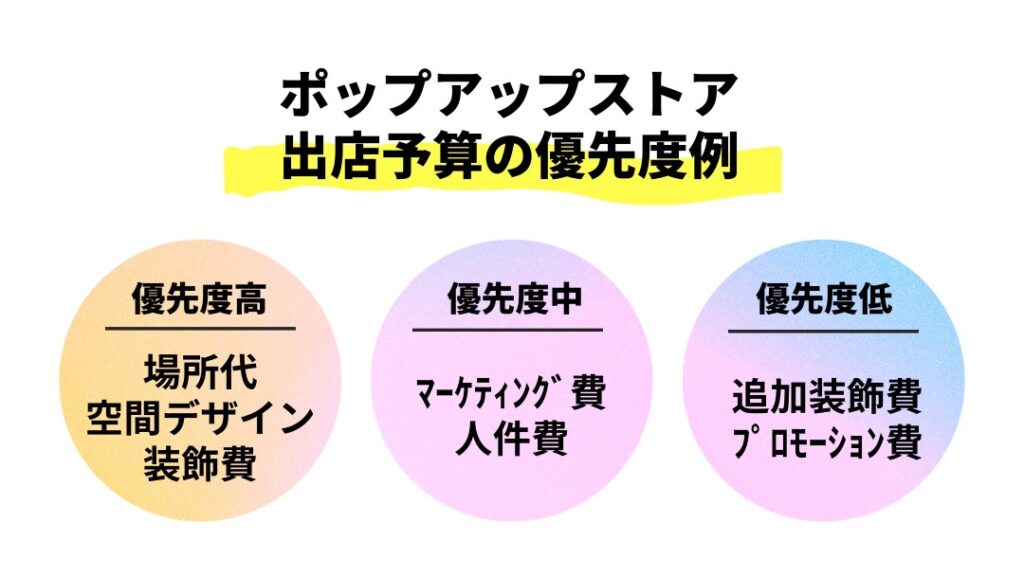
If the upper limit of your pop-up store budget is already decided, prioritize and allocate the budget to each cost item. Although the way of thinking about priority is just an example, please refer to the following:
High Priority: Venue rent, basic design and decoration Medium Priority: Marketing costs, personnel costs Low Priority: Additional decoration, special promotional events
Especially, the pop-up store venue rent varies greatly depending on the period of opening (how many days the pop-up store is held) and the location (what kind of venue it is held at). Because there is a tendency for venue rental costs to be high in commercial facilities or popular areas where customer attraction can be expected, setting the location selection and opening period according to your budget is necessary.
Tip 5. Choose an ideal location for your pop-up store
Venue selection is directly linked to the success of a pop-up store. From here, we will introduce tips for finding an ideal pop-up store location.
◇◇◇
Tips for Choosing a Pop-up Store Location
When considering the location for a pop-up store, let's consider the following three points.
◇ Choose a location that fits the target's lifestyle Choose the area and venue by thinking about the affinity with the target, not just because it is a famous facility and has drawing power.
◇ Check for good access For pop-up stores held only for a short period, good access is also an important element of location selection. Evaluate candidate areas and venues by referring to data such as the following:
・Pedestrian traffic survey: Investigate the daily number of pedestrians in the chosen area ・Confirmation of transportation access: Check the distance from the nearest station or bus stop, the presence of parking, etc. ・Collaboration with surrounding facilities: Check if there are popular stores or facilities in the neighborhood and look for opportunities for customer attraction
◇ Check for locations matching events and seasons Because there are places where people gather during specific seasonal events or periods, research events at the planned opening time and choose a place where it is easier to attract customers.
After choosing the location, the next step is the process of finding a specific venue. First, let's confirm what types of venues there are for pop-up stores.
◇◇◇
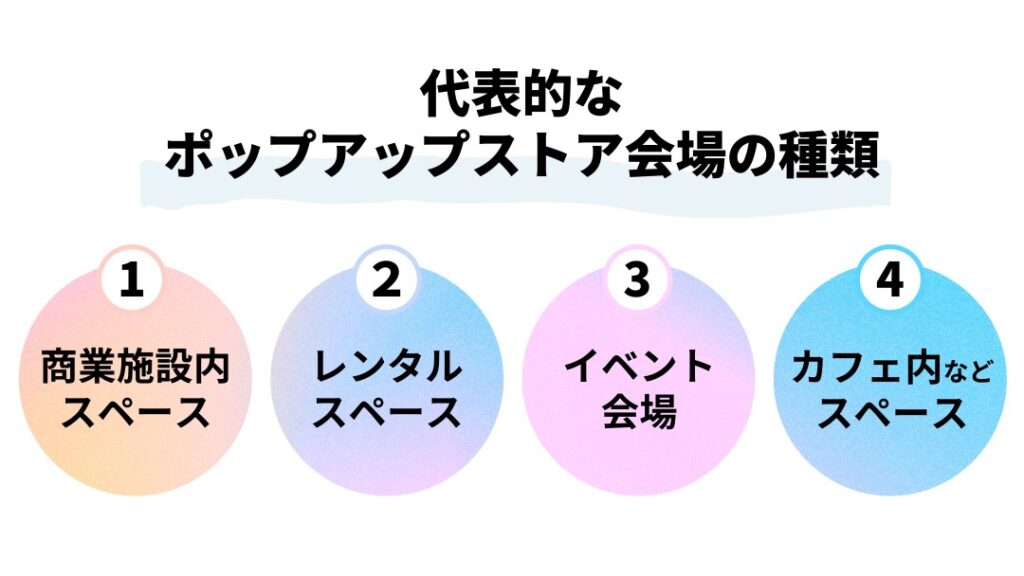
Types of pop-up store venues
[Venue Types]
1. Space inside a commercial facility Spaces inside shopping malls or large commercial facilities are popular pop-up store locations.
▼Merits ・High drawing power Because many people visit commercial facilities, it is expected that a large number of visitors will come naturally. ・Improvement of brand image By opening in a popular commercial facility, it leads to brand reliability and image improvement. ・Existing infrastructure Because basic infrastructure such as electricity and the internet is in place, preparation is relatively smooth.
▼Demerits ・High costs The more popular the commercial facility, the higher the rental cost tends to be. ・Presence of competitors Because many brands open stores within the same facility, competitors may also be present.
2. Rental space Because rental spaces can be used flexibly, they can respond to various needs.
▼Merits ・Flexibility Because you can freely choose the opening period and space size, it tends to be easy to respond to short-term events. ・Cost performance Compared to commercial facilities, they can often be used at a relatively reasonable price. ・Diverse locations Because rental spaces exist in various places from the city center to the suburbs, you can choose according to the target.
▼Demerits ・Uncertainty of drawing power Because you cannot expect the same drawing power as a commercial facility, promotion for customer attraction becomes important. ・Infrastructure development In some rental spaces, electricity or internet equipment may be required separately.
3. Event venues or exhibition halls There is also a method of opening a store to coincide with a specific event or exhibition.
▼Merits ・Clarification of target You can effectively approach your target according to the event theme or participants. ・Temporary drawing power Because many visitors can be expected during the event period, it is suitable for short-term customer attraction. ・Networking opportunities New business opportunities may be born through exchanges with other exhibitors and participants.
▼Demerits ・Limited time Because the event period is limited, it is not suitable for long-term pop-up store development. ・Preparation required In many cases, special preparation or decoration matching the event is required.
4. Spaces inside cafes or restaurants In some cafes and restaurants, it is possible to set up a pop-up store inside the store.
▼Merits ・Relaxed atmosphere Because you can approach cafe or restaurant users naturally, you can introduce products in a relaxed atmosphere. ・Opportunities for collaboration Through collaboration with other restaurants, you can increase drawing power mutually. ・Low cost Compared to regular rental spaces, they can sometimes be used at a relatively low cost.
▼Demerits ・Space restrictions Because the store space is limited, it is not suitable for large-scale store openings. ・Adjustment with business days It is necessary to adjust to the business days or business hours of the restaurant, and flexibility is required.
Choose a venue type that fits your purpose from these various venue types. If you can't research what kind of venues are available, or are lost in venue selection, you can request venue selection from a partner company that supports pop-up store openings, but you can also search for a venue that meets your desired conditions by yourself by utilizing venue reservation sites and platforms specializing in pop-up stores.
Once you find your ideal venue, go ahead and book it. Popular venues can get booked up quickly, so plan early and reach out.
Tip 6. Create a pop-up store space that matches your brand image
Pop-up store space design and decoration are key elements for expressing your brand's personality and providing an attractive experience to visiting customers. We have summarized and introduced the important points to consider for pop-up store space design below.
♢POINT 1. Layout ・Securing traffic flow: Design the traffic flow so that customers can move smoothly within the pop-up store. Aim for a layout that naturally guides them from the entrance to the exit.
・Zoning: For example, if it is an apparel brand, clearly separating areas with different functions, such as a product display area, a fitting area, and a checkout area, will provide efficient operations and a comfortable shopping experience.
♢POINT 2. Color and Lighting ・Utilization of brand colors and logos: By incorporating brand colors and tones into the entire space or placing the logo in a prominent position, you can enhance brand recognition while emphasizing a consistent brand image.
・Lighting ingenuity: Choose appropriate lighting that is neither too bright nor too dark and arrange it so that the products look beautiful. Using spotlights to highlight specific products is also effective.
♢POINT 3. Materials and Textures ・Unification of textures: By unifying the materials and textures used in the store, you can give a sophisticated impression. Choose materials that match your brand image, such as wood, metal, glass, etc.
・Use of accent items: You can also stimulate visual interest by adding accents to the space, such as incorporating different materials in some places.
♢POINT 4. Display to increase attractiveness ・Variation in height: By incorporating displays with varied heights, you can build an impressive space.
・Utilization of digital tools: Utilize digital signage, touch panels, etc., to provide brand information and product information interactively.
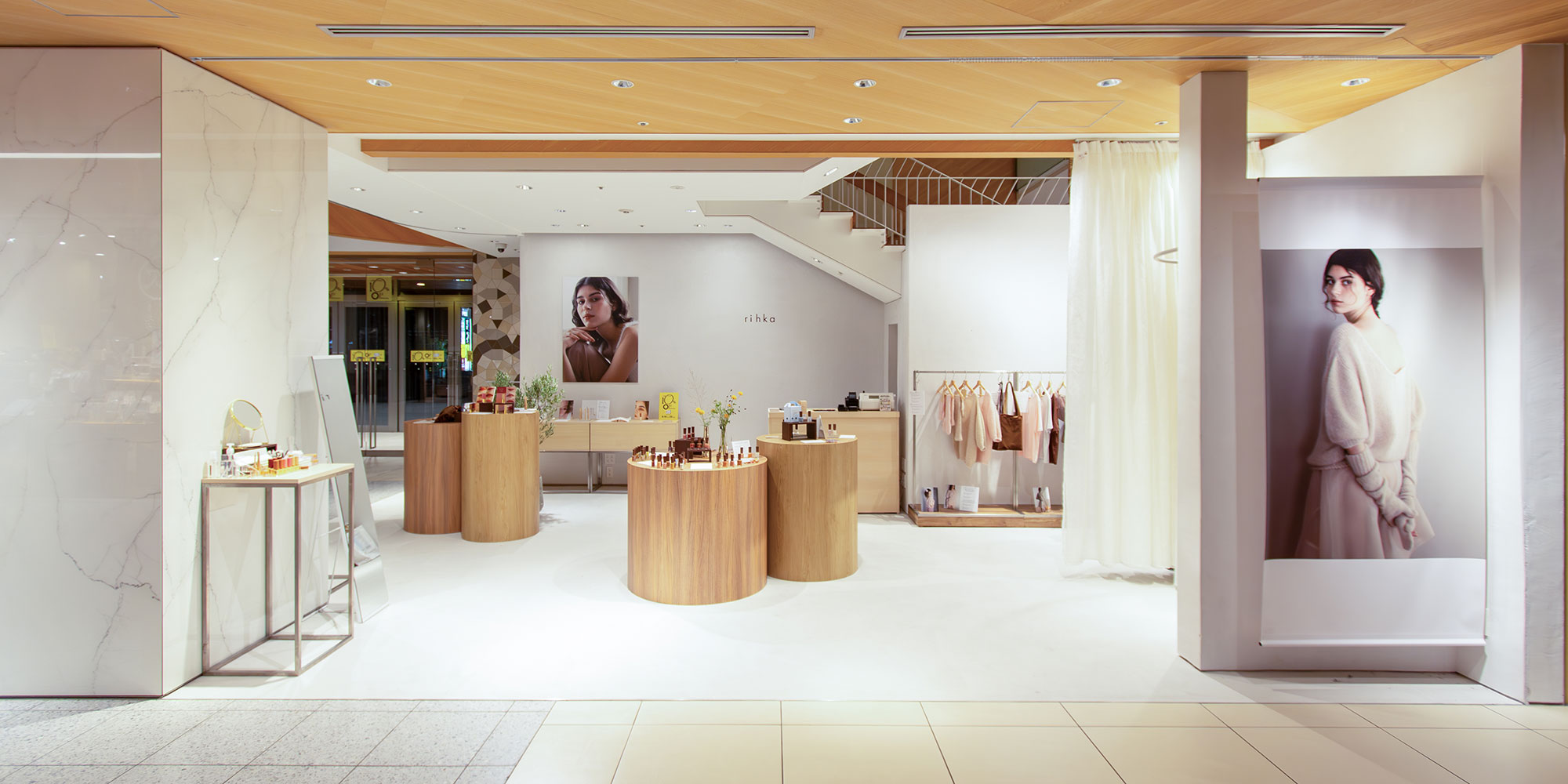
▼ Click here for the pop-up store case study of "rihka," a cosmetic brand popular on social media for which BEEATS was in charge of space design and construction
If there are brand visual guidelines, you will stage the pop-up store according to those rules. However, if there are no specific guidelines regarding spatial staging, consult with a partner company that has a track record in spatial design to prevent issues such as the pop-up store space not matching the brand image or the store being difficult to shop in (products being hard to see).
Tip 7. Plan experience content at the pop-up store
By considering and providing content such as experiences that can only be had at a pop-up store, rather than just selling products, you can create a more attractive pop-up store space.
[Examples of experience content]
・Experience-based exhibits: By setting up an area where customers can actually try and experience the products, they can realize the value of the products.
・Photo spots: Set up social-media-friendly photo spots to create a space that makes customers want to take photos and share them on social media.
・Workshops: Holding workshops related to products, such as making something using the products, is also standard content for pop-up stores.
Although what kind of experience is good depends on the brand or product being opened, it is important to prepare experience content that the visitors set as the target can enjoy.
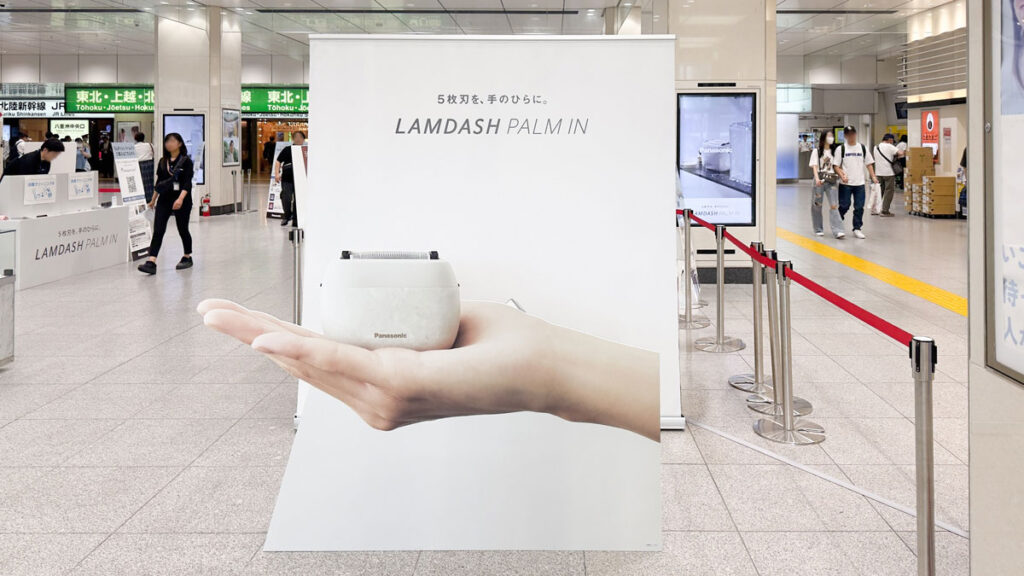
▼ Click here for the Panasonic "LAMDASH PALM IN" pop-up event case study, which provided a photo booth where you can enjoy taking pictures as if you were riding on the palm of your hand along with the product
Tip 8. Actively utilize social media
When opening a pop-up store, don't forget to actively utilize social media. By skillfully utilizing social media at all times—before, during, and after the opening period—you can increase the awareness of the pop-up store, strengthen your customer attraction power, and strengthen engagement with customers.
Tip 9. Consider promotional plans to enliven your pop-up store opening
As a promotional project to enliven pop-up store openings beyond just social media utilization,
・Inviting influencers (inviting them to visit the pop-up store and having them post about it on social media, etc.)
・Holding limited events where celebrities/influencers appear (such as events where you can participate by lottery from among those who purchased at the pop-up store)
・Preparation of pop-up store exclusive products or pop-up store exclusive commemorative gifts
etc., it is also possible to connect to visitor promotion and purchase promotion by adding a special feeling and adding plans that make people want to visit the pop-up store more.
Tip 10. Consult a pop-up store opening partner with expertise
We have introduced various tips so far, but opening a pop-up store requires a wide range of preparations and planning. Especially for your first pop-up store opening where there are many unfamiliar points, advancing while working alongside a partner who supports opening success is also a solution.
Based on the experience of leading many companies to successful openings, BEEATS provides total support from pop-up store planning to operation on the day. We will propose plans tailored to the individuality of each brand and product, such as clarifying purposes, setting goals, venue selection, design, and marketing strategies. You can also leave the "operation" to us, which could not be introduced in these 10 selected tips. Please also check our HP for details about BEEATS's pop-up store service.
We also have a free download of case studies that summarizes our past success stories. Please learn from pop-up store opening cases and utilize them for your own opening plans.
If you are anxious about preparations for your first pop-up store opening, or if you are struggling with planning or design for your opening, please feel free to consult BEEATS. We will draw out the charm of your products and brand, and fully support the success of your pop-up store!
Q1. What is the main purpose of opening a pop-up store?
A1. The main purposes of a pop-up store are to improve brand awareness, test market new products, promote special campaigns, and approach new markets and customer segments. You can directly convey the appeal of your brand through real-world experiences.
Q2. How should I choose a location for my pop-up store?
A2. It is important to choose an area that fits the target's lifestyle and check for good access (number of pedestrians and public transport). Also, choosing a location that matches seasonal events can be expected to have a higher customer attraction effect.
Q3. How do you set goals (KPIs) to measure the results of your opening?
A3. The key is to make goals content that can be measured numerically. Combine multiple indicators depending on the purpose, such as "3 million yen in sales in 2 weeks," "Acquire 150 new members," or "Increase social media followers by 300."
Q4. What are the cost items required for pop-up store budget planning?
A4. Main cost items include venue rent (venue rental fee), design and decoration costs, personnel costs, marketing costs, shipping costs, and operation costs (electricity, communication fees, etc.). It is important to prioritize and allocate the budget.
Q5. Could you tell me examples of content to provide attractive experiences to customers?
A5. As attractive experience content, "experience-based exhibits" where you can actually try the products, "photo spots" that you want to share on social media, and "workshops" where you enjoy making things related to products, etc., are classic and effective.