More and more companies are utilizing "pop-up stores" as a measure to give shape to their brand's worldview and lead to increased awareness and sales promotion. When considering a plan, isn't "cost perception" what many people in charge are concerned about?
The cost of a pop-up store is determined by a combination of multiple elements, such as store location, spatial design, operational structure, and promotional measures.
Even for pop-ups of the same brand, the thinking behind necessary costs varies depending on the store location, spatial production, the presence or absence of experiential content, and the operational structure during the event. Therefore, when thinking about the cost of a pop-up store, it is important to organize "what kind of structure you will implement the event with," rather than just a simple amount of money.
This article explains the main elements that make up the cost of a pop-up store and the way of thinking about budget design that you should organize when planning.
What you will understand in this article ・Main elements that make up the cost of a pop-up store ・Reasons why costs change depending on the store location and spatial design ・Organization points when thinking about the budget for a pop-up store
What determines the cost of a pop-up store? Main cost composition
The cost of a pop-up store varies depending on the location, duration, and production, ranging from small-scale projects costing a few million yen to large-scale promotions reaching tens of millions of yen. Market prices are not uniform and vary greatly depending on the content, so when considering costs, it is important to organize not only the simple amount but also what kind of structure the event will be implemented with.
The cost of a pop-up store is mainly composed of the following elements:
Main cost composition of pop-up stores (4 elements)
1.
Venue costs
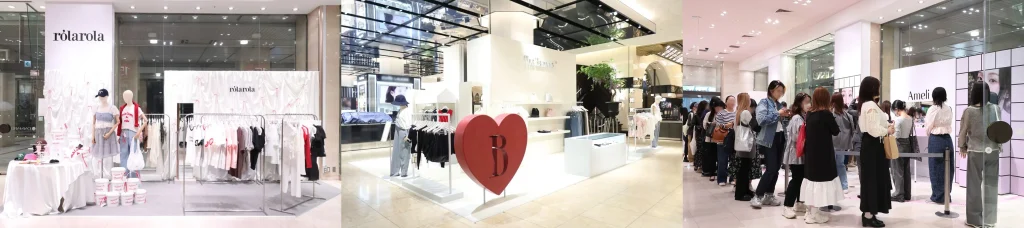
When thinking about the cost of a pop-up store, the first major element is the venue cost. The cost structure varies greatly depending on the place, such as department store event spaces, areas within commercial facilities, train stations, street-level spaces, and rental spaces. Also, since the decoratable range and setup conditions differ depending on the venue, it also affects the degree of freedom in spatial design.
Venue cost is not just a cost to rent "area." It has an aspect of buying a "coincidental encounter" between the people passing by that place and the brand. If you think that you can have a contact point where you can realistically present the brand's worldview to layers that web advertising cannot reach, the criteria for selecting a venue may also look different.
In a pop-up store, design and construction to express the brand's worldview as a space are also important elements. The production content varies depending on what kind of spatial experience you design, such as display fixtures, signage, and lighting production.
In recent pop-ups, there is a trend to design spots where visitors intuitively think, "I want to take a picture of this and share it," rather than just making the space look clean. Symbolic corners where the brand's worldview is concentrated, or scenes that can only be experienced on the spot. The construction cost for creating these "points you'll want to take a picture of" is not just a decoration, but can be called an investment in "triggers" to generate natural SNS diffusion through visitors.
3.
Operation and staff labor costs
A pop-up store is an important element not only in creating space but also in operation during the period. For example, ・Sales staff ・Sampling response ・Visitor guidance ・Support for experiential content etc., the necessary operational structure changes depending on the plan content. In pop-up stores, there are many cases where visitors' understanding of the brand is deepened by picking up products and talking to staff.
Therefore, it is not uncommon for staff's customer service and guidance style to affect the impression of the event experience. Also, it is important to establish a system that allows for smooth operations, such as guidance during congestion and guidance for experiential content. For pop-up stores, designing the entire event, including not only spatial design but also operational structure, is required.
Staff standing on site are like "the closest media" that directly conveys the brand's ideas to visitors. Not only explaining products, but also guiding them to spots they want to take pictures of, or casually supporting their experiences. Just having one staff member who cares about the visitor's feeling of "wanting to enjoy" should change satisfaction with the stay significantly. By regarding operating expenses not as mere labor costs but as an investment to directly convey the "body temperature" of the brand, you can see a convincing budget allocation.
4.
Promotion
In recent pop-up stores, there is an increase in promotion design that combines SNS and PR, not just the event itself.
▼ Regarding the relationship between pop-up stores and SNS, we also introduce it in detail in this article.
For example, ・Photo spots that encourage SNS posts ・Participatory content ・Event planning featuring influencers or guest appearances ・Novelty items and sampling distribution
By combining these, you can expect diffusion not only at the event venue but also online. Especially in recent years, there are increasing cases of incorporating plans where you can experience the brand's worldview and collaboration events with influencers. In pop-up stores, it is often seen that visitor experiences are designed while combining such measures.
What are the main factors that change the cost of a pop-up store? Explaining the points where costs change
The cost of a pop-up store varies greatly depending on the event content. Points that have a particularly large impact are as follows:
◆
Store location
Venue costs and setup conditions vary greatly depending on the area and facility where the store is opened. Since the movement of visitors changes depending on the location, such as commercial facilities, department stores, train stations, and street-level spaces, it also affects the way you think about spatial design.
◆
Scale of spatial production
The content of spatial production varies greatly between a simple product display pop-up and an event incorporating photo spots and experiential content. Production content also changes depending on how far you create the space, such as fixtures, signage, and lighting production.
◆
Duration (holding period)
Pop-up stores also have different cost compositions depending on the duration of the event. The way of thinking about venue costs and operational structure differs depending on whether it is a short-term event or a promotion spanning several weeks.
◆
Promotional measures
In a pop-up store, the cost structure may change depending on the content of the promotional measures. For example, this is because the necessary preparation and operational structure differ depending on the content of the measures, such as events inviting influencers, SNS campaigns, and novelty distribution. However, in pop-up stores, there are many cases where the store location and basic spatial design are important first, and promotional measures are generally considered according to the purpose and budget.
3 points to keep in mind when thinking about pop-up store budgets
When considering the budget for a pop-up store, it is important to think based on the overall design of the project, not just cost items. Here, we introduce three points that you should organize at the planning stage.
1. Organize the purpose of opening the store The purpose of a pop-up store varies depending on the brand. Event design changes depending on the purpose, such as raising awareness of new products, sales promotion, providing brand experiences, or SNS diffusion. First, by organizing what you want to achieve with the pop-up store, you can see where you should focus your budget.
2. Think about the compatibility between the venue and the target In a pop-up store, the visitor demographic and behavior change significantly depending on the location where it is opened. By selecting an area or facility where the target demographic gathers, it becomes easier to create a connection with the brand. Venue selection is one of the factors that determine the success of a pop-up store and is a point that also affects budget design.
3. How to design the spatial experience In recent pop-up stores, there are an increasing number of events that design brand experiences in addition to product displays. Depending on the content of spatial production and experiential content, the impression on visitors and the ease of SNS diffusion also change. By thinking about the plan from the perspective of what kind of experience you want to deliver, it becomes easier to organize the entire design of the pop-up store.
Frequently asked questions when thinking about the cost of a pop-up store
Regarding the cost of a pop-up store, various questions may arise when considering the plan. Here are some frequently asked questions.
Q. How much does a pop-up store cost?
A. The cost of a pop-up store varies significantly depending on the location, spatial design, duration, and promotional measures. While there is no uniform market price, it can range from a few million yen to several tens of millions of yen depending on the scale of the project. For example, a simple product display pop-up and an event incorporating experiential content will have different cost structures because they require different spatial production and operational structures.
Q. Can a pop-up store be held in a small space?
A. It is possible to hold a pop-up store even in a small space. Even in a limited space, you can lead to effective promotion by incorporating spatial design that expresses the brand's worldview and staging that is conscious of SNS diffusion.
Summary | Pop-up store costs change significantly depending on planning design and cost composition
The cost of a pop-up store is not simply decided by "venue cost + decoration cost." The cost of a pop-up store varies greatly depending on the planning content, store location, and spatial design.
For example, ・Events aimed at SNS diffusion ・Pop-ups aimed at sales promotion ・Experiential events to enhance brand awareness etc., spatial production and promotion design change depending on the purpose. Therefore, it is important to think about the overall design from the planning stage for pop-up stores.
Please consult BEEATS regarding your pop-up store planning
A1. It varies greatly depending on the store location, spatial design, duration, and promotional measures. There is no uniform market price, and it ranges from a few million yen to several tens of millions of yen depending on the scale of the project, from simple exhibitions to experiential events.
Q2. What are the main elements that make up the cost of a pop-up store?
A2. It is mainly composed of four elements: venue costs, spatial design and construction costs, operation and staff labor costs, and promotion costs. The total amount is determined by the location, the degree of spatial elaboration, the operational structure during the event, and the combination of SNS measures.
Q3. Can a pop-up store be held in a small space?
A3. Yes, it is possible to hold it even in a small space. Even in a limited space, you can achieve high promotional effects by incorporating spatial design that expresses the brand's worldview and staging that is conscious of SNS diffusion.
Q4. What are the important points when doing budget design?
A4. There are three key points: clarifying the purpose of the store opening, the compatibility between the target audience and the venue, and designing the spatial experience you want to provide. By organizing what you want to achieve, you can see the appropriate cost allocation, such as where you should focus your budget.