Exhibiting at exhibitions is a powerful marketing measure that allows for direct contact with many potential customers (leads). Even in this age where online marketing is widespread, the value of real-world exhibitions, where visitors can touch products directly and have high-intensity business negotiations on the spot, continues to rise. However, for those in charge of exhibiting for the first time or those considering stepping up to a larger booth, the most troublesome point is likely that the cost perception is unknown, making it impossible to proceed with internal budget approval. In this article, we explain the latest market trends clearly by scale (number of booths), and also provide detailed guidance from a professional perspective on cost allocation strategies to generate maximum "exhibition ROI" within a limited budget, as well as points to prepare before requesting a quote.
1. 3 major costs for exhibiting at exhibitions (cost structure)
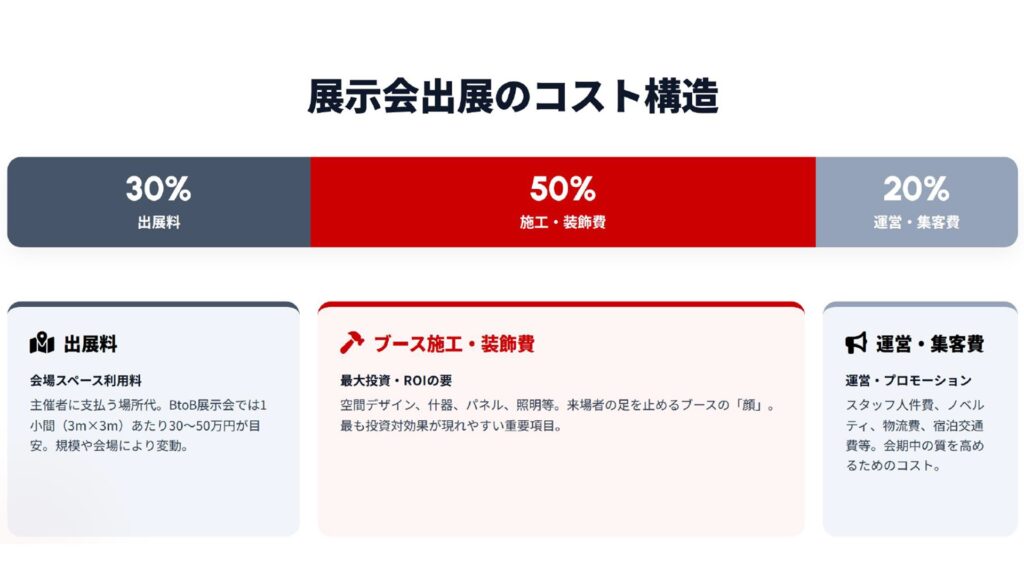
When exhibiting at an exhibition, the total budget is roughly classified into the following three categories. First, let's understand this cost structure (ratio) and points that are often missed in quotes.
① Exhibition fee (booth fee): Approx. 30% of total This is the space usage fee (purchase fee for exhibition frame) for the exhibition venue paid to the organizer. It fluctuates depending on the scale of the event, name recognition, and venue (Tokyo Big Sight, Makuhari Messe, etc.), but in the case of general large-scale BtoB exhibitions, the market price is approx. 300,000 to 600,000 yen per booth (approx. 3m x 3m = 9㎡).
② Booth construction and decoration costs (exhibition booth costs): Approx. 50% of total The largest weight in the exhibition budget is these exhibition booth costs. This corresponds to booth space design, wall panel construction, rental of various fixtures, sign production, electrical/lighting work, and floor carpet construction. It is the "face" that stops visitors and conveys your company's appeal; it directly affects appeal to visitors and makes it easier to achieve ROI, while it is also an item where costs fluctuate greatly depending on specifications.
③ Operations, customer attraction, and promotion costs: Approx. 20% of total This includes staff personnel costs during the event (companions, MCs, operational directors, etc.), novelty production costs, and printing/shipping costs for invitations and flyers. Also, if exhibiting from another region, staff accommodation and transportation costs, as well as logistics costs for transporting exhibits, are included here.
*The above ratios and amounts vary depending on the organizer and the scale of the exhibition. Please use them only as a guide.
[Hidden additional costs to watch out for!] When planning the budget, the following items are surprisingly easy to miss. Incorporating these into the budget as contingency funds is a trick to prevent budget overruns.
Invitations (production/shipping costs): Invitations to encourage existing or target customers to visit. Not only printing costs, but postage costs can also be significant.
Novelties (production costs): Novelties that serve as a trigger for bringing people to the booth or exchanging business cards. Since it becomes a large amount based on unit price × distribution quantity, prior calculation is essential.
Inbound/outbound logistics costs (logistics costs): Costs for bringing exhibits and equipment into the venue and removing them. Attention is necessary as it can easily become expensive, especially if there are heavy or precision equipment.
2. [By scale] Estimated exhibition booth costs and market prices (construction and decoration costs)
Now that you have grasped the overall budget structure, we will focus on "booth construction and decoration costs," where the amount fluctuates the most. Note that as the scale of the exhibition (number of booths) increases, the ratio of construction and decoration costs in the overall budget tends to rise. Based on this point, we will introduce cost estimates by scale and design points at each phase.
Market price ①
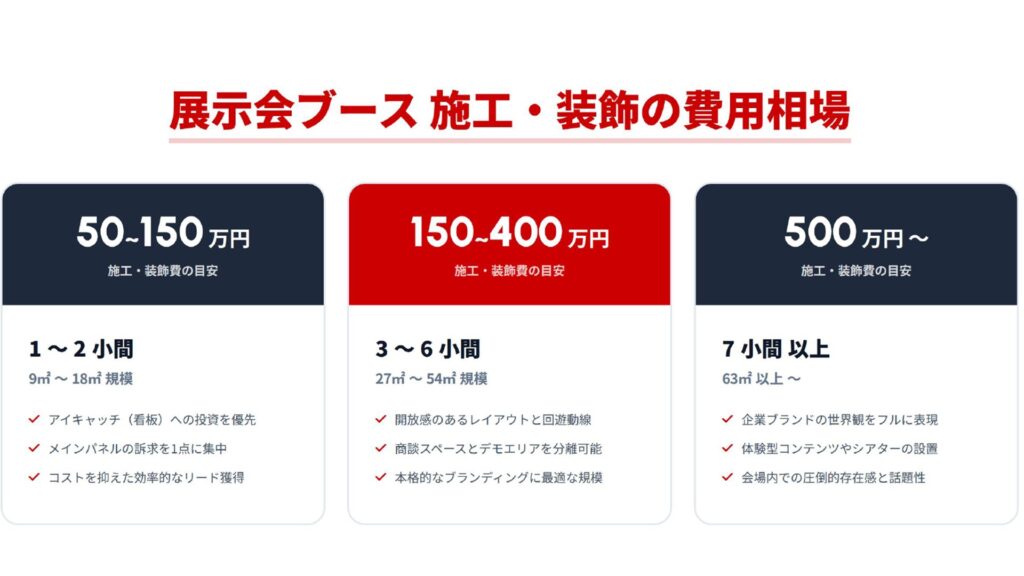
1–2 booths (9–18㎡): Approx. 500,000 yen to 1,500,000 yen
This scale is often used for a first-time exhibition or test marketing focused on specific products. To achieve results within limited budget and space, stuffing in too much information is strictly forbidden. It is important to concentrate appeal on eye-catchers (upper signage) that capture the gaze of visitors walking down the aisle and the main panel. Subtractive design that instantly communicates "whose and what kind of problems your company solves" with a simple and powerful message is required.
Market price ②
3–6 booths (27–54㎡): Approx. 1,500,000 yen to 4,000,000 yen
This is the scale that serves as the main battlefield for companies aiming for full-scale lead generation. At this size, it becomes possible to create a layout that clearly separates the open product demonstration area facing the aisle from the business meeting space in the back for sitting and talking thoroughly. The "flow design," which makes it easy for visitors to naturally step into the booth and smoothly transition to business negotiations and closing, greatly influences the number of leads acquired.
Market price ③
7 booths or more (63㎡~): 5,000,000 yen ~ No upper limit
This is a large-scale booth adopted by industry-leading companies or for major unveilings of new brands. It is a scale where the brand's worldview can be fully expressed, allowing for the provision of an "experience" that goes beyond a mere display. Space design that captures the attention of the venue with an overwhelming presence is required, such as the installation of a powerful theater using large LED visions and touch-and-try corners where visitors can operate the system directly.
3. Exhibition booth costs: 3 factors that significantly affect it
Many people ask, "Why is there a difference in quotes for the same number of booths?" Exhibition booth costs vary significantly depending on the following three main factors.
Booth construction method (woodworking vs. system) "Woodworking booths" that can express free shapes and curves and create a sense of luxury are expensive due to craftsmen's manual labor and painting. On the other hand, "system booths" that assemble standardized aluminum components (such as Octanorm) are linear but can significantly suppress costs.
Material and specification grades Costs change depending on whether you finish the walls with inexpensive wallpaper or use vibrant tarpaulin or LED backlit fabric. In recent years, more companies are adopting fabric materials that can be reused for multiple exhibitions even if initial costs are slightly higher, thus lowering medium- to long-term costs.
Scope of support (one-stop or not) If you split orders—such as design to Company A, construction to Company B, and novelty/video production to Company C—total costs tend to become higher because progress management fees and intermediate margins are added for each company. In most cases, requesting a company that can complete everything from planning to construction and operation in a "one-stop" manner ends up being cheaper.
To achieve results from exhibiting at an exhibition, you shouldn't just cut the budget blindly, but rather adopt strategic thinking that maximizes exhibition ROI by focusing on where to invest and where to improve efficiency.
[Where to spend: First impression and visibility] Visitors walking through the exhibition aisles decide whether it's relevant to them in "just 3 seconds" as they pass by the booth. Therefore, you should spend your budget firmly on "upper signage (main signboard)" that stands out even from a distance, "catch copy/design on the main panel" facing the aisle, and "dedicated lighting" that makes the product look attractive, and pursue quality thoroughly. If you compromise here, people won't approach your booth in the first place, and the exhibition fee itself will be wasted.
[Where to cut: Casual novelties] Inexpensive, mass-produced novelties "just for the sake of giving them out" are also a factor that lowers cost-effectiveness. By narrowing down the target and only giving high-quality, practical novelties to highly probable leads (potential customers) who have answered surveys or exchanged business cards, it is easier to remain in their memory after the event, leading to ROI improvement.
5. Don't fail! Four preparations to check before requesting a quote
When requesting quotes from booth production or construction companies, if prior preparation is insufficient, an accurate cost will not be calculated, and it may lead to troubles such as additional costs occurring later. To prevent the expansion of the aforementioned exhibition booth costs and to conduct smooth and highly accurate competitions or quote acquisitions, be sure to organize the following four points internally in advance.
① Decide the exhibition name, dates, and number of booths First is the confirmation of basic information. Which exhibition, when, and how large (number of booths) are you exhibiting? Furthermore, if conditions such as "corner booth" (how many sides are facing the aisle) are not decided, you cannot even give a rough estimate of construction and operational costs. It is important to consult with a production company early, at the stage where you are "considering exhibiting with 2 booths at the XX exhibition in the autumn," when the floor plan is released.
② Organize the message to convey (purpose/target) Clearly define "who" (a decision-maker or on-site person) to tell, "what" (new product features or corporate reliability) to tell, and "what kind of result" (getting X number of new business cards, X number of business negotiations, etc.) you want to achieve at the exhibition. If this concept (axis) is off, no matter how much money you spend to create a luxurious booth, it will just be a "beautiful box" that doesn't appeal to the target.
③ Confirm the budget ceiling internally It is extremely important to decide the MAX budget (approval ceiling) beforehand—i.e., "how much can we spend?" With a vague order of "the cheaper, the better," production companies cannot make optimal proposals. If the budget ceiling is known, it becomes easier for production companies to calculate and propose plans that maximize performance within that budget (such as downgrading materials or alternatives with a focus on priorities).
④ Clarify comparison points (selection criteria) for multiple companies "Do you value overwhelming design that other companies don't have?" "Do you value cheapness to keep it within the determined cost?" or "Do you want a company that can handle everything from operational manual creation to staff arrangement?" By clarifying the "evaluation axis" that your company values most in this partner selection, you will be able to compare and examine proposals from each company correctly.
6. Easy cost check with the simulator!
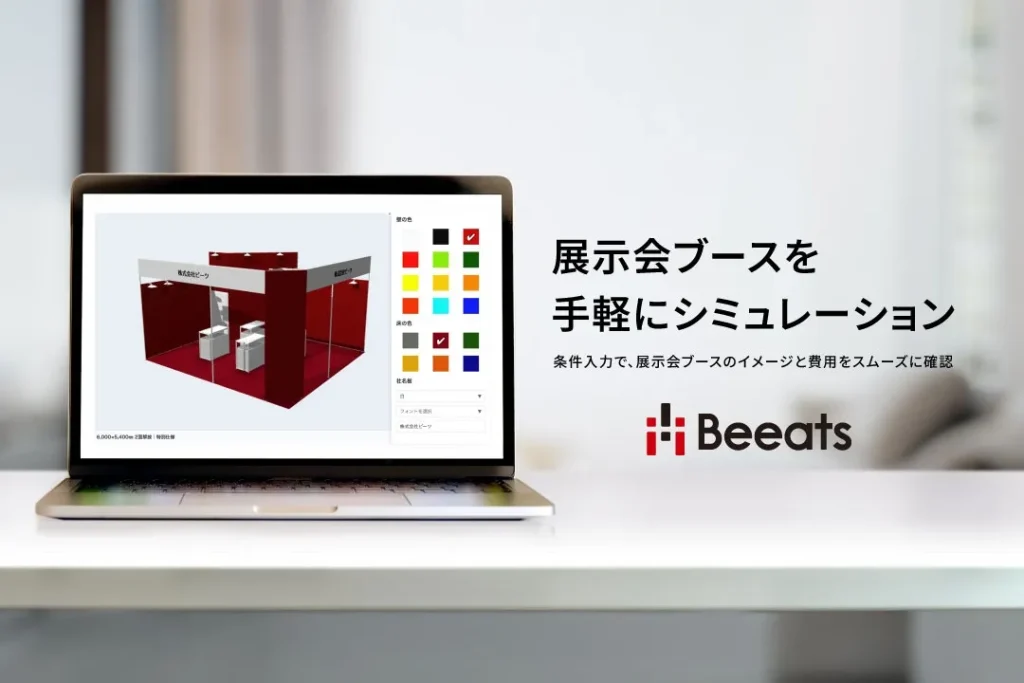
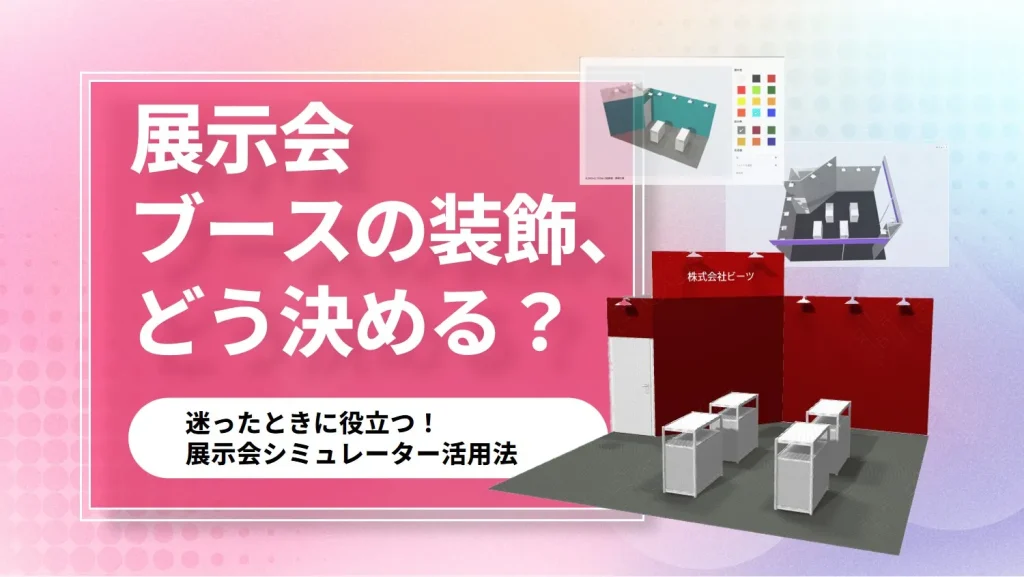
"Aren't you wondering if your company's trade show expenses are really reasonable?" At BEEATS, based on our extensive experience, we propose the optimal booth space tailored to your budget and objectives. "Exhibition Booth Estimate Simulator" Please use this service to check the estimated cost of the booth that best suits your company. ※ Please note that the simulator is available in Japanese only and cannot be accessed from outside Japan. For cost estimates, please contact us directly. For more specific budget and design consultations, please feel free to contact BEEATS.
FAQ: Frequently asked questions about exhibition costs and market prices
Finally, we have summarized the frequently asked questions from those in charge regarding exhibition budget planning.
Q1. What is the total market price for an exhibition booth? A. It depends on the number of booths, but there is a range from 500,000 yen to over 3 million yen just for construction and decoration costs. Adding the exhibition fee (space fee) and operational costs during the event (personnel, printed materials, etc.) to this gives the total budget. Please refer to "Cost Estimates by Scale" in this article for details.
Q2. How much does an exhibition booth for 1 booth cost? A. In the case of a general BtoB exhibition (3m x 3m), the market price is around 500,000 to 1,500,000 yen including construction and decoration costs. However, if you are installing LED monitors or doing special woodworking, there are cases where it costs more even for 1 booth.
Q3. How can I keep exhibition costs down? A. Methods such as utilizing system components for the booth framework, producing signage using fabric materials that can be reused for multiple exhibitions, and requesting a one-stop production company that can handle everything from planning/design to construction in-house to cut intermediate margins are effective.
Q4. Where is the cheapest place to request an exhibition booth? A. Requests can be broadly categorized into "construction specialty companies," "one-stop companies," and "advertising agencies," and each has a different cost structure and characteristics. For the cost of just building the booth, construction specialty companies tend to be cheaper, but if you are requesting everything from planning and design to promotional measures and on-the-day operations, "one-stop companies" that can cut intermediate margins have higher final cost-effectiveness. We recommend comparing and examining multiple companies according to your company's resources and the points you value.