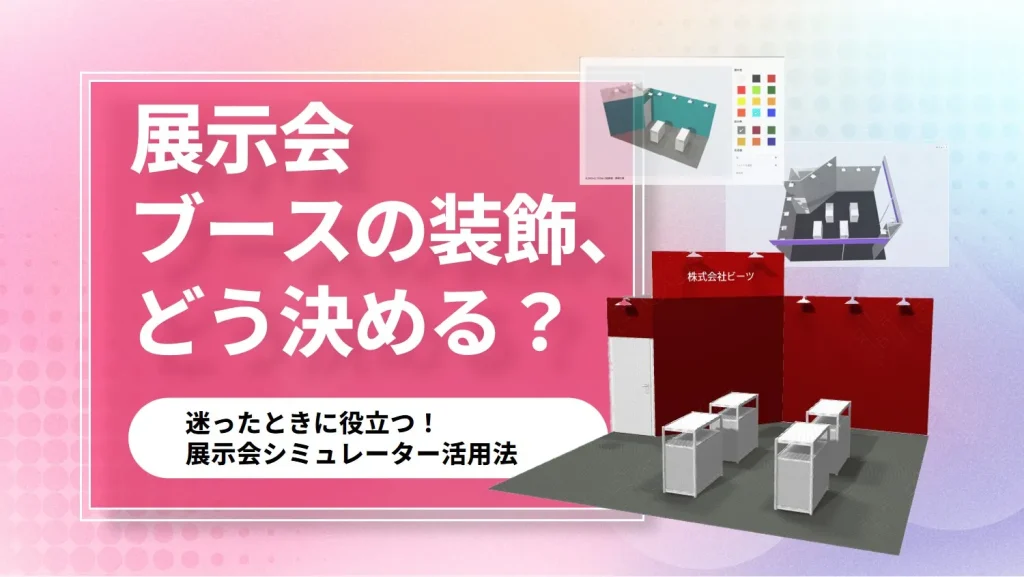
To those in charge who are worried, "We have decided to exhibit at an exhibition, but what kind of panel will catch the attendees' eyes?" No matter how impressive your booth is, if the appeal of your panels is weak, attendees will not stop.
In this article, we thoroughly explain the "tips for exhibition panel design" and "cost market prices" to stop visitors in their tracks. In addition, we deliver know-how directly related to practical business, such as how to choose effective novelties and checklists before ordering.
Before we get into the tips for panel design, let's organize what role exhibition panels play within a booth.
◆◆◆
3 roles that panels play
① Obtaining visibility from a distance: Acts as a signboard that lets visitors walking through the main aisle know "what kind of company it is" even from afar
② Inducement into the booth (hook): Role of making visitors who stop in their tracks think "It seems like they can solve my problem" and taking a step inside
③ Promoting service understanding: Serving as a visual aid when staff explain details orally during business meetings.
Configure the booth by combining the following types according to the application.
Back Panel (Wall Panel): Large panels that use the entire back of the booth. These prominently display the company logo or your greatest benefit.
Tapestry: Fabric decorations hung from the ceiling or placed on walls. Lightweight, easy to carry, and excellent for reuse.
Side panel: A self-standing or wall-mounted panel facing the aisle. Because it jumps directly into the pedestrian's line of sight, it is suitable for catchy issue raising.
Tabletop Panel: Small panels placed on exhibition counters or business meeting tables. These contain detailed information such as product specifications and price lists.
2. 4 tips for exhibition panel design that pierce visitors!
So, specifically what kind of "exhibition panel design" will stop attendees in their tracks? Here are four golden rules, common to successful cases handled by BEEATS for companies such as Yappli and Money Forward.
① Catch copy that conquers the "3-second rule" Visitors judge whether a booth is worth looking at in "just 3 seconds" while passing by. Therefore, the most important point is to place a catch copy directly linked to the target's problem solving, such as "Increase business efficiency by ◯%!" or "For those worried about ◯◯", in a large size at the top of the panel (above eye level), rather than the company name or product name.
② Layout conscious of gaze guidance (Z-pattern/F-pattern) Human eyes move unconsciously from "top-left to bottom-right (Z-pattern)" or "from top to bottom (F-pattern)." By utilizing this rule and placing the main copy in the top-left, diagrams or achievement figures in the center, and call-to-action information like "Consult us first" in the bottom-right, you can ensure information is read without stress.
③ Color strategy that differentiates you from competitors The venue is filled with various colors. By basing your booth on your brand colors while daring to incorporate complementary (opposite) colors that competitors rarely use as accent colors, you can prevent your entire booth from being buried.
④ Setting up QR codes and CTAs (Call to Action) There are cases where people who read the panel and become interested leave without speaking to staff. By placing a large QR code in the bottom-right of a panel or on a tabletop panel alongside a CTA that says "Download detailed materials here," you can reliably capture leads that might otherwise be missed.
3. Cost market price of exhibition panels (Design fees vs Printing fees)
The costs involved in panel production are broadly divided into "design production fees" and "printing/output fees."
Design fees: When requesting a professional production company, the market price is about 30,000 to 100,000 yen per item. It varies depending on whether you request the whole thing from composition to copywriting, or prepare a rough draft in-house.
Printing/Output Costs: Back Panel (Large): approx. 30,000 to 80,000 yen Tapestry (Cloth): approx. 10,000 to 30,000 yen Tabletop Panel (A3/A4 Styrene board): several thousand to 10,000 yen
*This is just a guideline for cost feeling. Please recognize it as a reference when considering.
[Cost comparison: Reuse vs Disposable] Conventional styrene board panels are inexpensive, but their corners are easily bent and they tend to become disposable. In recent years, an increasing number of companies are adopting "fabric (cloth) material" that can be rolled up, carried, and reused many times, even if the initial cost is slightly higher. If you exhibit multiple times a year, fabric material can overwhelmingly keep total costs down.
4. "Giving them away just because" is NG! Recommended exhibition novelties by scene
Exhibition novelties are what connect the interaction with attendees who were stopped by your panels to the next step.
The optimal item for a novelty changes depending on "who you give it to and in what situation." We have organized items that are a good match for each distribution scene.
Purpose and selection criteria for novelties The true purpose of a novelty is not just to attract customers, but "to have them remember your company when they return to the office after the exhibition (increase recall rate)." The golden rule is to choose items that are associated with the panel design and the brand's worldview, and are easy to use daily around the desk.
Recommended exhibition novelties by scene For mass distribution/eye-catching: Used for distribution to an unspecified number of people and attracting people to the booth. Highly practical ballpoint pens, sticky notes, original label bottled water, etc.
For lead acquisition: As a thank-you for survey responses or business card exchanges. Eco bags, mobile batteries, thermo tumblers, etc., that have a slightly special feel.
For VIP/individual business negotiations: For pre-appointment tiers or high-probability prospective customers. High-quality system notebooks, confectioneries from famous brands, etc.
The budget for novelties is based on the "Act against Unjustifiable Premiums and Misleading Representations"
The budget available for novelties is not determined by a uniform market rate but by the "Total Gift" rules under the Act against Unjustifiable Premiums and Misleading Representations (Keihin Hyōji Hō). According to the Consumer Affairs Agency's operational standards, when providing gifts to all attendees without requiring a product purchase, the transaction value is generally considered to be 100 yen, and the upper limit for the gift is 200 yen. Novelties distributed to everyone as a condition for answering a survey or exchanging business cards may fall under this category. On the other hand, items intended for advertising and publicity purposes that bear a company or service name and are considered appropriate in light of normal business practices may be categorized as exempt from the total gift regulations. Additionally, for "sweepstakes" forms such as lotteries or rock-paper-scissors where prizes are given only to winners, a different upper limit applies compared to total gifts. Thus, the budget you can allocate for the same novelty can change depending on "how it is distributed" and "whether it can be categorized as advertising material." Since this is an area where judgment can be divided, it is recommended to consult with your legal department or a specialist during the planning stage regarding your distribution method.
5. Don't fail! Checklist before requesting to a production company
When outsourcing the production of panels and novelties to external partners, simply saying "make it look good" is a recipe for failure. To ensure a smooth process and high-quality creative output, please decide on the following 5 items internally in advance.
5 items to decide before requesting ① Message to convey (priority): Whose problem to solve and what kind of problem. What are the numbers and achievements to make stand out the most? ② Target image: Executive level or on-site person in charge. The words that resonate (cost reduction or business efficiency) change depending on the target. ③ Brand color/tone & manner: Corporate color of the company and presence/absence of logo usage rules (guidelines). ④ Size regulations of the exhibition venue: Accurate size of the wall, presence/absence of fireproof material designation by the Fire Service Act, etc. ⑤ Budget cap: MAX budget of how much can be spent on panel design, printing, and novelties respectively. Novelties are set taking into account the upper limit under the Act against Unjustifiable Premiums and Misleading Representations.
Schedule from ordering to delivery Production of panels and named novelties takes time from the initial design proof to revisions, final approval, and the actual printing/manufacturing process. Set up a schedule with enough time so that you can have the official order and kickoff at least "3-4 weeks (about 1 month) before delivery."
Panel design that thoroughly implements the 3-second rule and gaze guidance, combined with strategic novelty selection that unifies the brand's worldview, is the key to improving cost-effectiveness. If you want to achieve solid results with creative work from the attendee's perspective, please consult BEEATS first.
FAQ: Frequently Asked Questions about Exhibition Panels and Novelties
Finally, we will answer questions frequently sent to us by those in charge regarding panels and novelties.
Q. What is the most important thing in exhibition panel design? A. It is to be conscious of the "3-second rule" and place a catch copy that instantly conveys the content at the top. Furthermore, by using a layout conscious of line-of-sight guidance such as Z-type or F-type, information is conveyed to visitors smoothly.
Q. How much is the production cost of exhibition panels? A. Combining design and printing fees, the guideline is about 60,000 to 180,000 yen per back panel. It may fluctuate depending on the material used (styrene board or fabric), size, presence/absence of reuse, and design content.
Q. How should I decide the budget for exhibition novelties? A. The budget for novelties is not based on a uniform market rate but is determined by the "Total Gift" (Sōfukeihin) rules under the Act against Unjustifiable Premiums and Misleading Representations (Keihin Hyōji Hō). According to the Consumer Affairs Agency's operational standards, when providing gifts to all attendees without requiring a product purchase, the transaction value is generally considered to be 100 yen, and the upper limit for the gift is 200 yen. Novelties distributed to everyone as a condition for answering a survey or exchanging business cards may fall under this category. On the other hand, for goods intended for advertising and publicity purposes that include the company name or service name, or items given away as part of a "sweepstakes" such as a lottery, the upper limit rules differ. Since the handling of the same novelty can change depending on the distribution method, it is recommended to consult with your legal department or a specialist during the planning stage along with your distribution strategy.
Q. When should I order exhibition panels by? A. It is recommended to place your order (and begin design production) at least 3-4 weeks before the exhibition date. Considering the time required for internal design reviews and corrections, it is safest to start consulting with a production company a month and a half in advance.