Labor shortages, soaring raw material costs, a rapid increase in inbound tourists—the environment surrounding restaurants continues to change even now after the COVID-19 pandemic. Focusing on digital technology as a key to responding to these changes is "restaurant DX."
However, we often hear voices saying, "Even if you say DX, I don't know where to start" or "There are too many tools to choose from."
In this article, we comprehensively explain everything from the definition of restaurant DX to major tools actually used in the field, success cases, and steps for advancement. Please use this as a practical guide to finding the first step of DX that suits your shop.
DX (Digital Transformation) is not just about introducing digital technology. The Ministry of Economy, Trade and Industry defines it as establishing a competitive advantage by utilizing digital technology to transform products, services, and business models themselves. In other words, installing one ticket machine is "ITization," not "DX." True DX is changing customer experiences, operational processes, and, by extension, the very nature of management itself through digital technology.
1-2. Why is DX necessary for restaurants now?
The reason why the food and beverage industry is working on DX is not just the need for "non-contact" and "labor saving" triggered by the COVID-19 pandemic.
This is because structural issues surrounding restaurants are now compound and overlapping, making it difficult to overcome them without digital utilization. We will organize exactly what kind of issues exist in the next chapter.
2. The 5 major challenges facing restaurants today
Challenge 1: Worsening labor shortage
The effective job opening ratio in the food service industry is at a high level compared to other industries. It is particularly difficult to secure hall staff and cooking staff, and more stores are not receiving applicants even when they post job openings. Since personnel cannot be secured, how to run the store with a limited number of people becomes the center of management issues.
Challenge 2: Soaring raw material and energy costs
The cost of purchasing ingredients/seasonings, electricity, and gas—the factors supporting the cost structure of restaurants are all rising. Profits are being squeezed at stores that cannot pass on these costs, and optimization of personnel expenses and fixed costs through operational efficiency is an urgent matter.
Challenge 3: Rapid surge in inbound demand and multilingual support
Inbound foreign tourists are at record highs, and dealing with foreign customers has become a daily task for restaurants in urban areas as well as tourist spots. DX is effective in areas that cannot be handled by human power alone, such as multilingual support for menus, ordering, and allergen information, and cultural consideration.
Challenge 4: Intensifying competition and the need for differentiation
Channels for choosing restaurants, such as Tabelog, Google Maps, and SNS, have diversified, and customer comparison behavior has become more refined. We are in an era where "delicious food" alone is not enough to get chosen, and the quality of the comprehensive customer experience, including reservations, payments, and in-store experience, is being questioned.
Challenge 5: Changes in sales promotion and customer attraction methods
As the effectiveness of paper flyers and in-store touting decreases, the importance of appeals through SNS and video content is increasing. It is necessary to digitize promotional methods to disseminate information in a timely manner and create motives for visiting the store.
3. 7 major categories of restaurant DX tools
From here, we will organize and explain the representative tools used for restaurant DX into 7 categories. It is not necessary to introduce them all at once, and it is a golden rule to start with what fits your shop's challenges.
[Tool 1]
Mobile ordering/self-ordering
This is a system that allows customers to order directly from their smartphones or tabletop tablets. It eliminates hearing errors in orders, allowing hall staff to focus on serving food and customer service. It also contributes to improving turnover rates.
[Tool 2]
POS register/Self-checkout register
Automatically aggregate sales data to visualize sales trends by menu and time zone. By introducing self-checkout registers, you can simultaneously achieve reductions in labor costs for cash register operations and shorten waiting times for checkout.
[Tool 3]
Food serving robots/cooking support equipment
Serving robots are being introduced in restaurants with labor shortages. This significantly reduces the walking distance of hall staff and allows them to devote time to customer service and guidance. There are also increasing cases of introducing equipment that assists in cooking processes, such as french fry cooking robots.
[Tool 4]
Reservation/customer management system
A system that centrally manages online reservations, customer information accumulation, and automatic DM distribution to repeat customers. It enables the prevention of double-booked reservations and the advancement of customer service based on visit history.
[Tool 5]
Cashless payment
Credit cards, QR code payments, electronic money, and contactless payments—supporting a variety of payment methods is becoming the minimum requirement, even before DX. It is also essential for dealing with inbound customers.
[Tool 6]
Digital signage
A system that transmits videos, images, and information on displays at the storefront or inside the store. It realizes "moving appeals," "time-based display switching," and "centralized management of multiple stores," which are difficult with paper posters. It fits well with restaurants and can stimulate visit motivation through appeals with a "sizzle" (appetizing) quality.
[Tool 7]
AI/Data utilization
Advanced management decision-making utilizing AI, such as demand forecasting, shift optimization, and menu development support, is progressing. Especially among chains that operate multiple stores, the use of predictions combining visit data and external data is spreading.
4. Success cases of restaurant DX
We will introduce examples of food and beverage companies that are actually working on DX and achieving results. First, we will look at the Clomoni introduction cases directly supported by BEEATS, and then look at representative DX promotion cases in the industry.
4-1. Real-life example of restaurant DX supported by BEEATS: Kura Sushi, Inc.
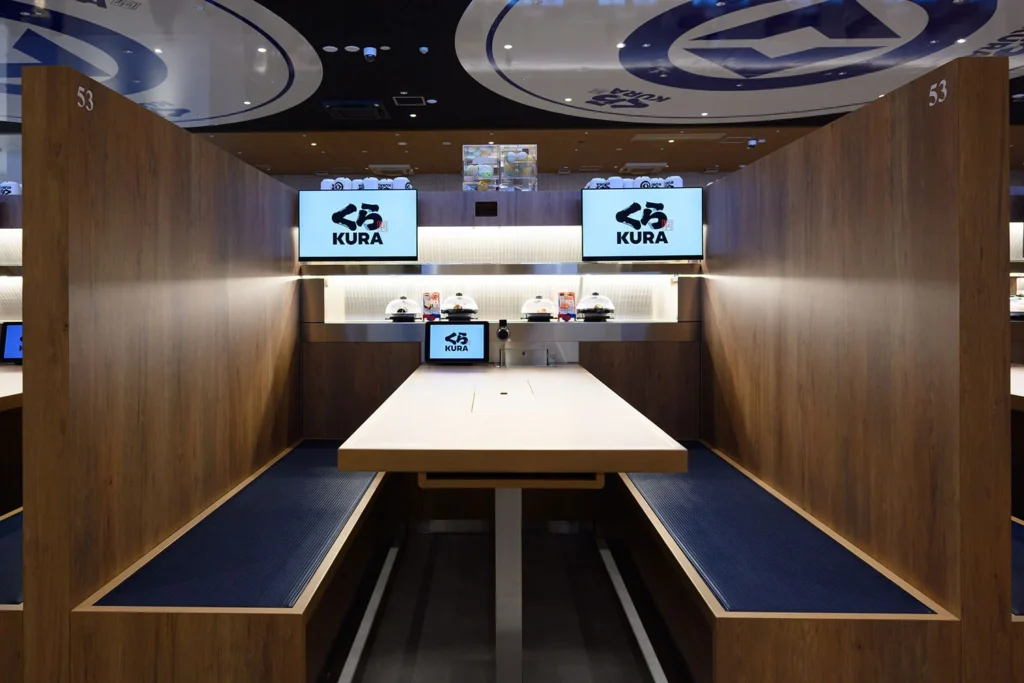
As an introduction case of the cloud-type digital signage "Clomoni" provided by BEEATS, we will introduce the initiatives of Kura Sushi, Inc. Kura Sushi has introduced "Clomoni" as the in-store signage for the Osaka-Kansai Expo store. It is being used for staging the visiting experience and promotional distribution. For food service chains developing multiple stores, a system that allows headquarters to manage signage for all stores at once leads to a significant reduction in operational man-hours. Furthermore, the point that local information for each store and common promotions for all stores from headquarters can be used separately is a feature suitable for chain management. The Kura Sushi case specifically shows how the signage tool functions in the layer of "in-store space staging and sales promotion" within restaurant DX. While the major chain cases introduced next center on "business-type DX," signage utilization is positioned as DX that strengthens customer touchpoints.
4-2. Real example of restaurant DX supported by BEEATS: Nilax, Inc.
Nilax, Inc., which develops a variety of food and beverage businesses nationwide with buffet restaurants as its core, is also a restaurant example that has introduced BEEATS' "Clomoni". Since February 2025, Nilax has introduced Clomoni as in-store signage in 124 units across 46 buffet restaurants nationwide, including "Festa Garden," "EX BLUE," and "Buffet & Cafe La Marea." They have realized operations such as displaying all-you-can-eat course prices and menu information, and switching content for each store according to the day of the week and time zone. The background to the introduction was the challenge of streamlining information dissemination at stores and reducing management burdens. Clomoni was adopted as a replacement for the signage system, valued for its separate distribution of weekdays and holidays via the time table function, simplicity of operation, flexible schedule distribution settings, and high cost-performance. While the Kura Sushi case was a use focused on "staging store experiences," the Nilax case is a case that shows how Clomoni functions from the perspective of chain headquarters operations, specifically for operational efficiency in information dissemination across multiple stores and business formats. With an implementation scale of 46 stores and 124 units, it serves as a reference for integrated signage management in food service chains developing multiple stores.
4-3. Representative DX promotion cases in the industry
From here on, although these are not BEEATS support cases, I will introduce initiatives by representative companies that lead DX in the restaurant industry as a whole. Focusing on "why each company is promoting DX" and "which areas they are focusing on" will provide hints for thinking about your store's DX strategy.
Integration of customer touchpoints through multi-channel support: Sukiya Co., Ltd.
Sukiya, which operates a beef bowl chain nationwide, has a DX strategy that actively utilizes advanced technologies such as AI, cloud, and IoT. Specifically, in addition to introducing POS systems, ticket vending machines, self-service ordering systems, and cashless payments, it is promoting multi-channel support such as drive-throughs, mobile orders, and deliveries. By integrally digitizing multiple customer touchpoints, it simultaneously achieves improved convenience and operational efficiency.
Clarifying the "role division between humans and digital": Toridoll Holdings Corporation
Toridoll Holdings, which operates Marugame Seimen and other brands, has established a basic DX policy of optimizing back-office business processes that support stores, while continuing to perform live cooking and customer service by human hands. Specifically, the company has announced a policy to refresh its aging on-premises business systems with a combination of cloud and subscriptions, and to consolidate back-office operations into a BPO center. This is a concept that many restaurants can refer to as an example of clarifying the line between "what to digitize and what humans should handle."
4-4. DX utilization at the individual store level is also spreading
It is not only large chains that are advancing DX. Even individual shops are increasingly seeing results by starting with low-cost tools such as Google Maps/Instagram operation, online reservation systems, and in-store signage promotions. The important thing is to "choose tools that are directly linked to your shop's challenges."
5. 5 steps to advance restaurant DX
Even if you introduce DX tools blindly, they will not be effective. We recommend that you proceed step by step with the following steps.
Step 1: Clarification of purpose
First, decide "what you are engaging in DX for." Is it to strengthen customer attraction, reduce personnel costs, or improve customer satisfaction? If you introduce it without a clear purpose, you will end up having only "installed the tool."
Step 2: Identification of current issues
First, take inventory of your store's operations and identify the bottleneck processes. It is important to visualize challenges at a concrete task level, such as "taking orders during peak times," "closing sales reconciliation," or "poster replacement work."
Step 3: Prioritization and tool selection
Among the identified challenges, prioritize based on the balance between effectiveness and ease of introduction. Do not try to change everything at once, and start one by one with those that are likely to be effective.
Step 4: Operational design and staff training
Before introducing a tool, design who will use it and how. Manual preparation, staff training, clarification of operation managers—if you neglect these, the tool will not take root in the workplace.
Step 5: Effect measurement and improvement
After implementation, measure the effects both quantitatively and qualitatively. Whether the initial goals are being achieved and whether new issues are emerging—continuous improvement is the key to ensuring DX does not end as a "one-off effort."
6. Common failure patterns and countermeasures
Failure 1: Tool introduction becomes the goal
This is a pattern where it is introduced for the reason that "other stores are also using it," and it is left unused. The countermeasure is to thoroughly implement "clarification of purpose" in Step 1.
Failure 2: Increased burden on the workplace
This is a case where new tools actually increase the workload of on-site staff. The countermeasure is to make the decision to introduce the tool after listening to the voices of the staff on the front lines, and to carefully design the operation.
Failure 3: Content or operation not updated
This is a failure that often occurs with "content-first" tools such as signage and SNS. It ends with the excitement at the time of introduction, and six months later, outdated information continues to be streamed. The countermeasure is to design a content operation system at the same time as introducing the tool.
Failure 4: Cost-effectiveness is not visible
This is a pattern where costs continue to occur while "you don't know if it's effective." The countermeasure is to incorporate the effect measurement of Step 5 into the system.
7. Multi-functional cloud-based digital signage "Clomoni"
Among restaurant DX, digital signage is one that can be started at a relatively low cost and provide immediate promotional effects. "Clomoni," a cloud-based digital signage service provided by BEEATS, is a service with a track record of implementation in approximately 250 companies and over 9,000 units in total.
The main features of Clomoni are as follows.
・Centrally manage monitors in stores nationwide from a computer at hand ・Supports real-time updates, time schedule settings, and area-based grouping distribution ・Intuitive UI requires no specialized knowledge, operable by drag-and-drop ・Scalability to meet field needs, such as 4K support and AI camera linkage ・Lineup of tablet and STB types to choose from according to installation location and use
Typical use cases in restaurants are as follows.
・Automatic switching of menus by time of day (Breakfast/Lunch/Dinner) ・Timely announcements of limited-time menus and campaigns ・Creating buzz by broadcasting viral SNS content in real-time ・Handling inbound tourism with multilingual menu displays ・Space creation through brand videos
If you are thinking, "I want to start restaurant DX but I don't know where to begin," or "I am considering introducing signage," please feel free to contact us.
Restaurant DX is not just the introduction of digital tools, but a management strategy to deal with structural challenges such as labor shortages, rising raw material costs, inbound demand, and intensifying competition.
The keys to success are summarized in the following 3 points. First, clarify the purpose. If the DX objective is not fixed, no tool will be effective. Second, start with tools directly linked to your shop's challenges. Rather than changing everything at once, prioritize based on the balance between effectiveness and ease of introduction. Third, systematize operation and continuous improvement. The real work begins after the tool is introduced. DX only leads to results when the cycle of content updates, effectiveness measurement, and improvement is running. Among these, digital signage can be started at a relatively low cost and has high immediate effects on sales promotion and customer attraction. As a first step in restaurant DX, please consider it.
First, clarify your goals. If it is not determined what the DX is for, no tool will be effective. Second, start with tools that directly address your store's issues. Instead of changing everything at once, prioritize based on the balance of effectiveness and ease of implementation. Third, systematize operations and continuous improvement. The real work begins after the tool is implemented. DX only leads to results once the cycle of content updates, effect measurement, and improvement is in operation. Among these, digital signage can be started at a relatively low cost and has immediate effects on sales promotion and customer attraction. Please consider it as the first step toward DX in restaurants.
9. Frequently Asked Questions (FAQ)
Q1. Is DX really necessary for restaurants? A. The necessity depends on the scale and situation of the store, but many of the challenges facing modern restaurants, such as labor shortages, soaring raw material costs, and inbound support, are difficult to overcome without utilizing digital technology. At the very least, it is an era where support for basic digitization, such as cashless payments and online reservations, is almost essential.
Q2. Where should I start with restaurant DX? A. The ironclad rule is to identify your store's greatest challenge and start with one tool that directly addresses that challenge. For example, if the labor shortage is serious, choose self-ordering or mobile ordering; if the goal is to strengthen promotions, choose digital signage. Trying to introduce everything at once will lead to failure.
Q3. How much does it cost to introduce DX tools for restaurants? A. It varies greatly depending on the type, scale, and number of tools. For signage, the basic configuration consists of an initial cost and a monthly cloud usage fee, and the cost per unit tends to decrease as the number of units increases. For details, we recommend that you contact the service provider you are considering and request a quote.
Q4. Can small, privately-owned restaurants also engage in DX? A. Yes, it is possible. In fact, in recent years, there has been an increase in low-cost tools that can be introduced even in small stores (cloud-based signage, mobile ordering, online reservations, etc.), and cases of individual stores achieving results through DX are increasing.
Q5. Is digital signage effective as restaurant DX? A. Yes, it is one of the tools that is easily effective. It has advantages such as being able to make appeals with a "sizzle feeling" through videos and images, automatically switching menus by time of day, and managing multiple stores at once from the headquarters, so results can be expected in both sales promotion and operational efficiency. If you use a cloud-type service like Clomoni, you can start operation without specialized knowledge.
Q6. I want to know success cases of restaurant DX. A. Representative examples for major chains include Sukiya, Marugame Seimen (Toridoll Holdings), and Kura Sushi. Each is developing DX measures in line with their own strategies, such as multi-channeling through self-ordering, back-office optimization, and signage utilization. We introduce them in detail in the "Success Cases" section of this article.