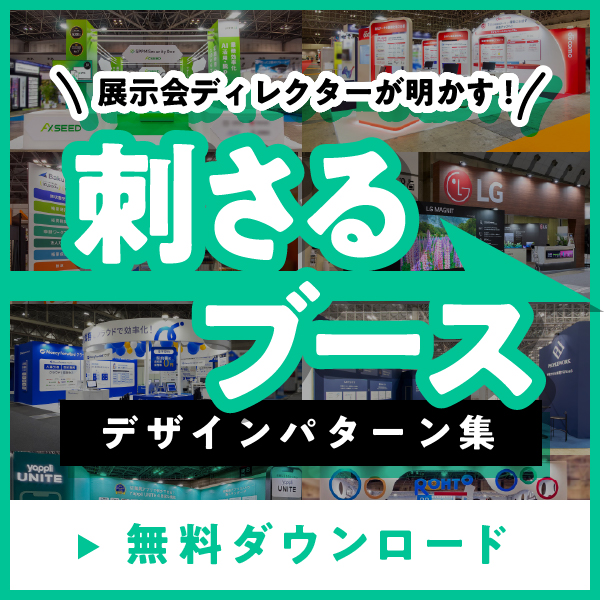
Exhibitions feature countless booths. However, only a small fraction of them get people to stop. Then, what kind of booths "stick"?
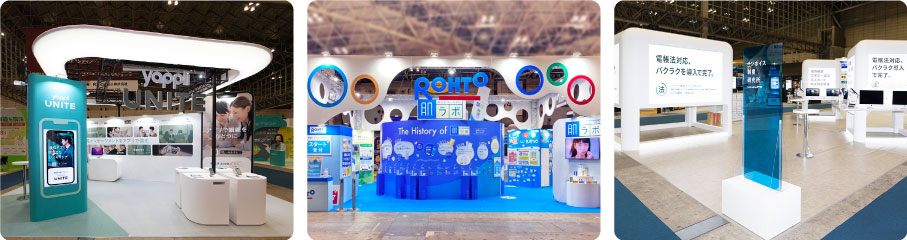
This time, we asked the space designers & directors of BEEATS CO.,LTD., who have handled numerous exhibitions, about the "types" of booth design according to attendee movement. In this article, we clearly introduce space design patterns while also including actual examples.
For those who are planning and preparing for an exhibition, we have summarized useful on-site tips. A little ingenuity might lead to a big difference. Please take a look until the end.
The starting point of booth design ― Strategy that changes based on "where you exhibit"
When creating a booth at an exhibition, what comes to mind first might be the expressive aspects such as "what kind of design to make" or "what to do with the catchphrase." Of course, those are also important elements.
But actually, there is an important point to consider before that. That is the perspective of "where the booth is located in the venue".
Is the booth along the main traffic line, in a secluded area, or on a corner? Depending on the location, the movement and stopping patterns of attendees change surprisingly. For example, if it's along the main traffic line, you need a design that catches the eye even while walking, and if it's in a secluded area, you need presentations that can be seen from afar and a configuration that encourages people to take a closer look.
At BEEATS, we proceed with the design while simulating visitor movement based on the venue floor plan and anticipating eye entry points and stay points. We construct the booth based on hypotheses about where people will stop and what information will be easily received. The important thing is not just to build a booth that stands out, but to think about where and how to deliver information. By designing with a focus on visitor movement, you create a space where the information you want to convey is firmly delivered.
▼ Check out this article for an explanation on how to create catchphrases for exhibition booths!
Tips for area-specific booth design tailored to visitor movement and "feelings"
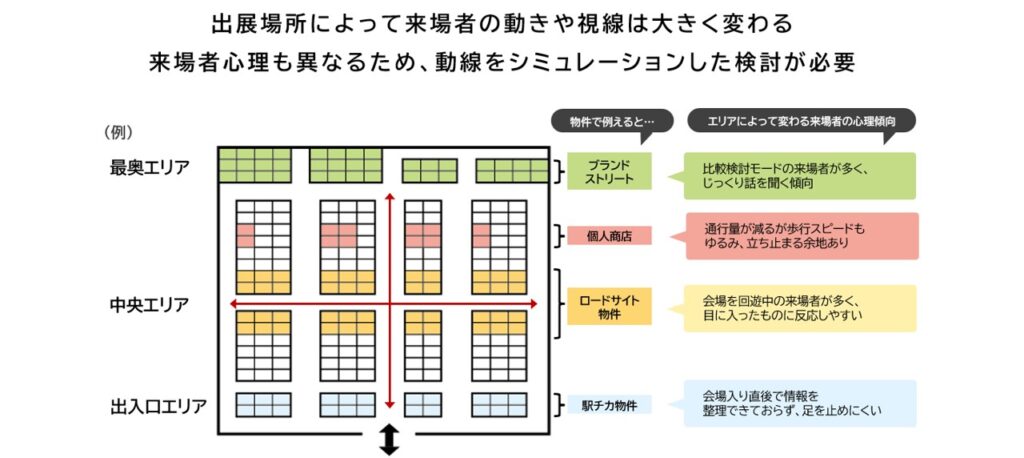
Once the booth location is decided, the next thing to consider is "what kind of feeling the visitors are walking in that area with". Even in the same venue, the movement and psychological state of people vary surprisingly depending on the position. Here, we take up four representative areas and introduce design thinking suitable for each.
Area1
Entrance area: How to leave an impression in the moment right after entry
At the entrance, visitors are not yet in the mode to absorb information. The important thing at this timing is "not to tell everything" = narrowing down the information. The key is whether you can make them think "I'm a little interested" the moment it catches their eyes.
・Place short and memorable words or visuals ・Create a traffic flow with pamphlets or novelties that makes them think "I'll come back later"
Area2
Central area (near the main traffic line): How to stop the gaze of passersby
In the central area of the venue or along the main traffic line, there is high foot traffic, but many visitors pass by without stopping. In this area, "conveying at a glance" is important.
・Strong catchphrases and display methods that make features immediately understandable ・Ingenuity to catch the eye with dynamic videos or graphics
Area3
Central area (somewhat off the main traffic line): What kind of information to deliver to visitors who walk slowly
In areas slightly off the main traffic line, visitor movement becomes slower, making it easier to see the surroundings. Utilize this whitespace to organize information that can be read carefully.
・Present information in stages using walls and panels ・Prepare multiple angles so that they can read on according to the visitor's interest
Area4
Innermost area: Responding carefully to those who have come with interest
Visitors who make their way to the back of the venue are often clearly looking for a specific company or service they are interested in. Here, preparation is required to respond to people seeking information on the premise of comparison, consideration, or introduction.
・Show detailed cases and functional explanations firmly ・Create a place to deepen understanding through conversation with staff and materials
The important thing in any area is to think from the visitor's perspective. At what speed do people walk, and with what feeling do they look at the booth? That imagination leads to an effective booth design.
4 booth design patterns to choose from according to visitor movement
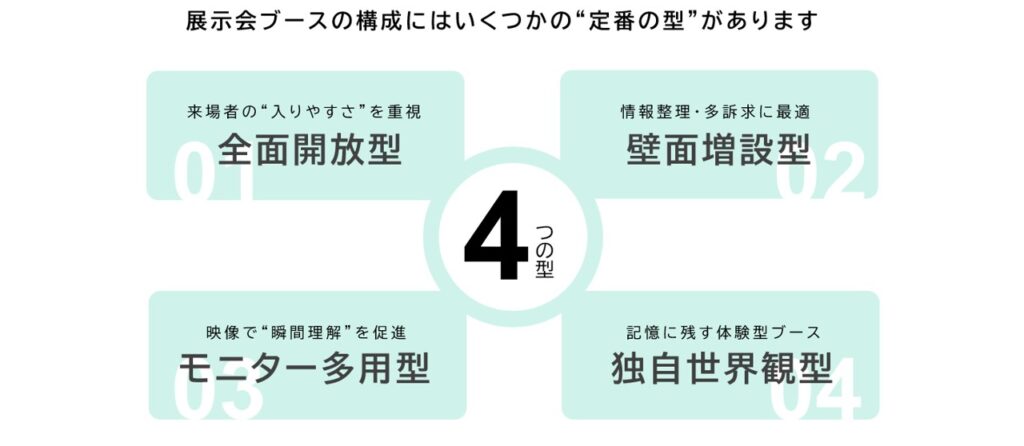
There are several "types" of exhibition booth designs depending on the exhibition location and purpose. Depending on which one you choose, the way you encounter visitors will change greatly. Here, we introduce four representative patterns that BEEATS often uses in the actual field.
Case1
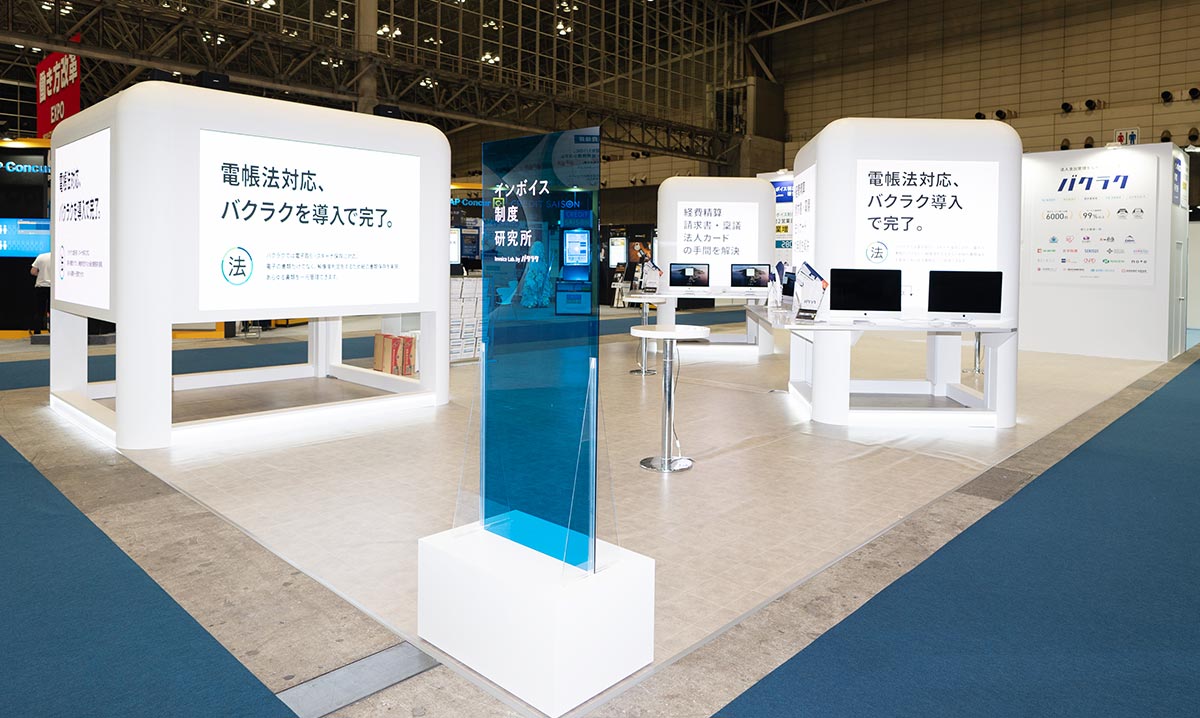
Fully Open Type | Booths that prioritize accessibility
A configuration that removes walls as much as possible and lets you understand the situation inside from the aisle at a glance. It has the effect of not making visitors feel "hard to enter" and letting them step in naturally.
◆ Suitable situations ・Areas with fast attendee flow, such as along main aisles ・When service content is simple and easy to convey at a glance ◆ Points ・Keep it open with a layout that does not block the line of sight ・Place eye-catching signs or monitors in the center to strengthen attraction
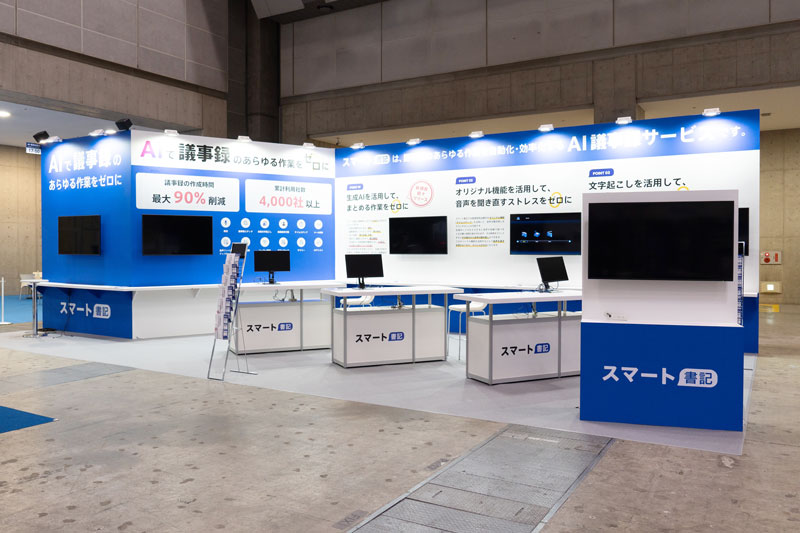
Wall Expansion Type | Booths strong in information organization and multiple appeals
A style that uses walls to organize and show multiple pieces of information. By making it easier to grasp the overall picture, visitors are naturally drawn to the content they are interested in.
◆ Suitable situations ・Areas slightly off the main aisle that are easy to stay in ・When you want to introduce multiple services or functions ◆ Points ・Divide into zones for each piece of information and arrange them to be easy to see ・Organize content that can be read while standing on the wall surface
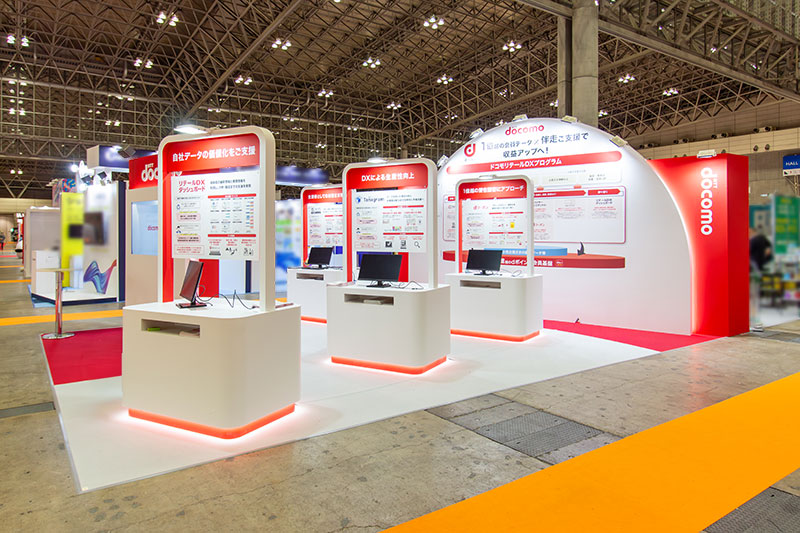
Monitor-Heavy Type | Booths that promote "instant understanding" with video
This is a configuration that leverages large monitors and video content to catch the eye of people passing by. It is also effective when you want to convey the characteristics of a service in a short time.
◆Suitable situations ・Central area or places with relatively high traffic ・Contents that take time to explain, such as IT and SaaS services ◆Points ・Prepare short videos that can be understood even while walking ・Combine videos and static explanation panels to promote understanding
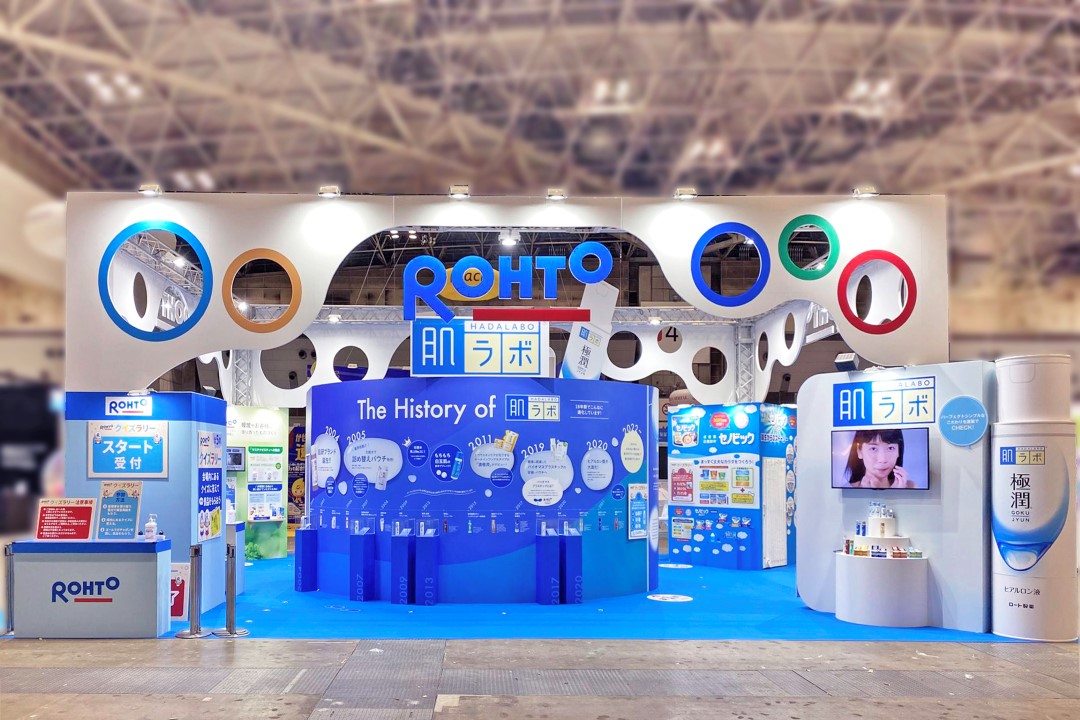
Unique World View Type | Booths that design memorable experiences
A configuration that expresses the world view and values of the brand throughout the entire space. By creating an experience that makes visitors feel "this is like this brand," it becomes an impressive booth.
◆Suitable situations ・Relatively large booths (4 or more sections) ・BtoC, lifestyle products, cosmetics/fashion, etc. ◆Points ・Direction that incorporates the brand story into the space ・Photo spots that are easy to share on social media are also effective
To get visitors to stop at an exhibition booth, it is not enough to just stand out; you need a design that makes them think, "I want to take a look at this booth!" Depending on the booth's location and what you want to convey, choose the best format and design encounters with visitors.
Utilizing patterns for a more effective booth
As introduced so far, there are several patterns for construction in exhibition booths. Understanding each pattern and flexibly utilizing it according to the exhibition location, purpose, and visitor flow is the point to improving the accuracy of the design.
▼ 자세한 것은 백서를 봐 주세요!
BEEATS 는 지금까지 많은 기업의 전시회 출전을 지원해 왔습니다. 본 기사에서 소개한 것과 같은 제작 패턴 외에도, 소송 패턴 에 대해서도 실제의 현장에서 어떻게 활용되고 있는지를, 사례 사진과 함께 소개한 백서를 준비하고 있습니다.
・각 패턴을 살린 설계의 궁리 ・부스 전체의 레이아웃이나 연출의 예 ・출전 목적이나 입지에 따른 사고 방식의 힌트
Why don't you start creating an effective booth with BEEATS?
For exhibition booth design, small, cumulative efforts—such as how to deliver what you want to convey and how to design the movement of visitors—lead to results. BEEATS has supported many exhibition participations across various industries and business types. With a system capable of consistently handling planning, design, layout, construction, and on-site operation, we have the experience to face every challenge that occurs on-site.
◆We respond to such concerns!
・It's my first time exhibiting at an exhibition, and I don't know where to start ・I have a lot to convey, and I'm lost in how to organize it ・I'm anxious about whether I can think about the on-site traffic flow and operational aspects
◆ Please consult us even at the stage of considering exhibition.
It is no problem even if the venue or the number of sections is not yet decided. We support you from the initial stage of consultation, such as "how to organize what you want to convey" or "what kind of configuration might fit". Depending on your request, we can also introduce past cases and spatial design materials. If you are lost in choosing an exhibition partner, please feel free to consult us first.
Q1. What is the first step to creating a "sticking" booth at an exhibition?
A1. The first step to creating a "sticking" booth at an exhibition is to grasp "where" the booth is in the venue and simulate the visitor's movement. Since the ease of stopping changes depending on whether it is along the main traffic line or in an tucked-away location, it is important to build a strategy according to the exhibition location.
Q2. What kind of design is effective for booths in the venue's entrance area?
A2. For booths in the entrance area, a design that narrows down information and places short, memorable words or visuals is effective. Since visitors right after entering are not yet in the mode to absorb information, creating a traffic flow using pamphlets or novelties that makes them think "I'll come back later" is key.
Q3. What is the recommended booth design pattern for along the main traffic line with high traffic?
A3. The recommended design patterns for along the main traffic line with high traffic are "Fully Open Type" and "Monitor-Heavy Type". By removing walls and prioritizing accessibility, or by conveying service features momentarily with short videos on large monitors, you can catch the eyes of walking visitors and get them to step in naturally.
Q4. If you want to convey multiple services or functions, which booth design is suitable?
A4. If you want to convey multiple services or functions, the "Wall Expansion Type" that organizes information using walls is suitable. It is suitable for areas that are slightly off the main traffic line and easy to stay in, and by dividing and arranging zones for each piece of information, visitors are naturally drawn to the content they are interested in and can read it carefully.