"I was put in charge of a business meeting event to expand our sales, but what is different from a trade show or briefing session?" "I don't know how to proceed with preparations to generate business matching and link it directly to results." As a person in charge of BtoB marketing or sales planning, it is not uncommon for those put in charge of planning and operating corporate events to face such worries. Corporate events come in various formats, but among them, the "business meeting event" is a highly practical event with the highest priority purpose of creating direct business opportunities, such as new transactions and market cultivation with participating companies. In this article, we will explain basic knowledge such as differences from trade shows and types of event formats, the way forward toward actual holding, and points for generating "high-quality business meetings" and maximizing results.
A business meeting event is a place where sellers (suppliers) and buyers (buyers) conduct concrete business discussions directly, with the main purpose of new transactions between companies, market development, and exploration of cooperative partners (business matching). Organizers include private companies, as well as countries, local governments, chambers of commerce, and financial institutions. Or it may sometimes be held by specific industry groups.
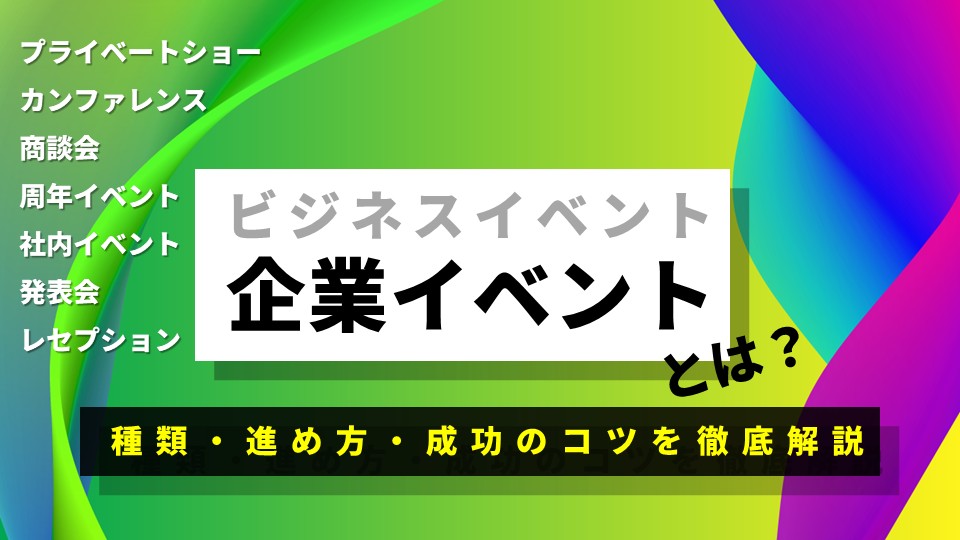
Please also refer to this article for basic knowledge of corporate events in general.
2. Decisive differences from exhibitions and briefings
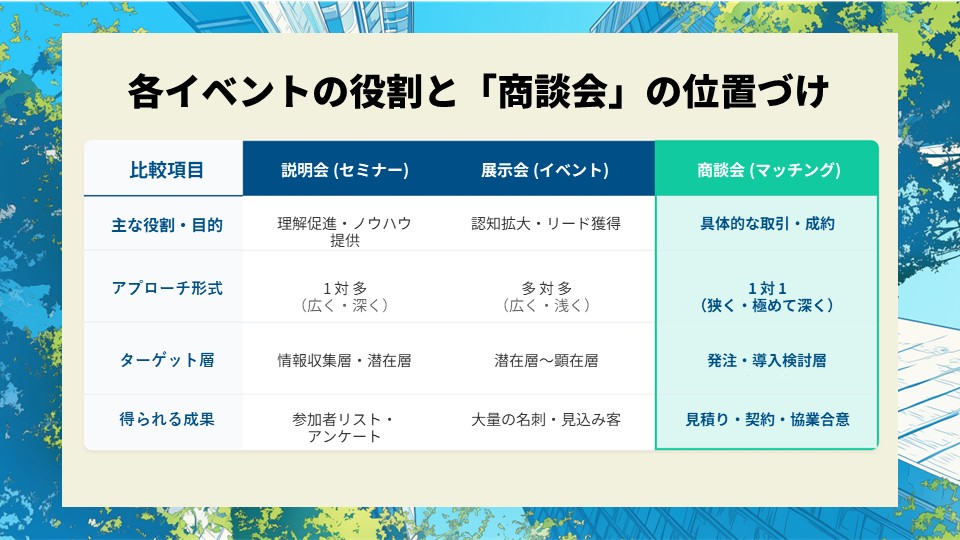
There are event formats often confused with business meeting events, such as "exhibitions" and "briefings (seminars)," but these clearly differ in purpose and phase.
exhibition The main objectives are "information dissemination," "brand awareness," and "acquisition of a wide range of leads (potential customers)." This phase is suitable for promoting products and services to a large, unspecified audience and for exchanging business cards broadly and superficially.
Briefing (Seminar/Conference) This is a place to convey know-how or detailed product information based on a specific theme in a "one-to-many" format. It is excellent for lead nurturing and improving understanding.
Business Matching Event The main objectives are "concrete business negotiations and contracts" and "business matching." After reconciling the needs of both parties in advance, deep discussions closer to order placement, such as specific price points, delivery dates, and specifications, are carried out in a "1-on-1" seated format.
In other words, while exhibitions are a place for broad "trigger creation" and briefings are a place for "understanding promotion/nurturing" of potential customers, business meeting events are characterized by a strong color as a "place for closing toward a contract."
3. Types of Business Meeting Events
Business meeting events are classified into several types depending on the form of holding and the theme. It is important to choose the appropriate format according to your company's purpose and target.
Category 1
Classification by Holding Format
In-person (Real) Business Meeting Event This is a format where business meeting booths are set up in exhibition halls, hotel banquet halls, or rented conference rooms to conduct business meetings face-to-face. The biggest advantage is that it is easy to convey enthusiasm because you can show the actual product or provide tasting/experiences.
Online Business Meeting Event This is a format that utilizes web conferencing systems or dedicated online exhibition platforms. It is easy for even distant companies to participate, and since venue expenses and travel costs can be reduced, it has become rapidly established in recent years.
Hybrid Business Meeting Event This is a format that combines the merits of in-person and online.
Category 2
Classification by Organizer/Participation Format
In-house (Private) Type This is a format where the company hosts the event alone, inviting existing customers and prospective customers to announce new products and hold business meetings at the same time. Since there are no competitors, deep business meetings are possible at your own pace.
Joint (Matching) Type This is a format where financial institutions, local governments, event companies, etc., act as organizers, gathering and introducing many selling companies and buying companies. You can expect chance encounters (serendipity) with new business partners.
Industry-Specialized (Theme-Specialized) Type A business meeting event held by focusing on specific industries or themes such as "Food," "IT/DX," and "Manufacturing." Because participants' needs are clear, matching accuracy becomes higher.
Please also check out this article for events that combine conference formats.
We explain the standard process for planning and operating a business meeting event as an organizer and leading it to success in 5 steps.
Step 1: Setting Purpose and KPI (Goal) First, we clarify the purpose of "why are we holding this business meeting event?" Is it cultivation of new customers? Is it cross-selling to existing customers? Based on that, we set concrete KPIs such as "number of participating companies (exhibiting/visiting)," "number of executed business meetings," "number of results (prospects) from business meetings," and "order amount."
Step 2: Recruitment and Attraction of Exhibiting Companies and Participants (Buyers) Gather participating companies that meet the objectives. In the case of a joint type, it is important to balance the seller side and the buyer side. In the case of an in-house type, attract targets by utilizing newsletter delivery to house lists (existing customer/lead information), individual approaches from sales representatives, or web advertising.
Step 3: Matching Design (Appointment Adjustment) This is the most important step that determines the success or failure of a business meeting event. Since unscheduled meetings on the day are inefficient, we build a mechanism for "pre-event matching" in which both parties share profiles, needs, and product information that can be provided, and request companies they want to meet. Preparation is carried out such as introducing a system to perform automatic matching or the secretariat manually creating the timetable.
Step 4: Day-of Operation (Management of Business Meeting Booths and Traffic Flow) Venue setup, reception handling, and guidance to business meeting booths are performed. To ensure business meetings go smoothly, we arrange appropriate size, Wi-Fi environments, and power sources for each booth. Also, the role of a timekeeper who strictly manages the duration of one meeting (e.g., 30 minutes) is important.
Step 5: Follow-up After the Business Meeting A business meeting event does not end when it is over on the day. Conduct surveys of participating companies and hear feedback on business meeting results. It is essential to design a continuous follow-up system leading up to the contract, such as confirming progress after the meeting and creating future proposal opportunities as needed.
5. Tips for Achieving Results (Generating High-Quality Business Meetings)
We explain points for not ending business meeting events as mere "places for greetings," but directly linking them to concrete business results.
Maximize the Accuracy of "Pre-Matching" Everything depends on whether participating companies can grasp beforehand "what the other party is looking for" and "what their own company can offer." By designing the hearing items (issues, budget, introduction timing, etc.) at the time of registration in detail, you can prevent mismatches.
Design of Space and Flow Lines to "Concentrate on Business Negotiations" Lively background music or flashy microphone performances like those at trade shows are unsuitable for deep business negotiations. We strive for a space design specialized for business negotiations, such as appropriate booth spacing that prevents you from worrying about the voices of neighbors, partitions that consider privacy, and tables where you can calmly spread out documents.
Preparation and Flexible Operational Structure Troubles such as same-day cancellations or business meetings running long and delaying the next schedule are inevitable. In addition to deciding on how to handle potential irregularities in advance, flexible support such as secretariat staff patrolling the venue and introducing buyers with spare time to exhibitors who are free will boost the overall number of business meetings.
6. Thinking about Business Meeting Event Costs and Preparation
The costs of a business meeting event depend on the format (in-person or online), scale (number of participating companies, size of venue), whether it is self-hosted or joint-type, and how much is outsourced to the outside. Since the range is wide from cases fitting in the tens of thousands of yen scale to tens of millions of yen scale, it is the current situation that it is difficult to indicate a uniform market price. Here, we organize not concrete amounts but the main breakdown of "what costs money" and the thinking you want to press when planning the budget. We recommend that you first wash out necessary items from your company's purpose and scale, and obtain estimates from multiple companies for comparison.
Venue and Setup Costs These include venue rental fees, construction of business meeting booths (partitions, desks, chairs), production of signs and billboards, and costs for building audio, lighting, and Wi-Fi environments. In the case of an in-person event, this is the item that is most likely to have the largest weight in the total cost. The amount varies greatly depending on the grade and scale of the venue and the number of booths.
System Introduction Costs (Matching Systems, etc.) These are usage fees for business matching systems or event management tools used for participant registration, searching for company information, making interview requests in advance, and automatically generating timetables for the day. These vary depending on the scale of participation and the necessary functions.
Operating Expenses/Labor Costs These are labor costs for planning and production fees, directors on the day, reception/guide staff (companions), and security guards. They are proportional to the number of days held and the elaborateness of the operation structure.
Customer Attraction and Sales Promotion Costs This includes production and shipping costs for DM, web advertising costs, production costs for special landing pages (LP), etc. It varies depending on the scale and method of the target you want to attract.
Points to Consider When Thinking About Costs
The costs of a business meeting event depend not only on "what you spend on the venue" but also on the quality of matching design, operation, and visitor attraction, which are hard to see. It is key to budget allocation that leads to results to examine it from the perspective of cost-effectiveness, asking "where should we invest to generate one effective business meeting?" rather than judging solely by the simple low cost.
7. BEEATS's BtoB Trade Show and Business Meeting Booth Support Case Studies
At BEEATS, we provide total support from the production of the entire corporate event to the planning, design, and construction of booths for exhibitions and business meeting events, as well as operation on the day. Here, we introduce examples of business events that functioned as places to deepen business meetings and product understanding.
Case Study 1
Nipponham Group (Product/Promotion Briefing/Group Exhibition)
We supported the space design and booth design of the venue at the regularly held "Nipponham Group Product & Sales Promotion Briefing." It realized effective traffic flow and spatial production that leads to smooth business meetings where the charm of products and promotional measures are accurately conveyed to visitors of various channels, not stopping at mere product display.
Supported the planning and operation of the private conference "Nulab Conference," which conveys the worldview of their own services. In addition to keynote speeches and sessions, we designed a space where participants could communicate and exchange information (business meetings/consultations) directly with each other and with company representatives, contributing to building deep engagement with users.
Sun Telephone Co., Ltd. (ICT Comprehensive Exhibition)
For a comprehensive exhibition where the latest ICT solutions gather, we provided total production including zoning of the entire venue, booth design, and signage planning so that exhibiting partner companies and visitors could efficiently and meaningfully proceed with matching and business meetings.
Unlike exhibitions, which are places to gather broad awareness, business meeting events are extremely practical corporate events specialized in "creation of concrete business opportunities" and "business matching and contracting." The key to success lies in clear target setting, a highly accurate "pre-matching" mechanism, and space and flow design that allows you to concentrate on business meetings on the day.
At BEEATS, we provide comprehensive support for the success of BtoB business events, from booth design and spatial production for in-person trade shows and business meeting events to prior customer attraction and operation direction on the day. If you have issues such as "I am going to host a business meeting event for the first time" or "I want to increase business meeting results at our own event," please feel free to consult with us.
FAQ: Frequently Asked Questions About Business Meeting Events
Q. What is a business meeting event? A. It is a place/event where sellers (suppliers) and buyers (buyers) directly conduct concrete business discussions (adjusting prices and specifications, etc.) with the purpose of new transactions between companies, market development, exploration of cooperative partners, etc.
Q. What is the difference between a business meeting event and an exhibition? A. The biggest difference is in the purpose. The main purpose of an exhibition is "information dissemination, awareness acquisition, and broad lead acquisition" for an unspecified large number of people, while the main purpose of a business meeting event is "concrete business meetings and business matching (closing)" after reconciling needs in advance.
Q. How should I proceed with a business meeting event? A. The basic steps proceed in the flow of "① Purpose/KPI Setting" → "② Recruitment of Exhibitors/Participating Companies (Buyers)" → "③ Matching Design/Appointment Adjustment" → "④ Day-of Operation (Executing Meetings)" → "⑤ Follow-up after Meetings." In particular, the accuracy of ③ pre-event matching significantly affects results.
Q. How much are the costs for a business meeting event? A. It varies greatly depending on the scale and format of the event (in-person/online, self-hosted/joint-type). Main costs are divided into "venue/setup fees," "system implementation fees for matching, etc.," "operation/personnel costs for the day," and "customer attraction/promotional fees." Since the range is large depending on the scale and scope of outsourcing, please first organize your objectives and scale, and then feel free to consult with us for an estimate.