Conferences have become an indispensable method in business growth strategies.
However, if you perceive it merely as a "large-scale meeting" or a "lecture-style event," you cannot draw out its true value. Especially in the current 2026 business trend, where the interactivity of information and experiential value are emphasized, conferences are once again attracting attention as a method for "building authority" and "community formation."
In this article, we thoroughly explain everything from the definition and types of conferences to the 7 steps to success practiced by professionals, and the "pitfalls" to avoid failure.
What is a conference? Definition and importance in business
Original meaning of words and definition in business "Conference" originally meant "discussion," "consultation," or "meeting." In a business setting, it refers to a place where experts and industry stakeholders gather to share information, discuss, and network based on a specific theme. While a seminar is "a one-way transmission of knowledge from lecturer to attendee," a conference generally refers to a larger, more multi-functional event that includes "discussions from multi-faceted perspectives" and "interaction between participants."
Business Trend: From one-way transmission to "interactive experience" Currently, the role of conferences in B2B marketing has changed significantly. In an era where information is easily obtained online, participants are seeking "enthusiasm that can only be obtained on the spot" and "real connections with speakers and participants." Future conferences must be designed not as a place for the organizer to transmit messages one-way, but as a place for "interactive experience" where value is co-created with participants.
<3 Values Brought by Holding a Conference>
1. Establishment of industry authority
By hosting a conference with a unique angle, you can establish your position as an "industry leader."
2. High-quality community construction
By gathering people with common issues, you can form a strong fan community that exceeds a mere customer list.
3. High-precision lead acquisition and conversion
Since the participants' interests are clear, you can acquire prospects with a much higher conversion rate than general advertising.
Main types and formats of conferences
Conferences are classified into several types depending on their purpose. Choosing the format that is best for your company's goals is the first step to success.
~Main types~ 1. B2B Marketing Type
Aimed at acquiring new leads or expanding industry share. The main focus is on explaining the latest trends and introducing case studies.
2. Inner Motivation Type
A place for sharing company vision and improving employee morale, such as internal kickoffs and company-wide conferences.
3. Academic/Technical Type
Highly specialized meetings aimed at announcing the latest technologies or setting industry standards.
4. User Community Type
Designed to improve loyalty (maximize LTV) for existing customers. Interaction between users is emphasized.
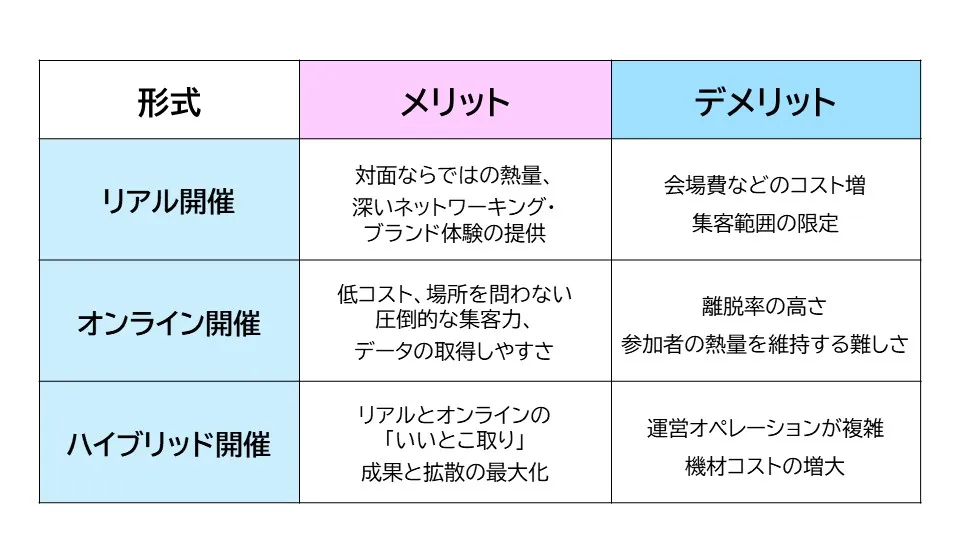
Pros and cons of the event format to choose
Currently, the options for formats have further expanded due to technological advancements. Let's understand the pros and cons of each and consider the optimal event format.
We introduce the "success routine" practiced by professionals to avoid failure in 7 steps.
STEP.1
Clarification of purpose (KGI/KPI)
Setting "number of participants" as a goal is not enough. Let's set KPIs that are directly linked to business results, such as "number of effective business meetings," "satisfaction (NPS) via surveys," and "business meeting acquisition rate after the event."
STEP.2
Concept and theme design
While competitors are holding similar events, a sharp angle that answers the question, "Why do I need to go to this conference now?" is necessary. We search for the point where the target's "what they want to know most right now" and your company's "unique strengths" intersect.
STEP.3
Program composition and speaker negotiation
The quality of the speakers is directly linked to visitor attraction. We design an engaging timetable (progress) by arranging not only famous keynote speakers but also panel discussions by practitioners who know the real struggles of the field.
STEP.4
Venue selection and infrastructure development
For in-person events, whether it fits the location or brand image is key; for online, the stability of the distribution platform is life. In particular, fine-tuned checks, from internet environment and audio equipment to catering to encourage interaction, will determine the quality of the experience.
STEP.5
Strategic visitor attraction promotion
We link all channels, such as email delivery to house lists, SNS ads, press releases, and requests for diffusion by speakers. The standard is to create initial momentum with "early application benefits".
STEP.6
Operation and progress management on the day
The key to success lies in the precision of the "progress script (progress Q-sheet)." It covers progress management by the second and countermeasures for anticipated troubles (equipment failure, late arrival of speakers, etc.). A rehearsal the day before is essential.
STEP.7
Post-event reflection and lead nurturing
A conference's real work begins "after it ends." Analyze survey results immediately and provide feedback to the sales department while enthusiasm is still high. Use follow-up emails tailored to participant attributes to lead to business meetings.
Learning from failures: "Pitfalls" in conference operation
We share typical failure patterns that many companies fall into and their countermeasures.
[Failure in Visitor Attraction] Why people don't gather even if you have luxurious speakers It is a big mistake to think that "people will come if there are well-known speakers." If the target's needs and the theme do not match, it will not lead to applications. Also, cases where notice starts too late (the ideal is 3 months before) are fatal.
[Failure in Operation] Distribution/equipment trouble on the day and lack of backup system A common issue in hybrid events, in particular, is audio dropouts or slide malfunctions. Backup systems that assume the worst-case scenario, such as "network redundancy (preparing 2 systems)" and "preparing spare PCs," differentiate professionals from amateurs.
[Failure in Results] How to prevent "fragmented events" that end without follow-up You need a design that is conscious of "content assetization," such as using videos of the day as archives or turning discussed content into white papers to lead to future lead acquisition, rather than letting the event end as a one-time thing.
Benefits of outsourcing a conference and how to choose a partner
In-house management (internal production) or requesting a professional, which is the correct answer? In-house management keeps costs down but occupies your team's resources for months. From the perspective of quality assurance, risk management for equipment failure, and know-how to maximize "visitor attraction," hiring professionals often ends up increasing ROI (cost-effectiveness).
Outsourcing scope: Partial contract or one-stop (all-out) delegation? Whether you want to entrust only the secretariat operation or entrust everything from concept creation to visitor attraction and performance on the day, flexibly divide the work according to your company's resources and budget.
Checkpoint
3 points to evaluate a reliable operation agency
〇 Do they have a track record in a similar scale and industry?
It is important whether they understand the specific circumstances of the industry.
〇 Do they have know-how in visitor attraction support?
Whether they have proposals on how to attract people, not just arranging the venue.
〇 Flexible trouble-handling capability
Are they equipped with on-site judgment skills that aren't just by the book?
Summary: Accelerating business with the next generation of conferences
A conference is not just a means of transmitting information. It is a "strategic investment" to establish a company's brand and build strong bonds with customers.
To transform a conference from a one-time event into an "asset" Data obtained from holding it, content disseminated, and communities built all become company assets. Do not be overly happy or sad about short-term "numbers," but position the conference as an engine for long-term business growth.
Start small. Your first action to take a step forward There is no need to aim for thousands of people from the beginning. Please start with a dense conference for a specific target. That successful experience will lead to the next big step.
BEEATS supports conference operation and construction
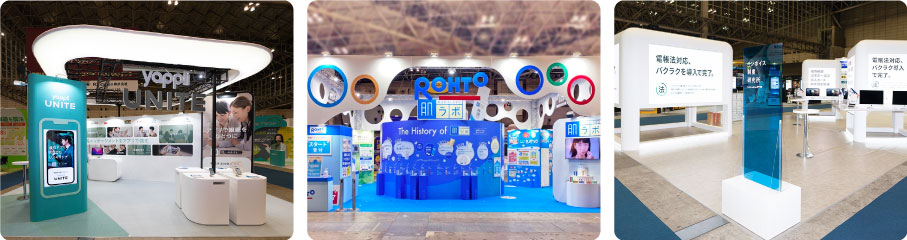
BEEATS has handled the spatial design and operation of numerous exhibitions and private shows to date. From structural design at the planning stage to arranging reception and guidance staff on the day, we provide one-stop support. Leveraging operational know-how polished through various promotions and exhibitions/private shows, you can leave your first conference holding to us with peace of mind.
BEEATS can flexibly respond to such "field challenges": ● Maximizing limited venue space ● Responding to tight planning-to-construction schedules ● Optimization of visitor flow and signage planning ● Total direction from panels, handouts, and stage performance to souvenirs
Precisely because exhibition professionals handle it, you can realize a level of quality at your conference that is one step ahead.
If you feel, "I want to try a conference in my own company, but I don't know where to start...", please feel free to consult with us.
Q. What is a conference? A. A conference refers to a place where experts and industry stakeholders gather to share information, discuss, and network based on specific themes. Originally meaning "discussion," "consultation," or "meeting," it is attracting attention in the business scene as a method that brings value such as establishing authority in the industry, building high-quality communities, and acquiring leads with high conversion rates.
Q. What is the difference between a conference and a seminar? A. While a seminar is "a one-way transmission of knowledge from lecturer to attendee," a conference generally refers to a larger, more multi-functional event that includes "discussions from multi-faceted perspectives" and "interaction between participants." In recent years, design as a place for "interactive experience" where value is co-created with participants, rather than a place for the organizer to transmit information one-way, is emphasized.
Q. What types of conferences are there? A. They are mainly classified into 4 types. The "B2B Marketing Type" aimed at new lead acquisition and industry share expansion, the "Inner Motivation Type" aimed at sharing company vision and improving employee morale, the "Academic/Technical Type" for announcing the latest technology, etc., and the "User Community Type" for improving loyalty (LTV maximization) of existing customers. Choosing the format that is best for your company's goals is the first step to success.
Q. What steps are required to make a conference successful? A. We design it mainly in 7 steps: clarification of purpose (KGI/KPI), concept and theme design, program composition and speaker negotiation, venue selection and infrastructure development, strategic visitor attraction promotion, operational and progress management on the day, and post-event reflection and lead nurturing. In particular, it is said that the real work of a conference begins "after it ends," and it is important to design it to follow up while the participants' enthusiasm is still high and lead them to business meetings.
Q. Should I outsource a conference or manage it in-house? A. In-house management keeps costs down but occupies your team's resources for months. From the perspectives of quality assurance, risk management for equipment failure, and know-how in attracting visitors, hiring professionals often ends up increasing ROI (cost-effectiveness). If you decide to outsource, it is good to evaluate these 3 points: whether they have a track record of similar scale and industry, whether they have know-how in supporting visitor attraction, and whether they have flexible trouble-handling capabilities.