"I've been put in charge of hosting a corporate event, but I don't know where to start" or "I've been entrusted with the planning of a corporate event, but I don't see the big picture of how to proceed." I imagine many marketing, PR, and HR personnel at companies have these kinds of concerns.
This article provides a comprehensive and thorough explanation of corporate events (business events), including their definitions and objectives, representative types, step-by-step guidance from planning to execution, and tips for making them a success. We also introduce how to think about costs and budgets.
Please use this as a first step in event planning that meets your company's objectives.
Corporate events are a general term for events hosted by a company with a clear purpose. Mainly in the BtoB domain, they are held for customers, business partners, or employees, and are also called "business events." In general, "corporate event" often refers to all events involving a company, both internal and external, while "business event" is used with the nuance of referring to external events (such as exhibitions or conferences) that are more directly linked to business meetings or business creation.
Three main objectives for holding a corporate event
The purposes for holding corporate events can be broadly divided into three types depending on whether the target is external or internal.
① Business negotiation generation/lead acquisition (for external) We aim for opening up new customers and upsell/cross-sell by deepening relationships with existing customers. Letting them experience products and services directly and connecting them to specific business negotiations is the greatest objective.
(2) Information dissemination & Branding (for external/industry audiences) By sharing the company's vision, new product announcements, and cutting-edge knowledge in the industry, we enhance the company's expertise and brand value. It serves as a place for information dissemination to establish an advantage in the market.
(3) Organization activation & Engagement improvement (for internal/stakeholder audiences) The goal is to increase employee motivation, share the vision, and promote communication between departments. It also functions as a place to convey gratitude to shareholders and business partners.
Why real experiences (real events) are emphasized now
In recent years, digital marketing and online meetings have become widespread, and the speed and efficiency of information transmission have improved dramatically. However, on the other hand, "digital fatigue" due to information overload online has also been pointed out. Under such circumstances, the value of "corporate events in a real place" is being reconsidered. Real events can provide "experiences that stimulate the five senses" which cannot be conveyed online. Also, business sprouts born from coincidental encounters and small talk are a charm unique to reality. It can be said that the importance of real corporate events is higher than ever as a place to build deep relationships of trust that are difficult to build digitally.
2. Main types of corporate events
There are various formats for corporate events depending on the purpose. Here, we introduce 5 representative formats. Please use this as a reference when considering which format is suitable for solving your company's issues.
Format ①
Corporate Exhibition (Private Show)
A private show (self-exhibition) is an event where a specific company acts as the sole host to promote its products, services, and solutions on a large scale. Unlike joint exhibitions, competitors do not exhibit, so the greatest merit is that you can monopolize the visitor's interest for your company alone. It is possible to invite existing high-quality customers and prospective customers with high probability, conduct product demonstrations with plenty of time, and carry out deep issue hearings. By applying unique spatial decoration, you can have visitors fully experience the world view of the brand.
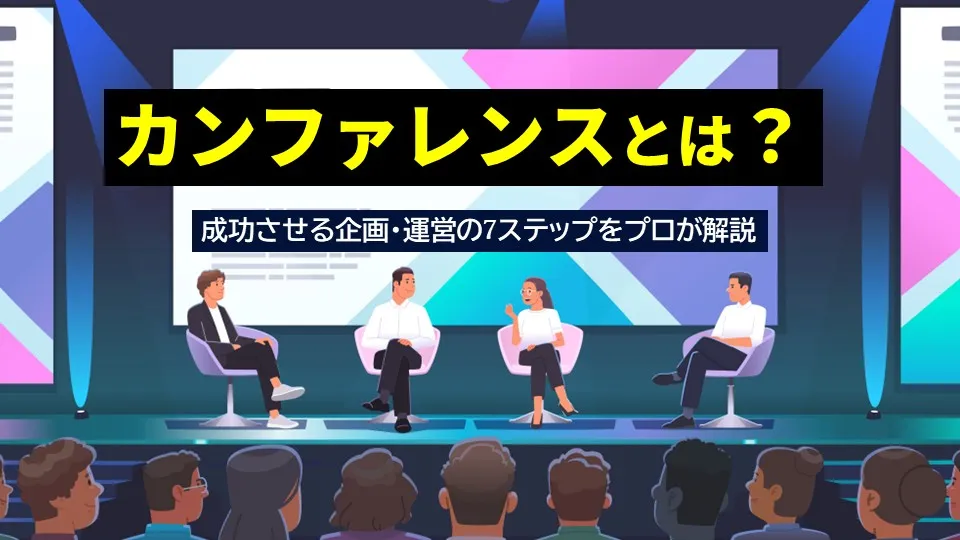
Conferences are events centered on lectures by experts (keynote speeches), panel discussions, and seminars regarding specific themes or industry trends.
Rather than directly selling the company's products, it functions as "a place to provide the latest industry trends and hints for solving issues." It enhances presence in the industry and demonstrates enormous effects for branding, establishing that "we are leaders in this field." Another feature is that it makes it easier to attract decision-maker groups and potential customers who are usually hard to reach, all seeking high-quality content.
Business meetings are, as the name suggests, very practical corporate events held with the main objective of conducting "concrete business transactions (negotiations)." They are set up as a place to focus even more narrowly than a corporate exhibition, directly linking to sales and contracts.
Features and Importance of Business Meetings
Business meetings often adopt a "matching format" where visitors (buyers, corporate procurement managers, etc.) and the hosting company (sales representatives) set appointments in advance. Because both parties' needs and provided solutions are aligned in advance, a characteristic feature is that it is easier to proceed to concrete negotiations for presenting quotes and concluding contracts on the spot.
Points for a successful business meeting
To make a business meeting successful, the question is "how to create a comfortable and focused business environment" from the stage of event planning.
Ensuring privacy: It is important to provide separate business booths separated by partitions or completely private rooms so that attendees don't have to worry about the eyes or voices of other participants.
Hospitality: To reduce fatigue from long business meetings, considerations such as providing high-quality drink service and placing comfortable furniture to relax in are also hidden factors that influence the success rate of business meetings.
Hospitality: Considerations such as high-quality drink service to reduce fatigue from long business meetings or comfortable furniture to help people relax are hidden factors that can influence the success rate of business negotiations.
For BtoB companies seeking certain ROI (Return on Investment) beyond simple product displays, hosting high-quality business meetings is an extremely effective measure.
Format 4
Anniversary Event
Anniversary events are held to commemorate company milestones, such as a 10th anniversary of founding or a 50th anniversary of establishment.
Rather than just being a celebration, it holds the important meaning of "looking back on the journey so far, conveying gratitude to stakeholders (customers, business partners, employees), and announcing new visions and management strategies for the future." For external audiences, it is a perfect opportunity to appeal the company's stability and future potential, and for internal audiences, it serves as a turning point that dramatically increases a sense of belonging.
Internal-facing events targeting employees and stakeholders, or events specialized for specific announcements, are also an important part of corporate events.
Internal events: Kickoff meetings, award ceremonies, company-wide meetings, etc. They aim for the permeation of visions, improvement of motivation, and the creation of cross-departmental communication.
(Presentation (press conferences, etc.): Extensively announce new product releases, new CM announcements, or the launch of new businesses to the media and stakeholders to maximize PR effects.
Reception (Social Gathering): Events such as standing-style parties held after seminars or conferences, or when a new office opens, with the primary objective of networking (building personal connections).
3. How to proceed with corporate events / Flow of events
Planning a corporate event is a long-term project spanning several months (or over a year depending on the scale). Here, we explain the 5 basic steps to success.
Step ①
Planning and Setting Objectives (How to determine KPIs)
The starting point for everything is the clarification of the objective: "Why hold this event?" If the objective is vague, all subsequent judgments will become ambiguous. Once the objective is set, we will set "KPIs (Key Performance Indicators)" to measure whether it has been achieved.
For the purpose of generating business negotiations: "Number of business cards acquired," "Number of effective leads," "Number of quotes presented," "Negotiation conversion rate," etc.
When the objective is branding: "Number of visitors," "Number of media placements," "Number of mentions on social media (buzz)," "Satisfaction/brand lift effect via surveys," etc.
For internal use: "Participation rate," "Degree of vision empathy in post-event surveys," etc.
Define who the target audience is, what you want them to feel and do through the event, and put it into a project proposal.
Step 2
Venue selection and flow design
Selecting the right venue is a major factor in the success or failure of an event. We select the venue from the perspective of expected number of attendees, traffic access, necessary equipment (large screens, special lighting, presence of business booths, etc.), and whether it is a space that matches the brand image.
Once the venue is decided, we perform space design and "flow design." From the moment visitors enter the entrance, finish registration, experience the main content (exhibits and lectures), proceed to the meeting space, and leave the building. We meticulously plan a layout and flow that ensures this series of steps is stress-free and allows the company to communicate information according to its intended story.
Step ③
Customer Attraction and PR
Even the most wonderful plan is meaningless if people don't gather. We will deploy customer attraction measures tailored to the target audience.
Invitations/DM: For existing customers and important clients, we will send special paper invitations or individually customized emails (DM) to encourage reliable attendance.
Special Website (LP): Create a landing page that conveys the details and appeal of the event to serve as a hub for participant registration.
SNS utilization: We will use X (formerly Twitter), Facebook, LinkedIn, etc., to release speaker information and highlights little by little before the event to build anticipation.
Press Release: If the event includes a novel announcement, we will distribute a Press Release to the media to aim for expanded recognition through media articles.
Step 4
Day-of Operations and Staff Arrangements
Unexpected troubles are always a part of the day of the event. To ensure smooth progress, it is essential to create a detailed operation manual in advance and build a staff structure.
Starting with a general director, we clarify role assignments such as progress management, reception, guidance, equipment trouble response, and speaker attendance. If your own company lacks operation know-how or sufficient staff, we will arrange professional event operation staff and casting companies. Making attendees feel that "the hospitality was wonderful" is directly linked to increasing brand value.
Step ⑤
Effect verification
It can be said that "the most important part of an event is after it ends." We perform effect verification and follow-up promptly immediately after the event.
Measure the degree of achievement against the KPIs set in (1). Promptly input visitor survey results and business card information (leads) obtained into SFA (Sales Force Automation)/CRM (Customer Relationship Management) tools and hand them over to the sales department. It is important to summarize the good points and reflections in a report, and cycle through the PDCA cycle to utilize them for future event planning and improvements to daily marketing activities.
4. Tips for making a corporate event successful
We introduce 3 important tips to prevent failure and maximize results in corporate events that invest large budgets and resources. ① Thoroughly reverse calculate from the holding objective When proceeding with event planning, means such as "I want to use the latest digital equipment" or "I want to do flashy production" sometimes end up becoming the purpose.
It is important to constantly ask, "Does this production contribute to business negotiation acquisition (or the set objective)?" If the goal is business negotiations, you should spend more of your budget on expanding quiet and calm business meeting spaces rather than excessive sound production. If engagement is the goal, you need mechanisms that foster two-way communication rather than one-way speeches. Always keep "reverse calculation from the objective" as your judgment standard.
(2) Focus on "Experience Design" from the visitor's perspective The key to success is not for the organizer to one-sidedly push what they "want to convey," but to imagine what visitors "want to know" and "want to experience," and to design that experience.
Prepare "highlight events" (keynote speeches by celebrities, industry-first new product demos, etc.) that grab the hearts of visitors, creating motivation to attend. Inside the venue, provide a memorable brand experience through visually attractive space design, hands-on exhibits that can be touched and tried, and effects that stimulate the five senses. Experience design that makes visitors feel "I'm glad I came" or "it was a meaningful time" is what leads to final business results.
③ Avoid placing separate orders with multiple contractors to ensure consistency Holding a corporate event involves a wide range of specialized fields, including venue arrangements, space design and construction, video and audio equipment, web production, and event staff arrangements. Placing separate orders with different contractors (split ordering) not only increases the amount of direction work required by company personnel, but also makes it easier for miscommunications to occur between contractors. As a result, the risk increases that the world view of the design will not be unified, or that unexpected problems will occur on the day.
Therefore, we recommend that you entrust the entire process from planning and space design to on-site construction, management, and post-event follow-up to an "event production company that can handle everything in one-stop." Centralizing the point of contact not only drastically reduces the burden on your staff, but also ensures that the original objectives and concepts do not waver, and you can realize a high-quality event with consistency throughout every stage.
5. How to think about corporate event costs and budgets
When holding a corporate event, the most concerning issue is probably "cost (budget)." While the total amount will vary significantly depending on the scale and format of the event and the points of focus, it is important to first understand what kind of costs will occur and their breakdown (expense items).
Main breakdown of costs Costs for corporate events are broadly classified into the following four categories.
(1) Venue costs: Usage fees for facilities such as event halls, hotel banquet halls, and conference centers. It is necessary to consider not only the event day, but also the costs for setup and teardown days. Additionally, there may be separate usage fees for incidental equipment (such as projectors, basic sound, and lighting).
② Decor and construction costs: Space design inside the venue, booth setup using wooden creations or system panels, sign (signboard) production, rental and operation costs for special lighting and audio equipment, etc. In order to express the brand's world view, this part often occupies a large weight of the budget.
(3) Operations and labor costs: Includes preliminary planning and direction fees, creation of progress scripts, and labor costs for day-of event directors, reception staff, promotional models, security guards, etc. Casting fees for inviting prominent speakers are also included here.
④ Production and promotion costs: Printing and production costs for invitations, brochures, novelties, etc. Also, costs related to attracting customers, such as website production costs for special sites, web advertising costs, and Press Release distribution costs.
Points for budget optimization It is also necessary to devise ways to achieve maximum results within a limited budget.
Furniture reuse: By not discarding the furniture used for display stands and decorations after just one use, but rather utilizing rental items skillfully or creating designs that can be reused for the next event (reuse), it is possible to achieve both medium-to-long-term cost reduction and sustainability (environmental consideration).
Tone and manner in budget allocation: It is important to invest heavily in places that directly link to experience value and are visible to visitors, such as "main stage construction" and "comfort of business booths," while keeping decorations in backyards and inconspicuous areas simple with system panels. This "on-off" approach to investing in areas directly linked to achieving objectives is important.
※ Regarding specific cost ranges and rough estimates based on the scale and format of the event (exhibitions, conferences, anniversary events, etc.), we will make proposals based on past performance data. If you would like to know detailed cost information, please do not hesitate to contact us.
6. BEEATS corporate event (business event) case studies
How do the planning and operation points explained so far take shape in the actual field? We introduce examples of corporate events (business events) that BEEATS has produced in one-stop, categorized by format. Please use this as a reference to materialize your own event.
Conference | Nulab Inc. "Nulab Conference 2025"
A conference with 500 attendees held at Shinagawa Intercity Hall by Nulab, which provides the project/task management tool "Backlog" and the online whiteboard tool "Cacoo." The theme was to deliver the concept of "Teamwork Management," proposed on the occasion of the 20th anniversary of the "Backlog" release, to attendees as an "experience."
BEEATS designed a complex space with a main lecture "A Stage" and a "B Stage" that consolidated workshops, product booths, and receptions, all in a unified design that embodies the brand philosophy. By creating flow lines that made it easy for attendees to circulate, we also encouraged interaction with sponsors. We handled everything in one-stop, from venue and booth design to stage production, novelty production, operation manual creation, on-site management, and catering for the reception. A total of 8 sessions were held by 19 speakers, achieving a "place for co-creation" where attendees could experience the brand philosophy under safe and smooth operation.
An exhibition hosted by San Telecom, a specialized trading company for information and communication (ICT), introducing the latest ICT products and solutions. Held in 2024 for the first time in 5 years, 74 companies exhibited, and it was composed of 5 zones: "Network," "Security," "Communication," "ICT Infrastructure," and "Energy." BEEATS was in charge of construction and operation at 5 locations nationwide: Nagoya, Hiroshima, Fukuoka, Osaka, and Sapporo. To maximize the opportunity of "holding it for the first time in 5 years," we implemented layout and booth design from the perspective of visitors, emphasizing face-to-face interaction. In addition, we took charge of secretariat tasks such as formulating operation manuals and various adjustments with exhibitors, and accompanied them in solving issues throughout the nationwide caravan-type event period through regular meetings.
Self-exhibition (Briefing) | NH Foods Ltd. "2026 Nipponham Group Product and Sales Promotion Briefing"
A group exhibition held at the New Year by NH Foods, which handles a wide range of food fields such as ham, sausages, meat, and processed foods. It is a large-scale private exhibition that communicates the next term's new products, new sales promotions, and future initiatives to business partners. BEEATS was in charge of everything from planning, design, and construction to staff arrangement and operation management at two venues in Tokyo and Osaka, following the previous year.
Based on the knowledge gained from working together multiple times, we reorganized the spatial composition and method of communicating information to improve the quality of the visitor experience. Starting with the introductory theater, we organized zones by theme and designed a flow that allows visitors to wander without getting lost, aiming to promote understanding of the exhibition content and improve the value of their time there. We incorporated the brand message into the experience, such as visually appealing to SDGs efforts with objects using product packaging. This is a case where we provided consistent support from planning to day-of operations with an expanded team system to correspond to the large-scale event.
In addition to these, we have published examples of various corporate events (business events) such as conferences, private shows, anniversary events, and internal events.
Summary: Accelerate your business with event planning that matches your objectives
In this article, we explained everything from the types of corporate events (business events) to the steps for leading to success and how to think about costs. The deep engagement and passion that can only be obtained in a real place have the power to move a company's business forward significantly. BEEATS provides powerful one-stop support, from planning and space design to construction and on-site operation for diverse "corporate events (business events)" including private shows and conferences. If your company has challenges such as "I am anxious because it is my first corporate event" or "I want to refresh a routine anniversary event," please feel free to consult us.
A. This is a strategic event hosted by a company with a clear purpose. Primarily in the BtoB field, it is held for the purpose of acquiring new leads, generating business negotiations, branding (dissemination of information), or revitalizing internal organizations. It is sometimes used synonymously with business events.
Q. What types of corporate events are there?
A. There are various formats depending on the purpose, but typical examples include "private shows" (self-exhibitions) to appeal for products or services alone, "conferences" to disseminate industry knowledge and show authority, "business meetings" that lead directly to specific transactions, "anniversary events" to celebrate corporate milestones, and "internal events/presentations" for internal purposes.
Q. How should I proceed with a corporate event?
A. The basic flow consists of 5 steps: "(1) Planning & Objective Setting (KPI formulation) → (2) Venue Selection & Flow Design → (3) Customer Attraction & PR → (4) Day-of Operations & Staffing Structure → (5) Effectiveness Verification & Follow-up." The key to increasing results is to manage these processes consistently without disconnecting them and without straying from your objectives.
Q. What is the typical cost range for a corporate event?
A. It is difficult to provide a general market price because costs vary significantly depending on the scale of the event (number of attendees), venue grade, attention to decor, and production content. The main cost components are divided into "venue fees," "decor and construction fees," "management and labor costs," and "production and promotion fees." We will calculate a quote for detailed budget estimates based on the project content.