"I want to open a pop-up store in Seoul as a foothold for my company's brand to enter South Korea." "However, we do not have a local subsidiary or branch in South Korea, and I have no idea where to start, from finding a property to local construction and operation." We often receive such consultations from Japanese brand managers recently. For Japanese companies, the importance of Korean pop-up stores as a "test marketing field" for full-scale global expansion is higher than ever before.
In this article, we explain to Japanese companies without a local subsidiary about the 4 representative opening formats, how to choose an area according to the target, the flow from preparation to opening, and how to think about the budget.
1. Why open a pop-up store in South Korea (Seoul) now?
Before we look at the specific methods for opening a store, let's summarize the background of why many Japanese companies are now eager to open pop-up stores in South Korea (Seoul).
The Overwhelming Influence of the Trend Hub: Seoul South Korea, and Seoul in particular, is currently the epicenter of the latest trends in Asia. Thanks to the global boom in K-POP, Korean cosmetics, and Korean fashion, the soil is already prepared for brands and items that become hot topics in Seoul to spread across Japan, the rest of Asia, and eventually globally through social media. The simple fact that "a pop-up store was successful in Seoul" generates powerful PR and a halo effect for the brand.
The Core of Consumption: The "MZ Generation" and Pop-up Store Culture The "MZ Generation," which combines the Millennial and Z generations, is driving consumption trends in South Korea. They actively seek out new experiences and Instagrammable spaces, making "visiting popular pop-up stores on the weekend" a regular leisure activity. The passion for "special, limited-time spaces" is higher than in Japan, and if the spatial design and experience design are excellent, even an unknown overseas brand has a great opportunity to gain recognition all at once.
Ideal as "test marketing" before a full-scale entry Full-scale entry into the South Korean market with a permanent store involves large investments and risks. Therefore, a mainstream method is test marketing, where you first open a pop-up store for a limited time of a few days to a few weeks to verify "whether your product will be accepted by Korean consumers," "what price range is appropriate," and "what kind of promotion resonates." Even without a local subsidiary, by teaming up with an appropriate partner company, it is possible to explore real reactions in the Korean market at low risk and quickly.
2. Types of pop-up store formats in South Korea (4 types)
Even if we say "Korean pop-up store" in one word, there are various scales and formats. Here, we will introduce 4 types of store opening formats that are currently mainstream in Seoul. Choosing the optimal format according to your brand's phase, budget, and purpose is the first step to success.
Part 1
Seongsu main street street-level store format
This is a form of setting up an independent store on a street with heavy foot traffic in the center of the "Seongsu" area, which is currently the mecca for South Korean pop-up stores.
Characteristics: Because you can fully express the brand's worldview from the entire building or the facade (exterior), you can produce overwhelming immersion and impact. You can create a strong impact and buzz for high-sensitivity younger generations and influencers, easily attract the attention of passersby, and expect large-scale customer attraction.
Suitable for: Brands that already have a certain level of recognition and want to maximize topic-worthiness all at once with large-scale promotion. For companies that can set up a large promotion budget.
Scale: Medium to large. Implementation for a few days to a few weeks is common, and it requires the most budget and time for spatial construction.
その2
Seongsu café-integrated format (for test marketing)
This is a format for opening by renting a corner of an existing popular café in the Seongsu area or an adjacent gallery space.
Characteristics: The biggest advantage is being able to utilize the existing customer gathering power (natural inflow) of the café. Also, by developing original drinks or limited sweets jointly with the café, you can aim for a deep brand experience and social media spread ("Instagrammable") toward sensitive layers.
Suitable for: Brands entering South Korea for the first time or companies that want to test market reactions with a small budget. It is very suitable for test marketing cosmetics, miscellaneous goods, and apparel.
Scale: Small to medium. It is easier to keep costs down compared to building a street-level store from scratch, and the preparation period can be set relatively short.
その3
Large Commercial Facility Type (e.g., The Hyundai Seoul)
This is a format for opening in event spaces at the latest and highly sensitive large department stores or shopping malls in Seoul, such as "The Hyundai Seoul."
Characteristics: The facility itself has overwhelming power to attract customers, and stable operation is possible regardless of the weather. Furthermore, opening a store in a famous facility with high sensitivity directly leads to an improvement in brand credibility (status).
Suitable for: Brands with a clear concept and high quality that can pass the facility's strict screening (MD selection). Companies that want to approach high-intent shoppers directly.
Scale: It depends on the section (floor area) provided by the facility, but since register systems and basic fixtures are often provided by the facility side, operational setup is relatively smooth.
Part 4
Development in other areas (Hongdae, Gangnam, etc.)
In addition to Seongsu and The Hyundai Seoul, this is an approach that flexibly selects the opening area and format according to the target audience. It utilizes gallery spaces rooted in specific cultures or idle facilities in areas where young people gather.
3. How to choose a location: Thinking from the perspective of target audience and product characteristics
The key to the success of a pop-up store in Seoul, South Korea, is "area selection." Just as customer bases differ in Tokyo, Japan, such as Shibuya, Harajuku, and Ginza, the age groups and consumption behaviors of people gathering in Seoul also differ by area.
Overwhelming No. 1 popularity: Seongsu area An area that retains an industrial and sophisticated atmosphere, renovated from a former factory district. Currently, it is the "Mecca" that comes to mind first when opening a pop-up store in South Korea, and people ranging from MZ generation youth to adults sensitive to trends, and even foreign tourists flock here every day. Pop-up stores of all genres (fashion, beauty, food, entertainment) are crowded here, and becoming a topic here is the gateway to advancing into South Korea.
Characteristics by area and target audience Depending on the product characteristics and the target audience you want to aim for, areas other than Seongsu may be suitable.
・Around Hongdae: An area where young people in their teens to early 20s, mainly university students, gather. Trends change rapidly, and it is highly compatible with pop-up stores such as affordable cosmetics, casual fashion, and character IP (collaborations with anime or characters, etc.).
・Hannam-dong: An area adjacent to a luxury residential neighborhood, lined with sophisticated select shops and flagship stores of designer brands. There are many calm, mature, and affluent people, making it suitable for developing high-price range skincare, fragrances, and luxury apparel brands.
・Gangnam / Apgujeong: An area where businessmen and high-end consumers gather. High-end brands and beauty clinics are concentrated here, making it suitable for rich, experience-based pop-up stores aimed at segments with high beauty sensitivity.
It is important to return to the core of the brand—"who do you want to reach and what do you want to deliver?"—and match the optimal area and property.
4. How to Open a Pop-up Store in South Korea: Process and Workflow
How to overcome obstacles such as "not having a local subsidiary" or "not being able to speak Korean." Here, we explain the general steps for Japanese companies to open a pop-up store in South Korea. In conclusion, teaming up with a partner company (production company) that is well-versed in local affairs and capable of managing projects in Japanese is the most certain and safe shortcut.
STEP-1
Project Planning and Property Securing (Important)
First, clarify the purpose of opening (expanding awareness, test sales, social media dissemination, etc.), the target, and the budget. Based on this, you will research properties in the local area through a partner company.
[Points of Caution] Currently, it is not uncommon for prime properties in popular areas like Seongsu, and sections in popular commercial facilities like The Hyundai Seoul, to be fully booked for 6 months to 1 year in advance. Even if you start moving with the intention of "wanting to open in 3 months," in most cases you will not be able to secure your desired location. Even if the plan is not completely solidified, moving to secure a location at least 6 months in advance is an absolute prerequisite.
STEP-2
Spatial Design and Experience Design
Once the property is secured, you will build the spatial design and visitor flow (experience design) based on the concept of the pop-up store. While maintaining the worldview of the Japanese brand, how you incorporate "essences that strike a chord with the Korean MZ generation (that make them want to share on social media)" into the space will determine the success on the ground. Therefore, it is extremely powerful to be able to collaborate with a local space design company that is well-versed in local trends and handles flagship stores for famous K-Beauty brands.
STEP-3
Local Construction and Quality Control
Based on the design drawings, we place orders with local construction companies and perform the work. This is a major hurdle for overseas expansion. Since there is often a gap between Japan's precise quality standards and local construction methods, careful quality control on-site (direction based on Japanese standards) by a partner company is indispensable.
STEP-4
Preparation for promotion and social media customer gathering
South Korea has a much greater influence from digital marketing and social media than Japan. In preparation for the opening, we prepare teaser announcements in advance and OOH (outdoor advertising) in the surrounding area. Especially important are influencer initiatives. A method of linking with large local MCNs (Multi-Channel Networks), etc., and hiring many local creators to generate buzz on social media all at once, acts as a powerful engine for attracting customers.
STEP-5
Staff Arrangement, Operation Manual Construction, and Opening
We will hire and train local staff (such as bilingual Japanese/Korean staff) to conduct store operations during the exhibition period. We will construct a detailed operation manual that includes not only product knowledge but also Korea-specific customer service styles and troubleshooting flows, and welcome the opening. In this way, building a "system that can proceed one-stop with Japanese as it is at the counter in Japan" from local property arrangement to construction, customer attraction, and operation is the biggest key for companies without local subsidiaries.
5. Thinking about Expenses and Budgets for Opening a Pop-up Store in South Korea
How much does it cost to open a pop-up store in South Korea? In conclusion, it is difficult to provide a uniform market price because the cost varies significantly from several million to several tens of millions of yen depending on the opening area, store scale, duration, and the "degree of spatial detail." When considering a budget, it is basic to think about it by dividing it into the following four cost categories (breakdown).
[Main Expense Breakdown (4 Categories)] ① Property Costs (Real Estate Rent) This is the cost for the space. Rent for street-level stores on the main street of Seongsu is tending to soar due to excessive demand. The calculation method changes depending on the period, from one-time use for a few days to monthly contracts for several weeks to one month.
② Design/Construction expenses (Space decoration) Costs for design fees, carpentry, fixture production, signage (billboard) production, lighting/sound, etc. If you build a street-level store from scratch, this cost will expand significantly, but if you utilize existing spaces such as café-integrated types or use standard fixtures at large commercial facilities, it can be significantly suppressed.
③ Operating/Personnel expenses Personnel costs for local operation directors, sales staff (bilingual support, etc.), security guards, etc. Plus, running costs to keep the store running, such as POS system introduction fees, communication expenses, staff uniform production costs, etc.
④ Promotion/PR Costs This includes casting fees for local creators, digital advertising expenses for NAVER, etc., and production costs for creatives for pre-announcements. Since pop-up stores in South Korea depend on "how much it spreads on social media," we strongly recommend securing a solid budget for these PR expenses.
Key points for considering the budget
It is common to budget for a pop-up store in South Korea not as a place to recover "temporary sales (short-term ROI)," but as a "powerful PR and marketing investment aimed at acquiring brand awareness in the South Korean market and towards Japan and the world."
Regarding specific quotes based on the store format and scale of implementation, we will provide them individually after hearing your requirements. Please feel free to consult with us.
Summary: You can achieve expansion into South Korea even without a local subsidiary
In this article, we provided basic information for Japanese companies to open a pop-up store in South Korea (Seoul). There are unique hurdles to opening events or stores overseas, such as language barriers, differences in business customs, and local regulations. However, the "success and excitement in the Korean market" that can be obtained by clearing them has the power to greatly open up the future of a brand.
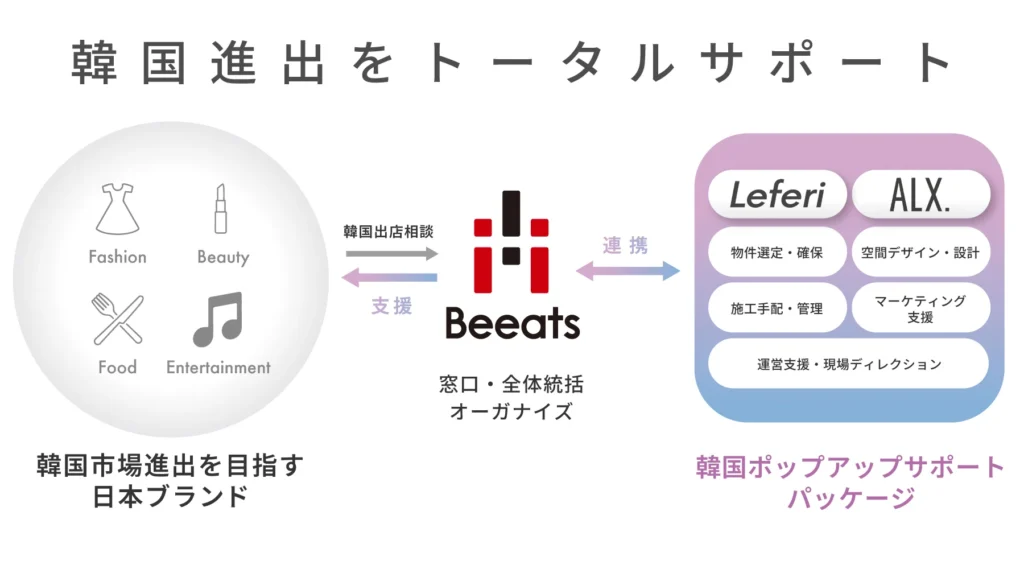
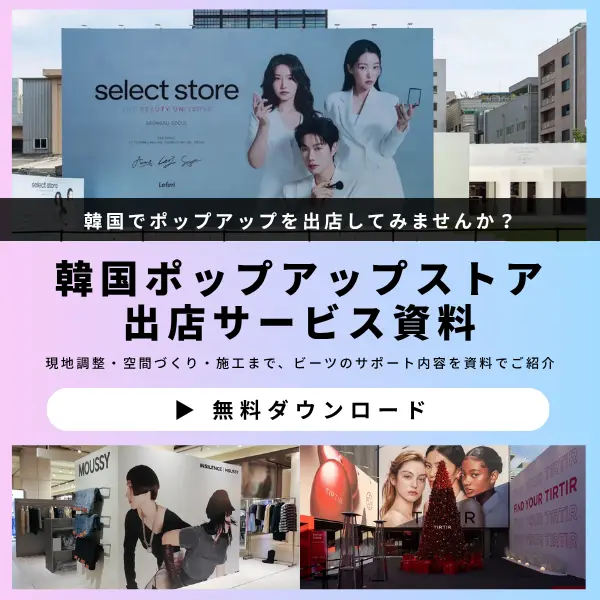
At BEEATS, to strongly support Japanese companies in opening pop-up stores in South Korea, we offer a "South Korean Pop-Up Store Launch Produce Package." This package is built on strategic partnerships with Leferi, one of South Korea's largest beauty MCNs; ALX Design, a spatial design company that handles flagship stores for famous K-Beauty brands; and World Mode Holdings (WMH), which provides store human resource support. From securing popular local properties and building spaces that capture trends to leveraging creators for social media promotion and handling day-of store operations, we provide one-stop support for complex overseas projects, all through a "dedicated point of contact in Japan and Japanese-standard quality control." We welcome consultations such as "I am still at the planning stage, but I want to explore the possibility of opening in South Korea" or "I want to know how much budget I need first." Please feel free to contact us.
Q. Can I open a pop-up store in South Korea without a local subsidiary (Korean branch)?
A. Yes, it is possible. By collaborating with a partner company (production company) familiar with local circumstances, it is possible to provide total support from finding a property to store operation. Building a system that can proceed with the project in Japan and only in Japanese is the secret to success.
Q. Which area is best for opening a pop-up store in South Korea?
A. Currently, the most prominent is the "Seongsu" area, which is the center of trends and the mecca for pop-up stores. However, since the customer base and consumption behavior clearly differ by area, such as "Hongdae" for younger people and "Hannam-dong" for high-price ranges and adults, it is necessary to choose the optimal location according to your brand's products and target.
Q. By when should I start preparing for a pop-up store opening in South Korea?
A. Street-level stores in popular areas like Seongsu and pop-up store sections in famous commercial facilities are often fully booked for 6 months to 1 year in advance. Even if your plans or product lineup are not fully solidified, we strongly recommend that you consult with us at least 6 months in advance (if possible, even earlier) because securing a location is the top priority.
Q. How much does it cost to open a pop-up store in South Korea?
A. The cost is roughly divided into "property costs," "design/construction costs (spatial decoration)," "operation/labor costs," and "promotion (PR) costs." Since there is a range from several million to several tens of millions of yen depending on the opening area, store scale, and degree of spatial detail, it cannot be said unconditionally. After hearing your detailed requirements (duration and desired scale), we will calculate an approximate estimate.