Recently, I have been seeing the term "experiential pop-up" often. This brand and that company are both launching pop-ups under the "experiential" label.
However, when people say, "experiential pop-ups are increasing," I also feel a bit uneasy. Pop-ups having experiential elements is nothing new; experiential projects like tastings, samplings, trying out products, photo spots, and workshops have always been staples of pop-ups. Even so, why are they being called "experiential" now? In this article, we will organize what an "experiential pop-up" is, including its definition, background, concrete examples, and key points for design.
What is an experiential pop-up? ~The "handling" of the experience is changing
An experiential pop-up refers to a limited-time event designed with the delivery of a brand's world view and value as an "experience" as its main axis.
In this article, the term is used to encompass both pop-up stores and pop-up events. For the differences between pop-up stores and pop-up events, please see another article where we have summarized the details.
Pop-ups were originally places to introduce and sell products for a limited time. Roles such as getting people to know about new products and having them touch the actual items remain unchanged even now. However, recently, the perspective of planning design has changed slightly, and pop-ups labeled "experiential" are increasing.
Pop-ups have suddenly become a familiar presence in the last few years.
Especially since 2023, pop-ups as a real (offline) measure are no longer a special promotion, and the option of "trying to develop it with a pop-up first" has become generalized.
On the other hand, the online environment has also evolved significantly.
Through purchaser reviews, comparison articles, SNS posts, and video content, most product understanding is completed within smartphones. We have reached an era where quite a lot of information can be obtained in advance regarding size, usability, and functionality.
As a result, what is required of real spaces has expanded from just "product understanding" to experience value that can only be obtained there.
We live in an era where people find value in the atmosphere that can only be felt on the spot and in the time spent immersing themselves in a brand's worldview. In pop-ups, in addition to the role of a "place to sell," the design as a "place to experience" has become more strongly emphasized. So, how is this "experience" different from before?
It is not just about the idea of "how to show the products," but also including "what kind of time visitors will spend there" in the design. From entering to leaving the space, what is the order of the experience and in what mood will they go home? Cases where that "flow" itself is placed at the center of the plan are increasing.
From “Confirmation” to “Experiencing the Worldview”
Until now, experience in real spaces has often been "confirmation behavior to support purchase."
・Checking the size ・Tasting or sampling ・Trying out the usage feel
All of these are important processes for understanding products, and this structure itself has not changed. The ultimate goal of a pop-up is still to encourage purchase or brand selection. However, the "way of encouraging" has changed a little.
Rather than having people understand specs and functions, moving hearts by experiencing the brand's world view.
Increasing "likes" by experiencing the brand's world view, getting them to become fans, and that resulting in purchases... such designs are increasing.
■ Previously: Confirming through repetition before purchasing ■ Currently: Empathizing through experience before purchasing
Even if the goal is the same, changing the approach also changes how the space is built. The background to the emergence of the term "experiential" seems to lie in this "difference in design."
Main types of experiential pop-ups (classified into 3 patterns)
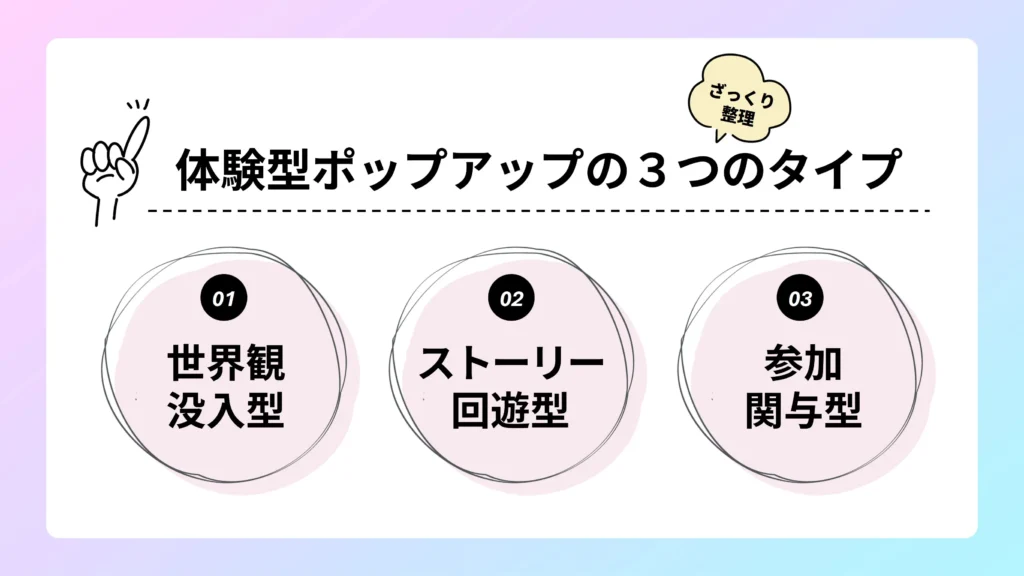
Even if you say "experiential" in one word, the content is varied. There are types that immerse you in the world view of the space, and there are others where the flow itself becomes a story. There are also planning projects that are only established when visitors participate. If you sort them out roughly, it seems they can be divided into three major types.
Type 1
World view immersion type (space-led)
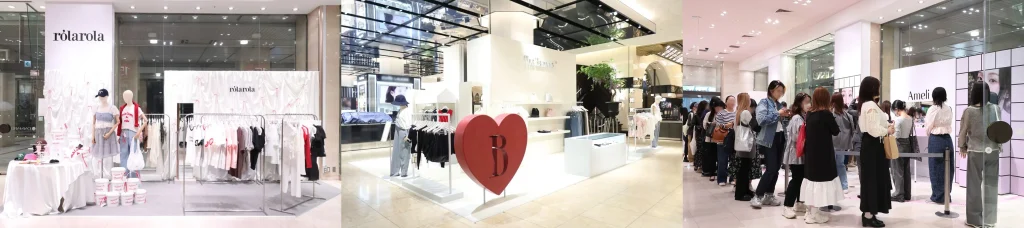
First is the type that puts effort into the creation of the space itself. Rather than just lining up products, we create the brand's world view for the entire space, including color, texture, sound, and scent. Visitors might feel closer to "coming to enter that world" than coming to see products.
With the concept of "Once you wear it, you can never go back...", it uses projection mapping, video, and graphics to create an otherworldly space. The entire venue is designed like a stage for a story, and the time spent soaking in the brand's world view becomes the experience itself. Product sales were of course conducted, but at the center is the "time spent in the space." World view immersion type is an experiential pop-up where the space itself becomes the protagonist.
Type 2
Story Browsing Type (Flow-led)
Next, the type that designs the "flow" from entrance to exit. Rather than experiences being placed as points, the sequence and flow are assembled, and the structure is such that understanding deepens while browsing the venue.
■ Example: Biore Zero "Last Summer Festival of the Year!?" Pop-up (2025, @cosme NAGOYA)
Developed with the concept of a "Summer Festival" themed around the lingering late summer heat. The design allows visitors to try products at a festival-style experience booth, proceed to a lottery, and then move on to purchase incentives. It is characterized by a structure where the experience accumulates in stages within the context of "enjoyably overcoming the late summer heat." The story-based tour type can be said to be a design that manages not only "what to let them experience" but also "the order in which they experience it."
The final type is one where the visitor's actions themselves become the core of the experience. Rather than the brand providing a fixed experience, the experience is completed through the visitor's choices and actions.
Developed a smoothie bowl experience where you freely choose from about 100 types of toppings and complete it by arranging them yourself. The brand prepares the world view and options, and the finished product is left to the visitor. Unlike trial tasting of set products, the characteristic is that the feeling of "choosing and making it myself" remains. Participation/involvement type could be said to be a design where the visitor plays a part of the experience.
Of course, an actual pop-up does not fit neatly into one of these three. There are those that draw stories with flow while building up the world view, and there are cases that incorporate participatory gimmicks while being immersive. This 3-category classification is one way of looking at experiential pop-ups to organize them a little. How to combine these elements in an actual plan will also be a point of design.
Of course, actual pop-ups do not fit neatly into any of these three categories. Some draw stories through flow lines while building a worldview, while others are immersive yet incorporate participatory gimmicks. These three classifications are one way to organize and grasp experiential pop-ups. In actual planning, how to combine these elements also becomes a key point of design.
Points to keep in mind for experiential pop-up design
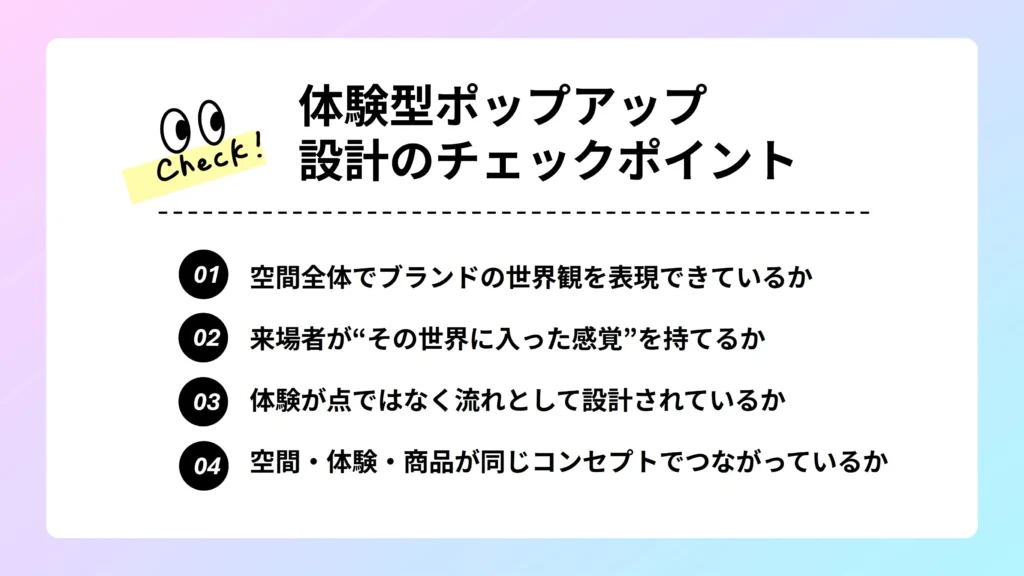
What is important when thinking about an experiential pop-up is not increasing experiences. It is whether that experience is properly connected to the brand or product.
For example, even if a photo spot or workshop is lively, if it is not linked to the context of the product or brand, it will end as just a "fun event." Also, if experiences exist individually, the story of the venue as a whole becomes hard to see.
Therefore, we want to confirm the following points.
This checklist is for not making the experience a "supplementary element" of the pop-up.
● Is the brand's world view expressed in the entire space? ● Can visitors have the feeling of "entering that world"? ● Is the experience designed as a flow, not a point? ● Are the space, experience, and product connected by the same concept?
The key to experiential pop-ups is not how much experience you pack in, but whether the entire space is designed as a single experience.
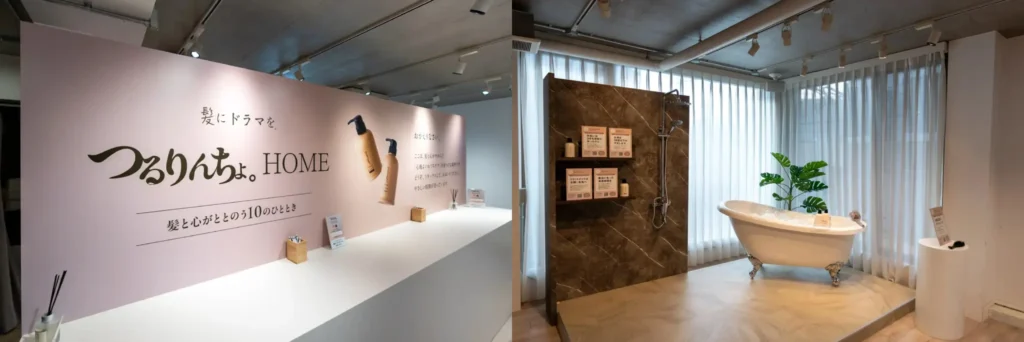
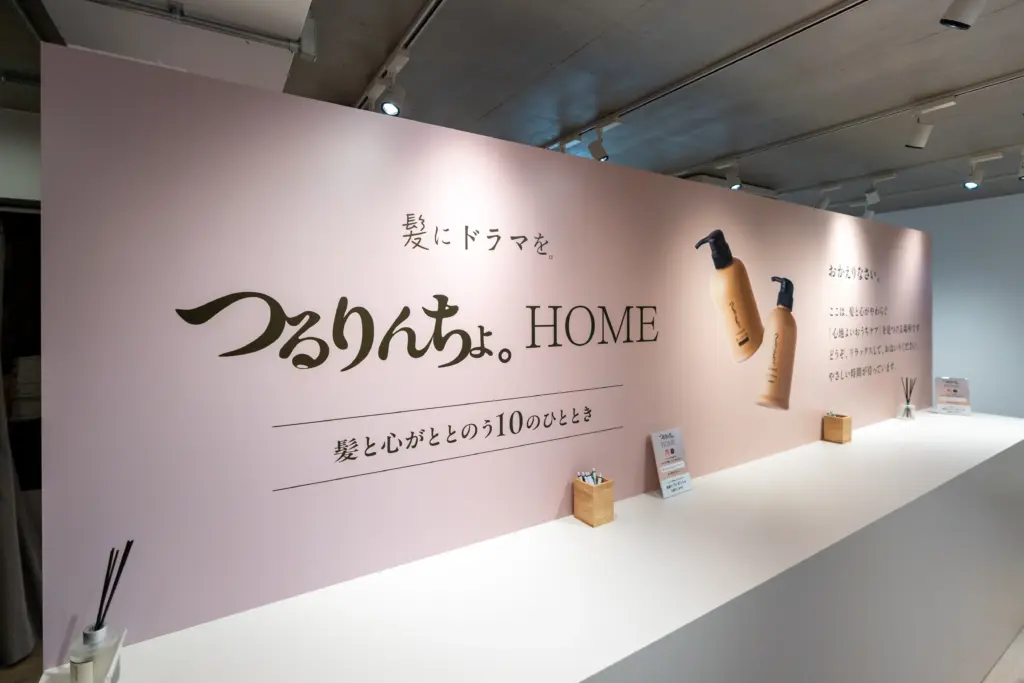
[Case Study Introduction] Experiential Pop-up Event "Tsururincho. 'HOME'"
As a case study of experience design based on such perspectives, I would like to introduce one case supported by BEEATS. It is the experiential pop-up for Kami ni Drama o Co., Ltd., for which we were responsible for design and construction in December 2025.
In this pop-up, we designed the space with a structure that conveys "how daily life changes by using the product" as an experience.
● Experience composition by daily scene (configuration visiting rooms for each scene such as bath time, drying, morning styling, etc.) ● One-way browsing flow design that does not crowd the visitor experience ● Spatial design with the theme of "at-home care"
By strategically placing diagnoses and workshops along the traffic flow, we created a space where visitors can experience "everyday life with the product" and the "appeal of the product" even within a limited stay.
▼ Please see the following for BEEATS case studies supporting various pop-ups.
Summary: What kind of memories do you want to leave with an experiential pop-up?
The reason the term "experiential pop-up" is spreading might be because the meaning of the pop-up space has been changing little by little.
From a place to display products to a place to create time for connecting with the brand. Not what to show, but what kind of time to have the visitors spend. This difference in perspective manifests in the design of the space, flow, and experience.
An experiential pop-up is a promotional measure that delivers a brand's world view as an experience.
What is important when thinking about experiential pop-ups is "what kind of memory you want to leave," rather than "what to do." Designing backward from there may become a hint for future pop-up planning.
Pop-up stores are not only about designing "what to deliver as an experience," but also about store opening preparation and operation design, which are important elements. We also explain in detail how to proceed when opening a pop-up store for the first time in this article.
BEEATS CO.,LTD. consistently supports everything from pop-up store planning to spatial design and construction. We value creating plans that not only express the brand's world view as a space, but also include browsing flow, experience design, and on-site operations. If you are considering a pop-up store plan, please take a look at BEEATS's service contents.
Q. What is an experiential pop-up? A. An experiential pop-up refers to a limited-time event designed with the delivery of a brand's world view and value as an "experience" as its main axis. Compared to conventional pop-ups that focused on introducing and selling products, it is characterized by placing the "flow" of what kind of time visitors spend from entering the space to leaving it at the center of the planning.
Q. Why are experiential pop-ups increasing now? A. The background is that most product understanding has come to be completed online, and the role required of real spaces has expanded from "product understanding" to "experience value that can only be obtained there." Rather than having people understand specs and functions, designs that move hearts by experiencing the brand's world view and leading to purchases through empathy and fan-making are increasing.
Q. What types of experiential pop-ups are there? A. They can be organized into 3 main types. "World view immersion type (space-led)" that immerses you in the world view through the creation of the space, "Story browsing type (flow-led)" that designs the flow from entrance to exit as a story, and "Participation/involvement type (action-led)" where the experience is completed by the visitor's choice or action. In actual planning, these elements are often designed in combination.
Q. What are the points when designing an experiential pop-up? A. It is important that the experience is properly connected to the brand or product, rather than "increasing" the experience. It would be good to check from perspectives such as whether the world view is expressed in the entire space, whether visitors can have the feeling of entering that world, whether the experience is designed as a flow rather than a point, and whether the space, experience, and product are connected with the same concept. The point is not how many experiential elements you pack in, but whether the entire space is designed as a single experience.
Q. How is an experiential pop-up different from previous pop-ups? A. Experiential elements like tastings or photo spots have existed in traditional pop-ups. The difference lies in the "handling" of the experience. Previously, the focus was on "confirmation actions" (testing size or usability) to encourage a purchase, but in experiential pop-ups, the thinking has shifted to a design that generates empathy through "experiencing the worldview," which leads to a purchase as a result. Even if the goal is the same, changing the approach changes how the space is constructed.