A "pop-up store" that gives shape to a brand's world view and leads to expanded awareness and strengthened sales. The location of a pop-up store is one of the factors that greatly influences visitor behavior and brand experience.
When giving concrete shape to a pop-up store opening plan, the key is to consider "where to hold it" at an early stage.
"Is a location with high customer-drawing power simply the best?" "Should I prioritize an area that fits the brand image?" "Ease of access is non-negotiable"
There are many people in charge who are worried about choosing a venue for a pop-up store.
From department store special event spaces, commercial facilities in trendy areas, and stations, to highly flexible rental spaces and street-level shops, there are various options for pop-up store venues. Because the choices are so wide, you are required to identify a "place that suits your brand and services."
In this article, we introduce hints for choosing a pop-up store location and points on how to utilize the characteristics of the location for spatial design after it is decided, from the perspective of BEEATS, which has supported pop-up stores for numerous brands.
For pop-up stores, the behavior of visitors and the quality of their experience change significantly depending on where the store is opened. For example, even for a pop-up of the same brand, the way visitors move differs greatly between commercial facilities, in-station locations, and street-level spaces.
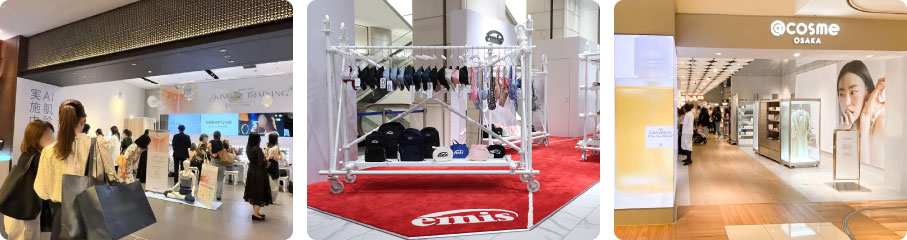
BEEATS has been involved in the spatial creation of pop-up stores in various locations, including: ・Sections within commercial facilities ・Event spaces in department stores ・In-station locations ・Street-level spaces ・Entire building usage for rental spaces and more.
What has become clear from that experience is the point that whether or not you can adjust the spatial expression to match the characteristics of the location greatly influences the attendee's experience value.
For example, ・For sales floors within circulation routes, how the entrance looks is important ・For high-traffic paths, visibility is important ・For independent spaces, flow design is important
In such a way, design points change depending on the location. These differences are hard to see on drawings alone, and there are many things that can only be understood after watching the movements of visitors at the actual site. Therefore, it is important to consider space design after understanding the characteristics of the location.
Then, what kind of venues are there for pop-up stores, and what are their characteristics?
Comparing the characteristics of the main locations for pop-up stores
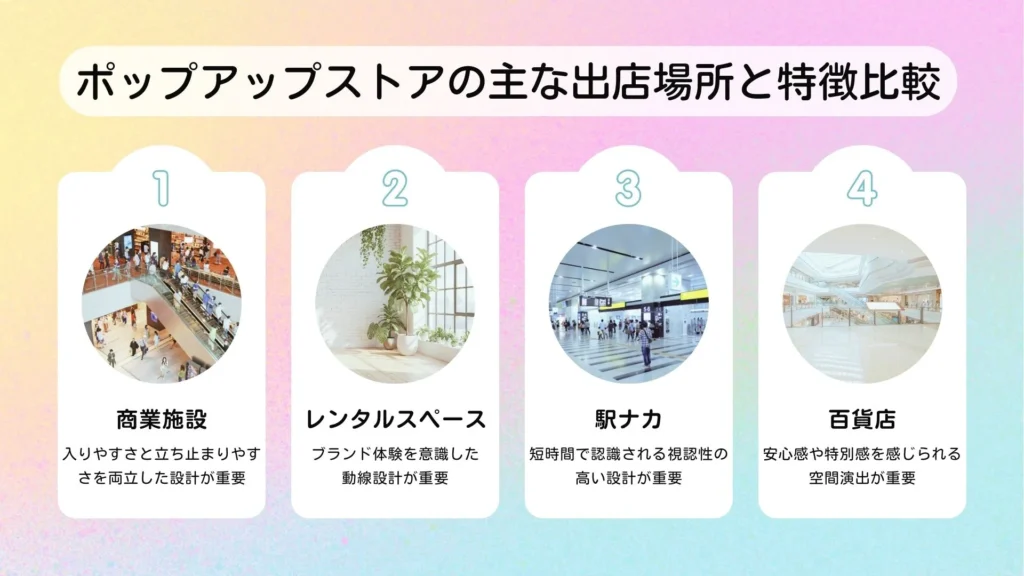
There are various types of pop-up store locations such as commercial facilities, department stores, train station areas, and rental spaces. Since the behavior and psychology of visitors change depending on the location, the thinking behind space design also changes. Each location has visitor behavioral characteristics, which also affect the space design of pop-up stores.
1.
Commercial facilities: A place where people compare products while walking around
For pop-up stores in commercial facilities, a sales floor design that balances "ease of entry" and "ease of stopping" is important.
At commercial facilities, visitors are often seen browsing multiple stores and comparing products. Beyond purpose-driven shopping, there are many visitors who walk around the sales floor looking for "something new." Therefore, not only effects that catch the eye from a distance, but also an easy-to-enter layout and spatial creation that makes people want to naturally stop are important. Small differences in design, such as the arrangement of products visible from the aisle, the ease of identifying the entrance, and the lighting, can sometimes influence visitor behavior.
2.
Rental space/Street-level space: Places where highly flexible spatial expression is possible
For rental spaces and street-level spaces, flow design that is conscious of the brand experience is a key point in pop-up store design.
Rental spaces and street-level spaces allow for relatively high-degree-of-freedom spatial creation. For entire building rentals, you can design the flow of the experience from the exterior to the interior, which makes it easier to create a space that is conscious of visitor movement. On the other hand, because you need to think about how to use the space from scratch, flow design—such as "where to make the entrance" and "where to place products"—becomes important. Being highly flexible, these are also places where the design intent is likely to be directly reflected in the customer experience.
3.
In-Station: A place to leave an impression in a short time
For pop-up stores in train station areas, display design with high visibility that is recognized in a short time is important.
In train station areas, many visitors pass in front of the store while on the move. Since the time available to get them to stop is limited, production that catches the eye instantaneously and display design that narrows down information are important. Space creation that conveys intuitively, such as colors and shapes that can be recognized from a distance and simple copy design, is required.
4.
Department store: A place that feels reliable and special
For pop-up stores in department stores, space production that makes visitors feel a sense of security and specialness is important.
At department stores, many visitors enjoy shopping in a relaxed manner and there is a high demand for gifts. It is not uncommon for visitors to stop on the sales floor, pick up products, and browse while talking with staff. Creating a space that conveys a sense of security and a special feeling, such as through material selection and lighting design that matches the atmosphere of the facility, is important.
3 points to consider after the store location is decided
For pop-up stores, spatial design after the location is decided is also important.
1. Imagine the movement of visitors Traffic volume and walking speed vary depending on the location. Imagining how visitors approach the sales floor and where they cast their gaze is the starting point of spatial design.
2. Check the scope of decoration The scope of decoration and conditions for installing fixtures vary depending on the facility or venue. Grasping the extent to which you can create a spatial effect will lead to a realistic and highly reproducible design.
3. Design including operation A pop-up store is a project that includes setup, operation, and removal. By considering work flow lines and setup efficiency, stable operation is possible while suppressing the burden on the site.
The value of a pop-up experience created because it is a physical location
Even now that online purchasing has become widespread, there is unique value in the experience of seeing and choosing the real thing, and the atmosphere that can only be obtained in that place. Actually, at the site of pop-up stores, voices of visitors who saw brand products they had seen on SNS "in person for the first time" are often heard. By picking up products or talking to staff, experiences that cannot be obtained online are born. A pop-up store is also a place that creates an opportunity for brands and visitors to meet directly.
While the perspective of how you will have them experience the brand is important, understanding the characteristics of the location where you are opening and designing the space accordingly also leads to a pleasant experience for visitors.
▼Read also
Click here for an article explaining the increasing "Experience-based Pop-ups"!
Summary of points for choosing a pop-up store location
When choosing a location for a pop-up store, it is important to be conscious of the following 3 points.
・Consider the compatibility between the target and the location ・Understand the flow of visitors (browsing/passing through) ・Design including spatial design and operations
Also, choosing the location for a pop-up store is not just a process of deciding where to open, but a process of deciding the prerequisites for space design. By understanding the characteristics of the location and performing production and fixture design tailored to it, the quality of the brand experience changes significantly.
At BEEATS, we have accumulated knowledge of design and operation tailored to the location through creating pop-up store spaces in various locations. When considering a pop-up store, why not think about space design from the perspective of "how to show it in that place" at the same time as "where to hold it"? By understanding the characteristics of the location and designing the experience to match it, the impression of a pop-up store will change significantly even for the same brand. Please use this as a hint when considering venue selection and space design for a pop-up store.
▼Also pay attention to opening stores in Korea! In addition to domestic pop-up expansion, the number of Japanese brands considering opening stores in Korea has been increasing in recent years. BEEATS provides one-stop support for pop-up store openings in Korea, from property acquisition, spatial design, and construction management to operations and promotion. Download the Korea pop-up store opening support case study for free
[Q&A] Answering frequently asked questions about pop-up stores!
Q. How should I choose a pop-up store location? A. It is important to choose based on three criteria: target segment, attraction characteristics of the location, and brand experience design.
Q. What kind of venues are suitable for pop-up stores? A. Commercial facilities, department stores, train station areas (ekinaka), street-level spaces, and rental spaces are common.
Q. Which is more important for a pop-up store: location or space design? A. Both are important, but optimizing space design according to the characteristics of the location enhances the experience value.
Q. Can you also make suggestions for a venue for BEEATS? A. Of course. We will search for the optimal venue for your brand, target, and promotional content, and will also handle reservations and arrangements on your behalf.
We also answer questions on our pop-up service page!