In recent years, in addition to exhibitions and seminars, the use of host-type business events, or conferences, has been spreading. Conferences held with diverse purposes, such as lead acquisition, brand promotion, and creating touchpoints with users, are becoming an important option in corporate marketing and business promotion.
While the hurdles for hosting and participating have lowered due to the spread of online events, the "value unique to in-person events" for offline events is being re-evaluated. There are many voices emphasizing face-to-face interaction, such as chance encounters at the venue, and moves toward returning to in-person events are seen in conferences as well.
However, there are likely many in charge who have worries such as, "I'm interested, but I don't know the preparations until holding it" or "How much should I prepare for operation on the day..." In this article, we focus on offline hosting and explain clearly from the basic role of a conference to the steps to make it a success and points for creating the venue.
What is a conference? Differences between seminars and exhibitions
"Conference" originally means "meeting" or "council," but in a business scene, it refers to an event format where the organizer conducts information provision, discussion, and networking for a specific theme or industry.
How are they different?
Seminar
One-way lecture-type event. A format where the lecturer conveys information to participants, with learning and information gathering as the main purposes. It is often held for small groups and for a short time, and interaction and exhibitions are basically not conducted.
How are they different?
exhibition
A place where multiple companies exhibit and directly appeal their products and services. The purpose is business encounters, such as business negotiations and business card exchanges, by stimulating interest through physical displays and demos.
How are they different?
Conference
A composite event held by an organizer with a set theme. In addition to lectures, it combines sessions, exhibitions, experience content, and social gatherings to promote co-creation and deep understanding with participants.
What are the main objectives of a business conference?
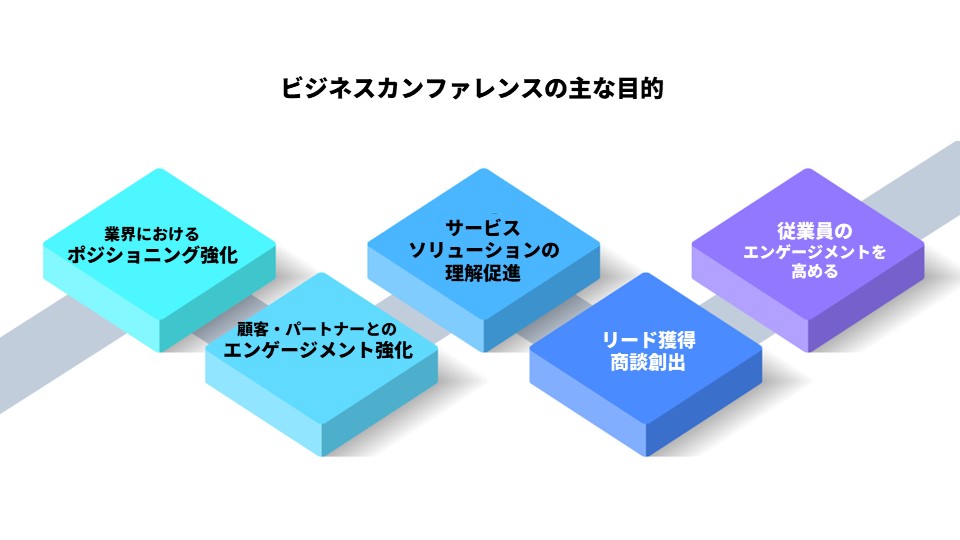
The reason companies hold conferences goes beyond mere events or public relations activities. Many companies are paying attention to it as a means to realize marketing, sales, and branding strategies in a composite way. The following are representative objectives and their overviews.
Objective ①
Strengthening positioning in the industry
Build a strategic positioning to be recognized as "the company when it comes to this field." By disseminating industry trends and sharing the latest examples, you can build a brand image that is advanced and reliable.
Objective ②
Strengthening engagement with customers/partners
It becomes an opportunity for relationship building and loyalty improvement with existing customers and related companies. You can deepen the quality of your connections through in-person interaction and exclusive sessions.
Objective ③
Promoting understanding of services and solutions
It is the perfect place to convey new products and complex services systematically and experientially. It is possible to turn value that cannot be fully conveyed through website or catalog explanations into "understanding and conviction" through sessions and exhibitions.
Objective ④
Lead acquisition and business negotiation creation
By utilizing participant registration, surveys, and experience booths, you can design everything from prospective customer data collection to turning them into business leads.
Objective ⑤
Increase employee engagement
The experience of making a conference successful becomes a "place to experience the company's strength" for employees. By being involved in the preparation and operation on the day, teamwork and a sense of responsibility are nurtured, and it also becomes an opportunity for growth through cooperation with other departments and taking on challenges.
In conferences, there are cases where business negotiations proceed on the spot, and they are attracting attention as measures with high marketing ROI. In other words, a conference is not just a "place for information provision," but a "strategic communication means" directly linked to the core of corporate activities.
Progress steps from planning to the day of the event
Even if a conference is a one-day event, its success depends on preparations made months in advance. Here, we will introduce the common schedule and the steps that host companies should keep in mind.
2.5 months before - Session planning, speaker negotiation, budget adjustment, determination of composition proposal
2 months before - Venue layout, construction planning, start of creative direction
1 month before - Attraction measures (email distribution, SNS announcements), script and schedule creation
2 weeks before - Rehearsal, pre-recording, venue confirmation, final adjustments
Day before - Day of event Move-in, setup, actual operation, move-out
Points for each phase
① Planning and design: First, clarify "who" you want to reach and "what" you want to convey If the theme and message are vague, the speakers and the target audience will also lack focus.
② Venue design and production: The space has the "power to convey" Experience value changes depending on "venue design," not just the strength of the content. It is necessary to be conscious of stages, screens, lighting, signage, flow lines, and rest areas.
③ Attraction and guidance: Every piece of communication decides the brand impression Think of the invitation, website, registration form, and reception flow as a set. Preparation and design for VIP response are also important.
④ Operation on the day: 80% is preparation, the rest is "on-site capability" An "operational system" strong enough for unexpected situations, such as reception, session transitions, and preparation for equipment trouble, is important.
The keys to conference success are "space design" and "operational capability"
What many companies overlook is the "importance of space creation." It is easy to pay attention to the content (speakers, session composition) of a conference, but the "venue itself" often determines the actual experience of visitors. Successful conference venues have things in common.
● Smooth reception and venue flow design ● Zoning conscious of sessions and communication ● Comfortable space production that makes visitors "want to stay" ● Creative design and signage that conveys the brand concept
By being supported by such professionals in space design and operation, the value of the content is maximized.
There are also hurdles to holding a conference...
While it is an effective marketing tool, there are also hurdles to holding a conference.
● Difficult to link directly to sales Unlike seminars and exhibitions, there is an aspect that is difficult to lead to immediate business negotiations or contracts. It is difficult to quantify the effect, and there are many cases where it is questioned within the company, "Is it worth doing?"
● High costs It is a fact that costs can swell more than expected, such as venue fees, construction fees, distribution fees, and speaker coordination. Especially for a first-time event, many voices say it is difficult to understand "where you should spend money" and "where you can cut back."
● Lack of internal resources Voices are often heard that the burden is too large to handle along with regular duties from planning, production, and attracting customers to operation on the day. Also, there are no past materials or knowledge remaining, and situations where you start considering from scratch every time are often seen.
As described above, while conferences can be highly effective, the reality is that there are many walls to overcome to make them a success. If you try to complete planning and operation solely in-house, you will often face challenges such as unexpected trouble, arrangement errors, and concentrated operational burden. To reduce such burdens and risks and reliably lead to results in line with your objectives, the presence of an experienced partner is indispensable.
BEEATS supports conference operation and construction
BEEATS has handled the space design and operation of numerous exhibitions and private shows to date. We support everything from composition design at the planning stage to the arrangement of reception and guidance staff on the day, providing one-stop service. Leveraging the operational know-how we have polished through various promotions, exhibitions, and private shows, you can leave it to us with peace of mind, even for your first conference hosting.
Exhibition team's "strong on-site capability" for conferences
Our exhibition team can also flexibly handle the following "on-site issues": ● Maximum utilization of limited venue space ● Response to tight planning - construction schedules ● Optimization of visitor flow and signage planning ● Total direction from panels, handouts, and stage production to souvenirs Because professionals in exhibitions handle it, you can achieve higher-level quality even at a conference.
For those who say, "I want to try holding a conference, but I don't know where to start..." please feel free to consult with us.
A1. A business conference is a composite event held by an organizer with the purpose of providing information, discussion, and networking for a specific theme or industry. Unlike one-way seminars or exhibitions centered on product appeals, it is characterized by promoting deep understanding and co-creation with participants by combining lectures, sessions, exhibitions, and social gatherings.
Q2. What are the main objectives of a company holding a conference?
A2. The main objectives of holding a conference are the strategic realization of marketing and branding. Specifically, these include strengthening positioning in the industry, strengthening engagement with customers and partners, promoting understanding of services, acquisition of prospective customers (leads), and furthermore, improving employee engagement.
Q3. What are the key points to make a conference successful?
A3. The keys to conference success are "space design" that enhances participant experience value and "operational capability" that can flexibly respond to trouble. Thoroughly implementing smooth reception and flow design, zoning conscious of sessions and interaction, and comfortable space production, it is important to prepare a robust operational system that can correspond to unexpected situations on the day.
Q4. What are the common challenges in holding a conference?
A4. The main challenges in holding a conference are that it is difficult to link to immediate business negotiations, the effect is difficult to quantify, costs such as venue fees and construction fees swell more than expected, and there is a shortage of internal resources. Since the burden of performing from planning to attracting customers and managing the day of the event alongside regular duties is high, support from an experienced partner is effective.