The word "Two Seasons" was selected for the top 10 "New Word and Buzzword Awards" of 2025. Seeing that news, many people might have sympathized, "Indeed, recently there's no time to feel autumn, and it's been hot the whole time."
「Spring and autumn have become shorter, and the sense of season has changed a little.」 The expression "Two Seasons" has come to be used to describe such changes. The "Two Seasons" is seen in the news as a term to describe climate change affected by global warming, but this change also seems to be gradually affecting the fields of sales promotion and experience design in retail and distribution.
「It's cold even though it's the season for cherry blossom viewing」 「It's still hot with short sleeves even though it's Halloween season」 Amidst increasing discomforts like these, the conventional idea of sales promotion based on "season-first" or "seasonal events (saiji)" may be starting to shift little by little.
In this article, based on the environmental change of "Two Seasons," I will organize what is happening now in the field of sales promotion and experience design, and what perspectives will be hints for the solution, based on concrete episodes.
What are the "Two Seasons"? | Changes brought about by climate change
The "Two Seasons" is a term referring to a climate state where spring and autumn in Japan have become extremely short due to the effects of global warming, and only two seasons, summer and winter, continue for a long time. Japan has been called a "country of four seasons" where spring, summer, autumn, and winter each have different expressions. However, in recent years, due to rising sea surface temperatures and the stagnation of high-pressure systems, the trend for summer to start early and last longer is strengthening. As a result, feeling that "before I knew it, summer hadn't ended, and suddenly it got cold and entered winter" is becoming a normal occurrence.
In fact, in 2025, the final intense heat day was October 12, breaking the latest record in domestic history. Even if it is autumn on the calendar, days close to midsummer continue as a sensory experience. This "gap between the calendar and sensory experience" is no longer a temporary abnormal weather, but it can be said that it is becoming a "new normal" that should be premised.
The influence of "Two Seasons" | The reason why sales promotions based on the four seasons don't mesh
So, how is the shift to two seasons affecting the field of sales promotion? Let's think about the issues from concrete scenes.
◆◆◆
Even though I'm promoting "moisturizing care," I'm still sweating
Let's think about the case of drugstores and cosmetics sales floors. In September, in line with the manufacturer's release calendar, new autumn/winter products claiming "moisturizing cream" or "dryness measures" will appear on the sales floor. However, when you go outside, the temperature is still a summer day. The skin concerns that customers feel are centered on sweat, sebum, and ultraviolet rays rather than "dryness."
・「The thick cream is still heavy」 ・「Rather than that, I want cooling sheets or sunscreen」 While such voices are heard, the "seasonal care" proposed by the sales floor does not mesh with the physical discomfort that the consumer is really feeling. As a result, although exposure to new products is increasing, the initial reaction to sales is stagnant. The influence of the shift to two seasons is also becoming easy to manifest as this kind of "discomfort on the sales floor."
◇◇◇
I don't buy because "I don't know what clothes to wear now"
Next, let’s think about it in terms of apparel and general merchandise retail floors. It is momentarily cool in the mornings and evenings, but hot like midsummer during the day. The sales floor has completely switched to autumn and winter items, but customers' heads are full of question marks. ・"When should I wear this?" ・"It seems too hot to use yet." ・"Will next week be hot? Cold? When should I actually wear it?"
Even if the product is attractive, there are cases where purchases are passed up because it's difficult to judge "when to wear it" or "when to use it," leading people to think, "I'll skip it today."
◆◆◆
Hesitating to participate in outdoor events
Let's imagine outdoor events this time. Until now, there was a common understanding that "spring and autumn are the right season for excursions to spend time outside." However, recently, even if I think, "shall I go?", harsh weather tends to become a hurdle.
Spring has intense temperature differences and many windy days. Autumn, even if it is autumn on the calendar, has harsh direct sunlight and risks of heatstroke.
・「I couldn't stay long because it was hotter than I thought」 ・「I was worried about the cold, so I cut it short」
Because these experiences are repeated, a psychological brake that is concerned about "climate risk" is more likely to be applied to participation in outdoor experiences.
What is happening due to the shift to two seasons is customer "hesitation" and "postponement"
Aren't the episodes seen so far scenes that are often heard and seen recently rather than special cases?
・It should be autumn, but it's still hot. ・The shop floor is set for autumn, but my physical experience hasn't caught up. ・I have a desire to buy, but I can't decide because I don't know if I "should buy it now."
What is happening due to the shift to two seasons might not be that something has become extremely bad, but rather a small sense of discomfort with "traditional proposals" and the "postponement of decisions" that comes with it.
Elements that were naturally linked until now, such as seasons, events, sensory experience, and mood, are no longer meshing, and it has become difficult to understand "what is the correct answer to act now." As a result, it leads to standing still just before actions such as buying, going, or participating.
Such "hesitation" and "postponement" are connected not only to issues of mood and psychology, but actually to more concrete factors such as temperature and weather.
A perspective of "Weather MD" thinking from the relationship between temperature and sales
Let's change our perspective here and look at the relationship between weather data and consumption. In the distribution industry, there is a method called "Weather Merchandising (Weather MD)" that analyzes the correlation between temperature changes and products that sell. Generally, the temperature guidelines for switching on a consumer's desire to buy are said to be as follows:
◆ 25°C or higher: Ice cream, beer, and soft drinks begin to sell ◆ 20°C–22°C: Long-sleeved shirts and cardigans start to move, and sales of short sleeves drop ◆ 15°C or lower: Demand for hot-pot ingredients surges, and hot drinks are preferred
What is troublesome in the era of the shift to two seasons is that the "wild fluctuations" where the seasons go back and forth across these "20°C" and "25°C" boundary lines occur frequently. Even though it's October, it exceeds 25°C and becomes a "summer day," and the following week it drops to near 15°C. Under such an environment, isn't it inevitable that calendar-based sales promotions like "uniform autumn items because it's October" will deviate from the consumer's sense (= purchasing switch)? For future sales promotions, judgment that uses "weekly weather forecasts" as an ally, in addition to year-on-year comparisons and calendars, may be required more than ever.
Of course, it is not a story that everything will go well if you match the temperature. Even if the shift to two seasons progresses, there are things that continue to move people's feelings. That is the "seasonal event (saiji)" mentioned next.
Even if the shift to two seasons progresses, "seasonal events (saiji)" are still important motives
Although the gap in the sense of season is increasing due to the shift to two seasons, it does not mean that "seasonal events (saiji)" such as cherry blossom viewing, Halloween, Christmas, New Year's, and the new life season have stopped functioning.
Even if there is a gap with sensory experience, the power that seasonal events hold as reasons for consumption, such as "because it's this time of year" or "because it's this milestone," is still powerful. In fact, as the shift to two seasons progresses and it becomes harder to feel the passage of the seasons, these events may even be more likely to be consciously recognized as "milestones to check the season."
However, it is likely becoming an era where the same reaction cannot be obtained with the same way (fixed schedule and expressions) as before.
Future sales promotions based on two seasons: 3 hints
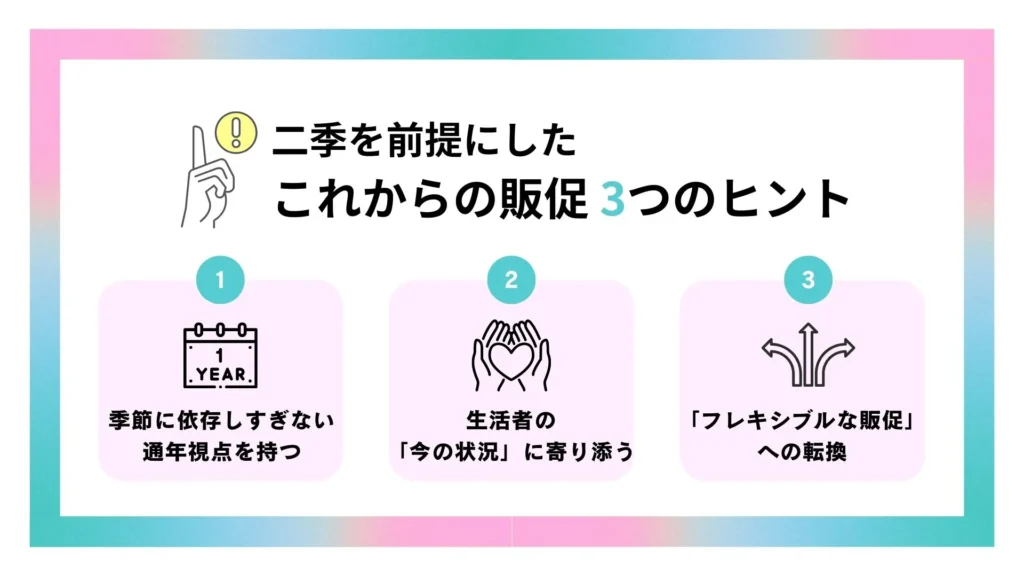
So, how should sales promotions and experience design be updated in the era of two seasons? Here are 3 hints.
Hint 1.
Have an all-year-round perspective that is not overly dependent on seasons
Rather than premising that the sales floor will be completely changed by "spring, summer, autumn, and winter," incorporate themes and designs that are less likely to be influenced by the climate in advance. "Established whenever you come," "discoveries whenever you come." Having such an all-year-round perspective (timeless value proposition) should be a risk hedge against a sales environment that is easily swayed by the shift to two seasons.
Hint 2.
Be close to the "current situation" rather than "because it's the season"
Hot, cold. I don't want to go out. I have no room to make decisions. Amidst the shift to two seasons, these "current conditions" of consumers are affecting their behavior more than ever. In sales promotions, approaches and expressions from the consumer's perspective, such as "just right for the current temperature" or "relieving your current discomfort," rather than the company's convenience of "because it's autumn," may be more sought after.
Hint 3.
Shifting to "flexible sales promotion"
The launch timing of new products and the campaign period themselves cannot be easily moved due to supply chain circumstances. On the other hand, the "heat and cold" felt by consumers changes greatly depending on the year and the day.
To bridge this gap, one realistic option is to allow room for creative adjustments according to the situation at that time, rather than continuing to fix and output determined expressions.
「Because it's a hot day today, appeal to coolness」 「Because the cold has returned this week, bring warmth/heat retention to the fore」 「When the temperature is hard to read, suggest items that are 'layered/easy to adjust'」
When considering such "flexible sales promotion," there is also the idea of utilizing mechanisms like cloud-based digital signage that can flexibly switch information. Instead of making fixed appeals with printed materials such as posters, change how you communicate according to the situation of that time and place. I feel that the importance of such "variable design" is increasing for sales promotions in the era of the two seasons.
---
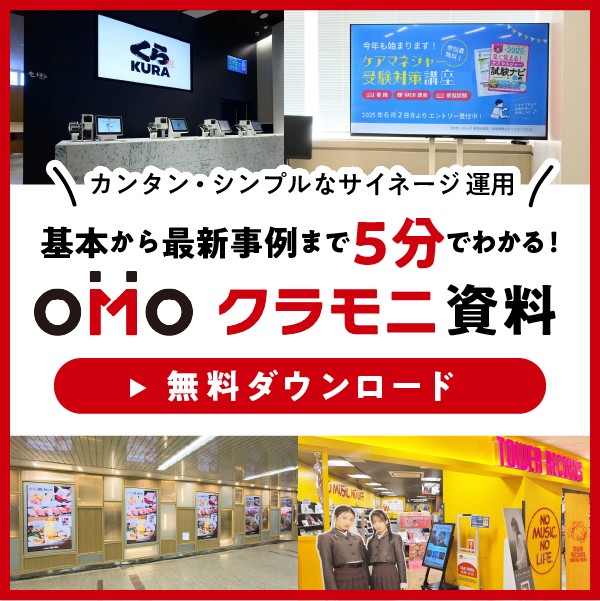
▼ Cloud-based digital signage "Clomoni" that can flexibly send sales promotion information to the shop floor
Summary | Promotion in the two-season era where flexibility is the key
Due to the shift to two seasons, it is thought that the gap between seasons and sensory experience will continue to expand in the future. As it becomes harder to read customer behavior and decisions, "correction power" may be becoming more important as one of the elements that determine the results of promotion.
Can you fine-tune your message to match the weather and consumer's physical experience in front of you, rather than just proceeding according to plan? In the era of the two seasons, how much you can be close to the customer's "now" seems to be a hint for becoming a chosen product or brand.
What BEEATS can do in the era of the two seasons
Conventional fixed sales promotion methods are becoming difficult to deal with the "gap between seasons and sensory experience" caused by the shift to two seasons. We at BEEATS support sales promotion design that is close to the consumer's situation and mindset through the planning and production of promotion design, pop-ups, DM, and various sales promotion tools. We also support the introduction and operation of cloud-based digital signage "Clomoni", which allows you to switch distribution content as needed in response to unpredictable climate change.
Do not be bound by fixed expressions, but deliver the "optimal communication method that matches the current situation."
I hope this will be helpful as a way of thinking about sales promotion in the era of the two seasons.
Q. What are the "Two Seasons"? A. The "Two Seasons" is a term referring to a climate state where spring and autumn in Japan have become extremely short due to the effects of global warming, and only two seasons, summer and winter, continue for a long time. It was selected as one of the top 10 "New Word and Buzzword Awards" in 2025. This is against the backdrop of the trend for summer to start early and last longer due to rising sea surface temperatures and the stagnation of high-pressure systems, making the "gap between the calendar and sensory experience" a normal occurrence.
Q. How is the shift to "Two Seasons" affecting sales promotion? A. The impact is that "season-first" sales promotions based on the four seasons are no longer meshing with consumers' physical experiences. For example, even if autumn/winter moisturizing products are lined up in September, visitors are still sweating, and in apparel, there are cases where purchases are passed up because "I don't know what clothes to wear now." Outdoor events are also becoming more hesitant to participate due to concerns about climate risk. A feature is that customer "hesitation" and "postponement of purchase" are becoming more likely to occur due to the shift to two seasons.
Q. What is "Weather MD (Weather Merchandising)"? A. Weather Merchandising (Weather MD) is a distribution industry method of analyzing the correlation between temperature changes and products that sell. Generally, it is said that soft drinks, etc., begin to sell at 25°C or higher, sales of short sleeves drop and cardigans move at 20–22°C, and demand for hot-pot ingredients and hot drinks increases at 15°C or lower. Since wild fluctuations in temperature occur frequently in the two-season era, the importance of incorporating not only calendar-based sales promotions but also weekly weather forecasts into decision-making materials is increasing.
Q. Even if the shift to "Two Seasons" progresses, are seasonal events (saiji) still effective for sales promotion? A. They are effective. "Saiji" such as cherry blossom viewing, Halloween, Christmas, and the new life season still have strong power as reasons to consume. In fact, precisely because it has become harder to feel the passage of the seasons, these events may be more likely to be consciously recognized as "milestones to check the season." However, it is necessary to be careful that it is no longer an era where the same reaction can be obtained with the same schedule and expressions as before.
Q. How should sales promotions be updated in the era of the "Two Seasons"? A. There are mainly three hints. Have an all-year-round perspective (timeless value proposition) that is not overly dependent on seasons, be close to the customer's "current situation/condition" rather than "because it's the season," and shift to "flexible sales promotion" where appeals can be switched according to the situation. Utilizing a variable mechanism that allows you to change how you communicate according to the temperature and weather of the moment, such as cloud-based digital signage, is also one option.