Retail media is a marketing method that has been attracting attention in recent years. It is spreading, especially as a means for companies with e-commerce sites or physical stores to expand revenue while strengthening cooperation with advertisers. In this article, we have prepared the basic concept of retail media, specific examples, and introductions to new tools. Please read until the end.
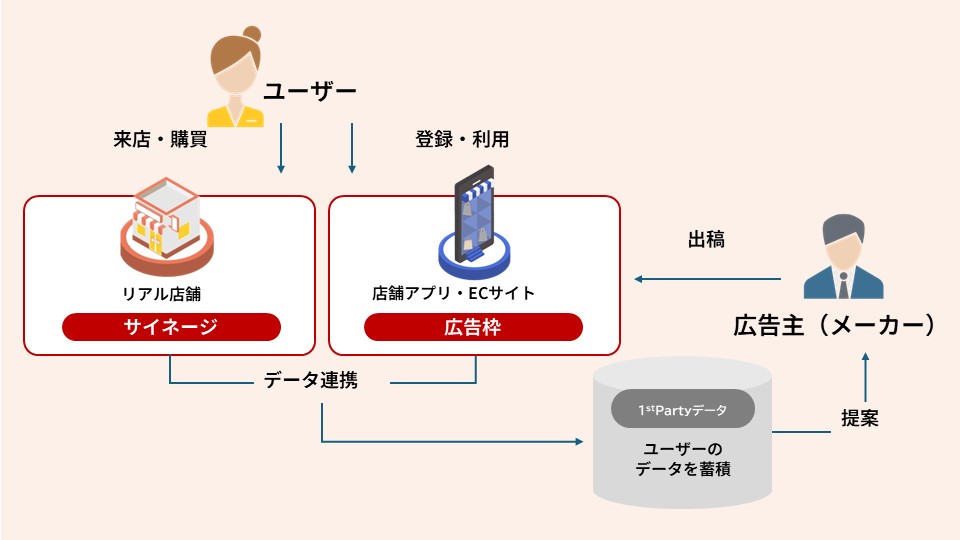
Retail media refers to a mechanism where retailers provide advertising by utilizing their own digital channels (e-commerce sites, apps, e-mail newsletters, etc.) or offline channels (in-store displays, digital signage, etc.). Retailers can use their customer data to conduct targeted advertising and earn advertising revenue from manufacturers and brands.
Benefits of retail media
Benefit 1
Targeting accuracy
Retailers can utilize customer purchase data and behavioral data to increase the precision of ad targeting.
Benefit 2
Promotion of sales
A key feature is that advertisements can directly lead to purchasing behavior. Advertising on e-commerce sites makes guidance to product pages smooth, and digital signage in stores allows for strong promotion at the point of purchase.
Benefit 3
New source of revenue
Since advertising revenue serves as a direct source of income, it is an attractive business model for retailers.
Benefit 4
Improvement of customer experience
You can improve the quality of the customer experience by displaying advertisements with high relevance to customers.
Retail media in offline channels
Retail media utilizing offline channels is also gaining attention. Major examples are listed below.
In-store displays and digital signage
It is common to use in-store displays and digital signage to promote manufacturer products. This enables real-time product promotion to visiting customers.
Ads around the checkout
The area near the checkout is an important point just before the customer purchases a product. By announcing specific products, sales, or campaigns here, it has the effect of promoting additional purchases.
Ads installed on product shelves
There is a method of installing small digital displays on product shelves to show advertisements for related products. This method is effective for supporting purchase decisions at the last minute.
Print media advertising
Flyers and coupons distributed within stores are also one type of offline retail media. They are especially effective as a means of conveying special sale information and limited-time campaigns.
Concrete case studies of retail media
Case Study 1
FamilyMart in-store signage
Installed in a total of 10,000 stores across all 47 prefectures in Japan (as of 2024), in-store signage has grown into a medium capable of reaching approximately 64 million people per week. Leveraging this characteristic, it provides advertisers with effective promotions tailored to their target audience. The signage is mainly installed near checkout counters, creating an environment where it is easy for visiting customers to view while waiting to pay.
In addition, broadcast content is optimized according to the time of day and area, disseminating diverse content such as new products, campaign information, and brand advertisements. In particular, because it allows for promotion at the timing just before purchase, it also plays a role in stimulating purchasing motivation and encouraging circulation within the store.
Case Study 2
Don Quijote/UNY data x shelf integration
The in-store "shelf" is viewed as a single medium, developing information dissemination directly linked to purchasing behavior. We maximize visual appeal by utilizing in-store digital signage, price cards, and the product shelf itself. In addition, we conduct promotions that fuse physical and digital by linking with official apps and UGC (User Generated Content) on social media. For example, by strengthening mechanisms such as coupon distribution through apps and store floor development linked with social media buzz, we are connecting visiting customers' interests and concerns to purchasing behavior in real-time.
Furthermore, individual optimization utilizing regional characteristics by store is progressing, enabling marketing measures according to location and customer segments. As a result, it continues to evolve as retail media that creates higher engagement and sales promotion effects.
Case Study 3
Ito-Yokado free papers
In order to differentiate from other companies, we are focusing on "media creation" and utilizing free papers as part of our retail media. Rather than just flyers, we incorporate editorial content that captures the reader's interest, contributing to improved repeat rates and LTV (Life Time Value).
Free papers distributed in-store are characterized by practical and friendly content such as recipe suggestions, lifestyle information, and health or seasonal features. They play a role not only in stimulating the desire to purchase but also in fostering brand advocacy.
Furthermore, we are advancing collaboration with the digital version to strengthen access from apps and websites. By utilizing QR codes for product introductions and linking with e-commerce sites, we are developing information dissemination that fuses offline and online.
Key points for implementing retail media
To make retail media a success, the following points are important.
Data utilization
A mechanism is needed to effectively collect customer data and reflect it in ad targeting.
Selection of appropriate advertising formats
It is important to choose an advertising format suitable for your own channel. For example, banner ads are effective on e-commerce sites, and digital signage is effective in stores.
Without impairing customer experience
Excessive ad display degrades the customer experience, so a balance is required.
Measurement of advertising effectiveness
It is important to accurately measure the results of advertising and make improvements based on data.
Challenges of retail media
However, there are many challenges in retail media.
Difficulty in data integration and utilization Offline (physical store) and online (e-commerce) data integration is often insufficient, making appropriate targeting difficult.
Lack of content There is a lack of content to capture user interest, often leaving advertisements as nothing more than promotions.
Balance with user experience Excessive display of advertisements may impair customer purchasing motivation.
Optimization of advertising formats Advertisers cannot prepare appropriate creative materials, or the formats are inconsistent, making it difficult to achieve results.
Building relationships with advertisers There is a risk of distrust, such as the concern that "if we don't buy ad space, our products won't be prioritized."
Solutions through the utilization of UGC content
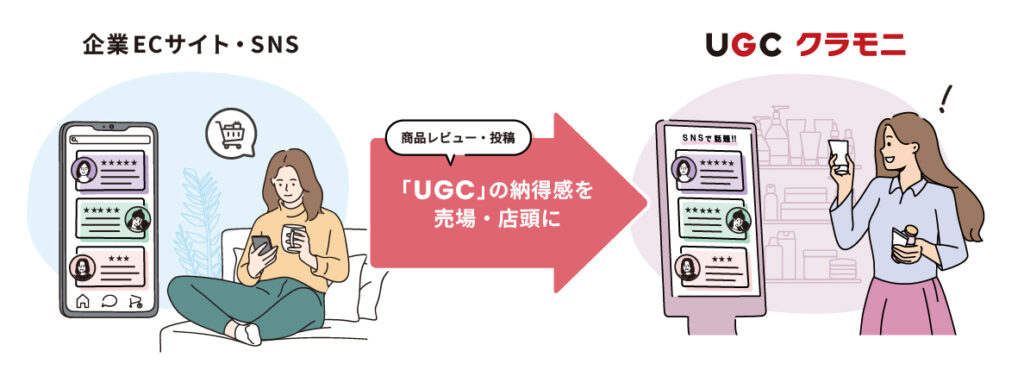
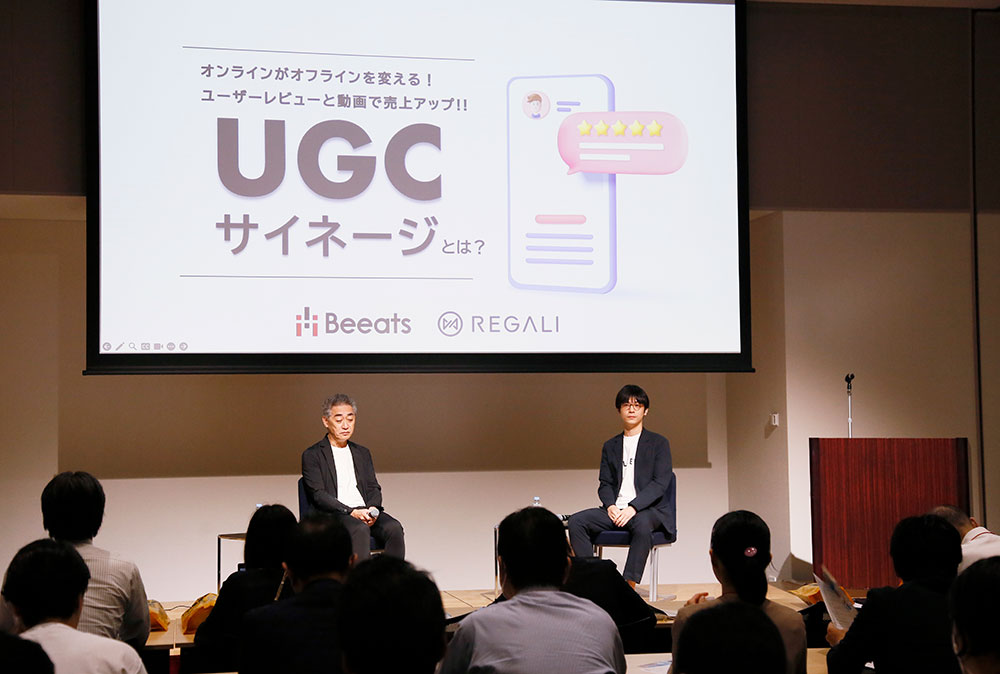
To solve these issues, retail media strategies utilizing UGC (User Generated Content) are attracting attention. Therefore, we would like to introduce our "UGC Clomoni." "UGC Clomoni" is a signage solution that utilizes UGC content (reviews + videos) that contributes most to sales on e-commerce sites and can also be appealed offline (in-store).
Features of "Clomoni"
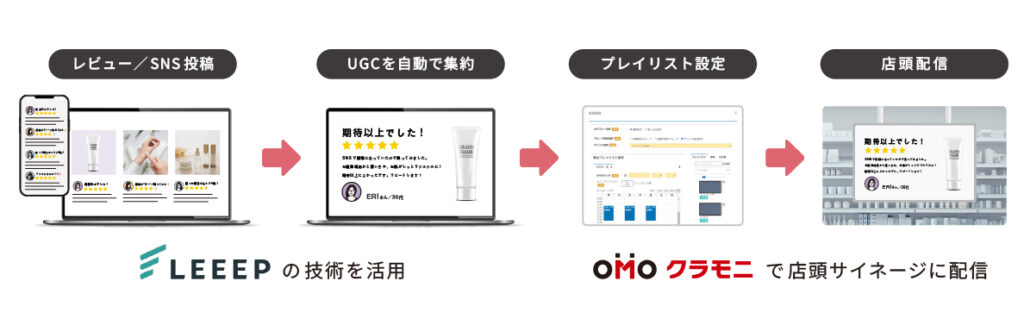
Utilizing the technology of "LEEEP," it automatically aggregates product reviews and other content posted on corporate e-commerce sites and social media. In addition to users, SNS posts and videos by sales staff, and promotional videos such as commercials can also be utilized. The display on signage is designed by leveraging BEEATS' in-store promotion and signage utilization technology and know-how. Content distribution and management can be easily performed by using the cloud signage "Clomoni."
Feature 1
Utilizing online UGC content in-store
By delivering product reviews and videos posted on e-commerce sites and social media to in-store signage, we encourage purchases in physical stores.
Automatically collects product reviews posted on corporate e-commerce sites or social media, sales staff social media posts, commercials, etc., and distributes them in the optimal format.
Feature 3
Easy management with "Clomoni" cloud signage
Content distribution and management can be centrally managed via the cloud, allowing for easy updates to in-store signage.
Retail media is a new source of revenue for retailers and an effective marketing method for advertisers. However, the shortage of appropriate content is a challenge. Therefore, by utilizing "Clomoni," it is possible to automatically collect and distribute content that gains user trust, leading to increased sales.
At Clomoni, we are proceeding with PoC (Proof of Concept), so we will introduce examples from time to time in the future. Also, if you are interested in conducting a PoC, please feel free to contact us.
A1. Retail media is a mechanism where retailers use channels such as their own e-commerce sites, apps, and in-store digital signage to provide advertisements. It is attracting attention as a business model where companies use their own customer data to perform highly accurate targeted advertising and earn advertising revenue from manufacturers and others.
Q2. What are the benefits of introducing retail media?
A2. There are mainly four benefits to introducing retail media. They are "improvement of targeting accuracy" utilizing customer purchase data, "promotion of sales" that easily leads directly from ads to purchases, "securing a new source of revenue" through advertising income, and "improvement of customer experience" by delivering information relevant to the customer.
Q3. What kind of offline retail media are there?
A3. Offline retail media includes in-store digital signage and displays, advertising near checkouts, small displays installed on product shelves, and paper media such as free papers distributed in stores. These are extremely effective in supporting customer decision-making immediately before purchase.
Q4. What kind of service is "Clomoni" in retail media?
A4. "Clomoni" is a solution that automatically aggregates and displays UGC (User Generated Content) such as product reviews and videos posted on e-commerce sites and social media on digital signage in physical stores. It solves the retail media challenge of insufficient content and supports in-store purchasing with highly reliable information.