In recent years, DM measures have once again garnered attention. In particular, targeting DM and approaches utilizing member databases are effective means to increase response rates and LTV. This article explains the concept of DM measures that make maximum use of member data, with "segment design" and "personalization" as the pillars.
The Current State of Direct Mail Campaigns and the Importance of Utilizing Member Data
1. Background to the Re-evaluation of Direct Mail Effects Amidst a mix of diverse channels such as SNS, email, and apps, due to digital fatigue and information overload, physical direct mail arriving in the mailbox is being re-evaluated as a "highly reliable reach channel" that can deliver information directly and calmly to customers. The high open rate and visibility of direct mail remain significant strengths compared to digital channels.
2. The superiority of DM leveraging a "membership base" Unlike general mass DM, using a member database allows for both a high open rate and highly precise targeting. Since personalized DM can be sent based on customer information such as names and purchase history, it deepens relationships with customers and directly leads to the maximization of LTV (Life Time Value).
3. Online x Offline Integration By utilizing online data such as EC site browsing history and app usage in offline direct mail campaigns, we provide a seamless customer experience, which is why direct mail is attracting attention again as a channel that leads to results.
Organizing Challenges: The Current Situation Where Member Data Is Not Fully Utilized
Challenge 1
Even if there is data, it is not being utilized in measures
Although a vast amount of member data (purchase history, attributes, behavioral history, etc.) is accumulated in many companies, cases where this is not sufficiently reflected in segment design or creative for DM measures are observed here and there. As a result, it may stop at "sending the same content to everyone at once," failing to demonstrate the true value of DM.
Task 2
Reaching unreached segments
For digital channels like email or LINE, there are customer segments that are difficult to reach or respond to because notifications are turned off or messages go to junk folders. DM is an effective reach means for these segments.
Task 3
The necessity of shifting to "DM that designs response rates"
Instead of being satisfied with the fact that "direct mail was sent," it is essential to shift to data-driven direct mail operation that plans the response rate of direct mail in advance and aims to achieve it for the purpose (new purchase, repeat, dormancy revival, etc.).
Measure design: Concepts for targeting DM that produce results
◆Basic Steps for Segment Design The key to a direct mail campaign that leads directly to results is segment design based on data.
1. Data Visualization and Analysis We analyze the member database to find axes for clearly classifying customers.
2. Narrowing down by conditions ・Behavioral data:Purchase history (purchase frequency, purchase amount), browsing history (interests) ・Status data:Member rank, dormancy period (last purchase date) ・Attribute data: Age, place of residence, etc.
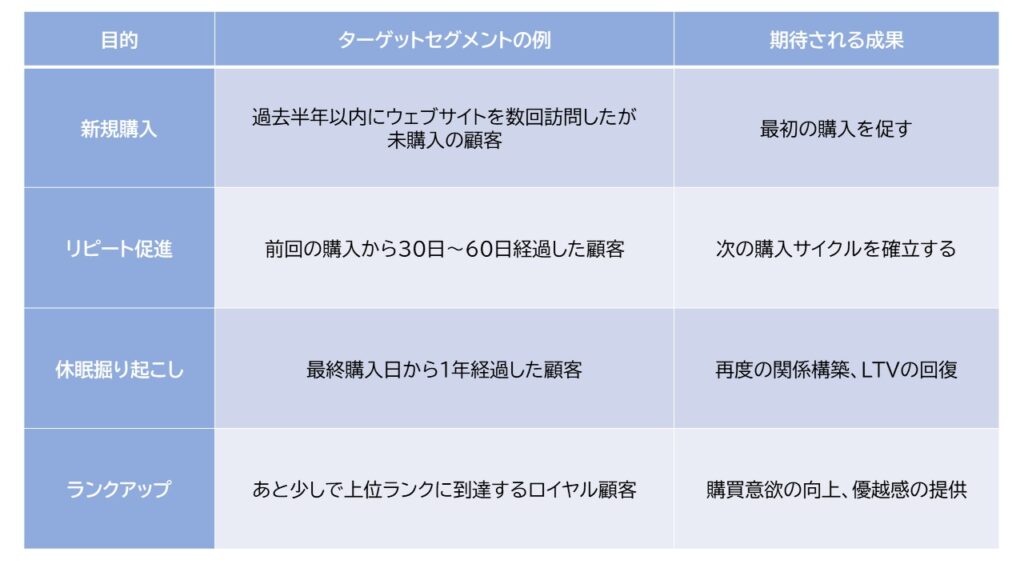
3. Creating segments by purpose Extract the optimal customer group based on the objective of the established measures.
◆The Importance of a "Purpose-Driven" Approach in Targeting Design The success of a direct mail campaign is determined by how clear you are about "who (segment)," "what (message)," and "what you want them to do (purpose)."
◆Examples of personalizing DM creative and messages Personalization is not just about printing the name; it is about providing information that the customer can perceive as "personal to them."
・Product recommendation: Propose highly relevant products or services based on past purchase history. ・Personal offer: List special discounts or benefits according to the customer's member rank. ・Sleepy customer return message: Touch on the past purchased product name or dormancy period, and list a message that appeals to emotions such as "Mr./Ms. XX, it has been a long time."
Member data utilization: Improving response rates with personalized DM
How to create personalization axes based on the member database To increase the response rate of direct mail, it is effective to design personalization by combining multiple pieces of information rather than single data. For example, there is a method of changing the appeal content using three axes: "Attribute" x "Purchase Motivation" x "Timing."
・Attribute: Woman in her 30s ・Purchase Motivation: Interested in skincare (browsing history) ・Timing: Change of seasons
Combine these three to send a new product sample DM specialized for "current skin fluctuations." Because you can deliver the "information that person wants right now" in this way, it directly leads to improved DM opening and response rates.
◆Effects of Offline DM + Digital Integration By combining the reliable reach that is the strength of direct mail with easy digital guidance, response rates improve dramatically.
QR Code/PURL (Personalized URL) Guidance
Lead customers to a dedicated landing page or member site from a QR code or PURL included in the DM. This not only allows you to easily measure the reaction to the DM digitally but also provides a personalized experience that has continuity with the DM even on digital platforms.
LINE Guidance
It can also be used to acquire followers for digital channels, such as by announcing specific campaign information or limited coupons via direct mail and encouraging users to add a LINE friend to receive them.
Outcome verification: How to increase DM response rate and LTV
◆How to visualize DM response rates Because DM is a costly measure, thorough outcome verification is important.
・Measurement method design: Introduce a mechanism that can identify the response starting from the DM, such as PURL, QR code exclusively for DM, DM-limited coupon code, or phone number included in the DM.
・Definition of response rate: Visualize the DM response rate as the percentage of people who performed the target action (purchase, store visit, request for information, etc.) out of the total number of DMs sent.
◆Points for Measuring LTV/ROI from Direct Mail In order to see the profit that direct mail campaigns ultimately bring to the company, we measure LTV and ROI (Return on Investment).
・LTV Measurement: We compare and analyze the LTV of the customer group that responded to the direct mail and the non-contact customer group that was not sent direct mail to clarify how much the direct mail contributed to LTV improvement.
・ROI Measurement: We calculate the "profit generated from direct mail" against the "production and shipping costs of direct mail" to understand the cost-effectiveness.
◆Building a "Test x Data Update" Cycle to Continuously Increase Results It is not enough to send it once; constant improvement is the key to maximizing results.
・A/B Testing: We subdivide segments and repeat A/B testing of direct mail by changing messages, offers, creatives, etc.
・Data Update and Reflection: We feedback test results to the member database and continuously review segment design based on the latest response rate data.
・Improvement Cycle: We build a cycle of "campaign design → execution → result verification → data update" to continuously improve the quality of direct mail.
Summary: Improving the quality of measures with member data-driven DM
"Member data x DM" measures are a cost-effective sales promotion means that leads directly to the revitalization of existing customers—who are difficult to reach via digital channels—and the maximization of LTV (Life Time Value).
The key to success lies not in the volume of mail sent, but in "design capability," with segment design and message personalization being particularly important.
DM in the future will likely go beyond mere paper promotional materials and, as a "promotional channel that evolves through data utilization," become a core presence in a company's marketing activities.
Consult BEEATS for marketing-driven DM measures!
BEEATS is a professional that has been supporting the resolution of various sales promotion and marketing issues for companies for over 48 years. We can deliver promotion planning that links DM with other elements, from in-store sales promotion to events, exhibitions, and customer attraction measures. If you are looking for new solutions to marketing issues, please feel free to consult us.
Q1. Why are DM measures being re-evaluated in the digital age?
A1. This is because, against a backdrop of digital fatigue and information overload, physical DM delivered to mailboxes is being re-evaluated as a "high-certainty reach channel." Even for segments that are difficult to reach via email or LINE, it has the strength of being able to deliver information directly with a high open rate and visibility.
Q2. What are the benefits of using member data for direct mail?
A2. The benefit is being able to send personalized direct mail based on information such as the customer's name and purchase history. Rather than sending the same content to everyone at once, delivering "information they want now" deepens the relationship with the customer and leads directly to the maximization of LTV (Life Time Value).
Q3. What is "segment design" to narrow down the DM target?
A3. It involves analyzing the accumulated member database and extracting the optimal customer groups according to the purpose of the campaign. Narrowing down is done by combining "behavioral data" such as purchase and browsing history, "status data" such as membership rank, and "attribute data" such as age and place of residence.
Q4. Please give me concrete examples of personalization that increase direct mail response rates.
A4. Providing information that customers can perceive as "personal to them." Specifically, this includes "product recommendations" based on past purchase history, "personal offers" according to member rank, and "sleepy customer return messages" that touch on past purchased products or the dormancy period to appeal to emotions.