When you look up information on Google Search, have you ever had the experience of having your questions answered just by looking at the search result page and not clicking on a website? This type of search behavior is called “zero-click search” and has been rapidly increasing in recent years.
Marketing managers at companies operating owned media have started hearing voices saying: “Traffic is not increasing even though search rankings are up,” “It's hard to see results even with SEO measures,” and “Conventional content strategies are no longer working.” Behind this is the change where search experiences without clicks are becoming the norm.
In this article, with B2B marketing and sales promotion managers as the primary target, we explain the basics of "what zero-click search is," its impact on SEO and lead acquisition, and how to face the zero-click search era.
What is zero-click search? Basic mechanisms and features
Zero-click search refers to search behavior where the user's question is resolved solely by the information displayed on the search result page, and no click to a website occurs.
Users can obtain the information they need just by viewing search results, so they end their search without navigating to a page. In recent Google searches, features that provide direct answers within the search result page have been expanded to improve the search experience. As a result, there is an increase in cases where search behavior that would have previously led to website traffic is completed within the search result page.
The main display formats where zero-click search is likely to occur are as follows.
● Featured snippets
A box at the very top of search results where answers to questions are displayed concisely. It is characterized by being easily displayed for searches such as “What is...” or “How to...”
● FAQ rich results
A format where "frequently asked questions and answers" are displayed in an expanded manner on the search result. You can check multiple questions without clicking.
● Knowledge panel
An information box displayed when searching for a company name or service name. Company overviews, official websites, social media, etc., are displayed all together.
●Local search results (Maps/Store information)
Map-linked search results displayed for searches including region names. Business hours, reviews, etc., can be checked within the search results.
While these display formats are highly convenient for users, they create a situation for corporate owned media where “clicks don't happen even if search rankings are high.” Therefore, a redesign of SEO strategies based on the assumption of zero-click search is required.
Why is zero-click search increasing?
The backdrop to the expansion of zero-click searches involves not only the evolution of search engines but also changes in the users' search behavior themselves.
Here, we organize three factors that are considered to have a particularly large impact.
● Search engine UX optimization
In recent years, Google has been prioritizing design so that "users can reach the correct answer as quickly as possible." As a result, the search result page itself has evolved into a place that directly provides information rather than just a list of links. With the expansion of displays such as featured snippets and FAQ rich results, users can resolve their questions within the search results without visiting a website. It is said that this UX-focused policy is a major factor accelerating zero-click search.
●Proliferation of smartphones and voice search
With smartphones and voice search, the need to "know the answer in a short time" is higher than with PC search. The background to this is the increase in situations where people search within limited time and screen sizes, such as while commuting or working. In such an environment, a concise answer that can be understood at a glance is more sought after than reading a long article. As a result, information provision that completes on the search result page has become the norm, and zero-click search is naturally increasing.
●Changes in information-gathering behavior
The way users gather information is also changing significantly. Currently, instead of reading detailed information suddenly, it is common to first grasp the outline and conclusion, and then delve deeper as necessary. The search result page plays the role of primary information for this "initial understanding." Therefore, cases where users are satisfied with just search results are increasing, and search behavior that does not involve clicks is becoming established.
These changes overlap, and zero-click search is not a temporary trend, but is becoming a standard of search behavior that will continue in the future.
In the era of zero-click, is SEO no longer meaningful?
“If zero-click searches are increasing, isn't it meaningless to put effort into SEO?” Many marketing managers feel this way.
However, to conclude, it does not mean that the importance of SEO has decreased. What has changed is the "role of SEO."
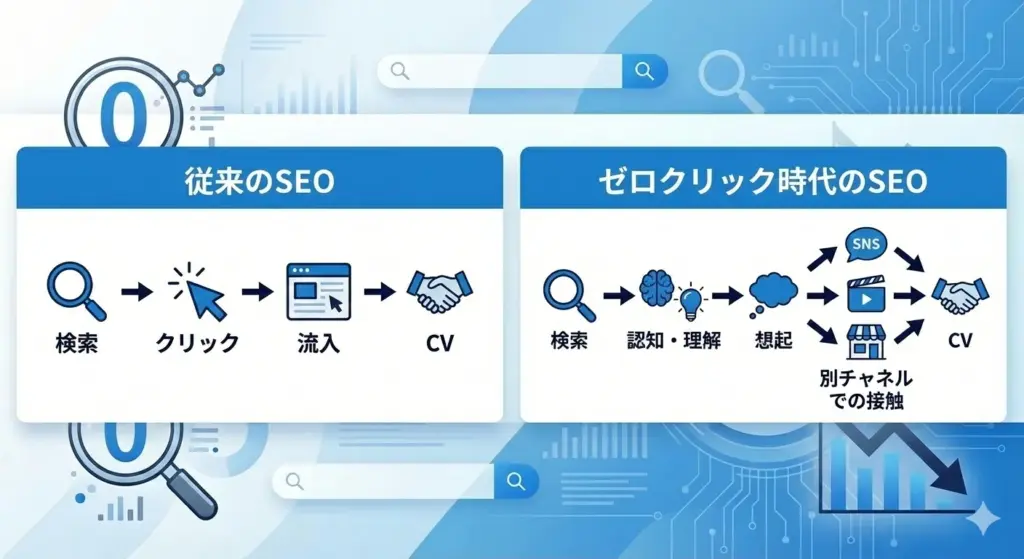
Traditional SEO was based on the premise of a linear model: Search → Click → Traffic → Conversion
On the other hand, SEO in the zero-click search era plays a long-term and multifaceted role, such as: Search → Awareness/Understanding → Recall → Contact through other channels → Conversion
Traditional SEO had the main purpose of "guiding from search results to a website." On the other hand, SEO in the zero-click search era treats the search results themselves as an important contact point and plays a role in accumulating awareness and understanding.
By being displayed continuously in search results, company names and service names remain in the user's memory, leading to subsequent branded searches, inquiries, and contact via other channels. Therefore, SEO is evolving from a "measure to generate inflow" to "a measure to build a foundation for being chosen."
KPIs and evaluation indicators to review in the zero-click search era
When looking only at click counts or PV, SEO in the zero-click search era is often judged as “not yielding results.”
However, by reviewing evaluation indicators, the true value of SEO becomes apparent.
・Number of search result impressions (Search Console) ・Increase in branded search volume ・Correlation with CVs via other channels ・Content contacted during business negotiations
It is important to view SEO not as a “traffic volume measure,” but as a marketing foundation that includes awareness and trust formation.
SEO content strategy based on zero-click search
In SEO in an era where people don't click, content design that dares to give the answer in the search results is required.
・Present the conclusion at the beginning ・Summarize definitions/key points concisely ・Utilize bullet points and tables
On top of that,
・Why can you say so? ・How should it be utilized in practice? ・How does it differ from other options?
By providing deep-dive information like this within an article, you can acquire clicks from "people who want to know more next." Especially in the BtoB field, not ending with just a glossary but presenting decision-making materials and case studies leads to differentiation.
Thinking about linking SEO and sales promotion measures
After a zero-click search, users do not inquire immediately. It is common for them to deepen their understanding and interest based on the information obtained from search results, and to take action at a different time or at a different touchpoint.
Therefore, for SEO in the zero-click search era, it is important to design it to link with other sales promotion measures rather than seeking results alone.
●Lead acquisition through document downloads
By preparing materials and white papers that lead to problem-solving for users who are interested in the search results, you can lead them to lead acquisition. SEO content plays the role of an entry point for consideration.
● Continuous contact via email/MA
Once a lead is acquired, it is important to use email and Marketing Automation to provide continuous information. It plays a role in nurturing the interest born in search results into a long-term, trusting relationship.
● Combined use with advertising, exhibitions, and webinars
Users who made contact via zero-click search often re-contact through ads, exhibitions, or webinars. By crossing multiple channels starting from SEO, you can support decision-making.
Designing to deepen relationships through multiple touchpoints, starting from contact in search results, is the marketing method that leads to results in the zero-click search era.
Summary | How to think about SEO in the zero-click search era
With the increase in zero-click searches, the conventional way of thinking about SEO—that “high search ranking = results”—is becoming obsolete. However, the value of SEO itself has not been lost.
What is important is to rethink SEO as a marketing foundation that accumulates awareness, understanding, and trust, rather than just an acquisition measure.
・Visibility in search results serves as the first point of contact ・Even without clicks, it leads to memory and brand recall ・It contributes to final results by linking with other measures
Zero-click search is not the end of SEO, but rather the result of the evolution of SEO's role.
By designing search results not as a "passing point" but as a "place to provide value," and connecting them to subsequent sales promotion measures, you can realize an SEO strategy that produces results even in an era where links are not clicked.
Towards a real-world brand experience beyond zero-click search
Now that zero-click search has become the norm, interest and impressions generated in search results are not completed on the spot, but cases where they function as a "trigger" for behavior in other channels are increasing.
In fact, based on the information obtained from searches, users encounter the brand or service again at various touchpoints such as social media, advertisements, exhibitions, and pop-up stores, deepening their understanding.
That is why it is important to design a connection between the interest generated online and experiential value in a real-world setting.
At BEEATS, we have handled many real-world brand experience designs, such as corporate sales promotions, exhibitions, and pop-up stores.
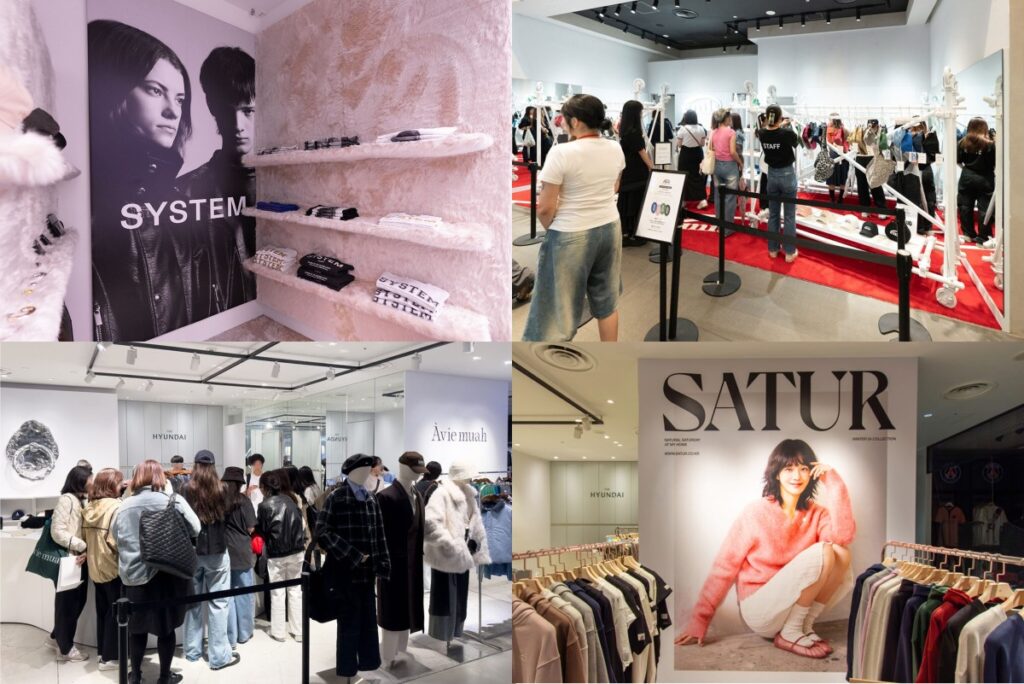
Recently, we have also handled pop-up stores themed around popular Korean brands and characters with Gen Z, and we create brand touchpoints that cross online and real life through gimmicks that "make you want to take pictures" and productions that make you want to share on social media.
If you are considering exhibition booths, pop-up stores, or promotional plans, including "post-search contact design," please feel free to consult with us.
A1. Zero-click search refers to search behavior where a user's question is resolved simply by the information displayed on the search result page, and no click to a website occurs. It has been rapidly increasing in recent years due to the expansion of search engine features that provide direct answers, such as featured snippets and FAQ rich results.
Q2. Why are zero-click searches increasing?
A2. There are three main reasons why zero-click search is increasing. First is the UX optimization of search engines, second is the spread of smartphones and voice search, and third is the change in user information gathering behavior where they "want to grasp the outline or conclusion first." These have overlapped, and information provision that completes in search results has become the norm.
Q3. Is SEO no longer meaningful in the zero-click search era?
A3. It's not that the importance of SEO has decreased, but rather that its role has changed. It has evolved from conventional “measures to generate site traffic” to “measures that build a foundation to be chosen” by accumulating awareness and understanding using search results as a touchpoint. Therefore, long-term effects that lead to an increase in brand-name searches and contact via other channels can be expected.
Q4. What KPIs should be reviewed in the zero-click search era?
A4. It is necessary to review evaluation indicators to treat SEO as a marketing foundation, not just clicks or PV. Specifically, it is important to set new KPIs such as the number of impressions in Search Console, an increase in brand-name searches, the correlation with conversions via other channels, and content contacted during business negotiations.