Online advertising, social media, email marketing--. Now that the means to connect with customers have diversified, the number of companies daring to use "paper DM (direct mail)" is increasing. The background to this is "digital contact saturation." Emails and social media ads that arrive in large quantities every day are difficult to remember even if they enter the eye as information. In the midst of this, DM that can be picked up and read is a precious channel that arrives as an "experience," not "information." In fact, there are survey results where many users who received paper DMs answered that it "left an impression" or "improved their favorability toward the company." It is precisely because marketing is centered on online that "the experience of actually receiving it leads to differentiation."
DM (direct mail) is a sales promotion method that "delivers directly" product or service information to a specific customer. Representative is paper DM (postcard/sealed letter) by mail, but it also includes email, FAX, and posting.
Common to all methods is the point of "clarifying the people you want to reach and approaching them individually." In other words, the goal is not to "widely notify" like TV commercials or listing ads, but to deliver information "only to those who need it."
2. Differences between DM and other channels
In recent years, it is sometimes misunderstood that "DM = SNS direct message," but DM in marketing refers to a "means to deliver sales promotion materials." Email DM and official LINE accounts are included in this, but paper DM is particularly distinctive in the point that it "arrives physically."
From sales promotion in BtoC to uncovering prospective customers in BtoB, DM is widely used according to its purpose.
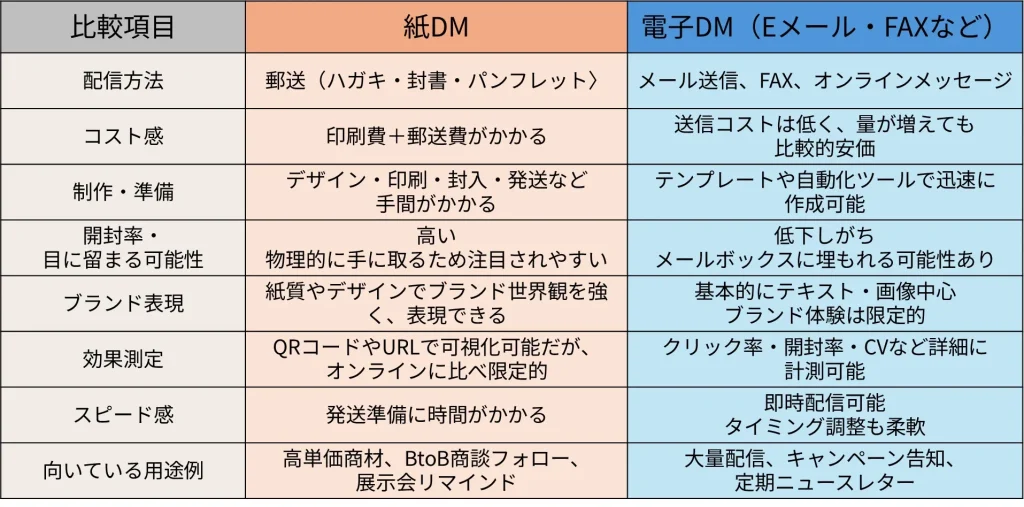
Even if you say DM in one word, its form is various. Various formats are used according to the purpose and target.
Here, we will introduce the types and features of DM and organize them so that you can compare each and confirm which method is suitable for your company.
[Paper DM] ・Postcard DM: Effective for creating casual touchpoints, such as campaign announcements and store visit promotions. Postcard DMs come in the following types: →Postal postcard size (normal postcard): Ideal when you want to deliver to many people while keeping costs down. →Large postcard (non-standard) such as A4 size: Because the appeal area can be used widely, it is suitable for visual appeals and product introductions. →Pressure-sealed postcard: Because it involves an opening action, it is effective for cases where you want to include a large amount of information or for campaign announcements.
・Sealed DM: Ideal for when you want to give a more polite impression, such as for material requests or service guides. Sealed DMs also come in various formats, and the impression changes significantly depending on the design and material. →Paper envelopes: The most common format. White envelopes are suitable for business use and give a simple and clean impression. In addition, by choosing materials that create a specific tone or world view, such as colored envelopes or kraft envelopes, you can express your brand. →Transparent OPP envelopes: Because the contents can be seen, it is possible to promote flyers and catalogs directly. Effective for increasing the opening rate.
・Catalog/Pamphlet DM: Suitable for high-unit price products and brand appeal. Effective when you want to convey a world view firmly.
[Electronic DM] ・Email DM: Mass distribution is possible at low cost. Strong in reaching expansion in a short period and campaign announcements. ・FAX DM: Deep-rooted mainly in the BtoB industry. Also has the merit of arriving directly to the person in charge's eyes.
Paper DM and electronic DM are measures that each have different strengths. By choosing appropriately according to the person you want to reach and the purpose, it will lead to higher response rates and brand penetration.
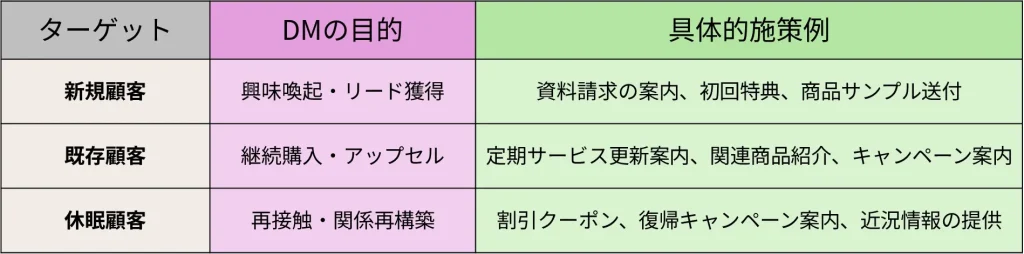
Direct mail (DM) effects and usage scenes (comparison by target)
DM is a tool that does not end with "a one-time touchpoint" and builds relationships continuously. Here, we will compare and organize how DM can be utilized for new customers, existing customers, and dormant customers, respectively.
Reasons why DM is effective by target
・New customers: Unlike online advertising, DM is a tool that is easy to attract interest because it can be delivered in a form that can be picked up. It becomes an opportunity to show "presence" even for brands you are contacting for the first time. ・Existing customers: By making the content based on purchase history and usage status, it becomes easier to aim for upsells and cross-sells. Having the customer feel it is "information for you" is the key to improving response rates. ・Dormant customers: For customers who have not had transactions for a while, it is important to have them remember you again. By re-recognizing the brand with paper DM, or by stimulating action with discounts or campaigns, it is useful for "rebuilding relationships."
Especially in the BtoB field, the number of cases where DM is used as a complementary measure for sales activities is increasing. It is useful for creating touchpoints that are difficult to reach only online, such as follow-ups for business negotiations, reminders after exhibitions, and announcements of service releases.
DM is also a tool for creating opportunities to have customers "remember you."
Key points for successful direct mail (DM) campaigns
1. Targeting and segment design
What determines results is the accuracy of the list. Based on age, gender, industry, past purchase history, etc., clarifying the person to be communicated is the first step.
For example, even with the same product information, response rates change significantly by simply changing the content, such as providing an "upsell proposal" to frequent customers or a "repurchase benefit guide" to churned customers.
2. Consistency of design and message
Whether you can have the customer feel "this is addressed to me" the moment they receive it is an important point of DM. Design, paper quality, copy, and enclosures--each needs to take a balance that considers the company's tone and customer psychology.
Especially in BtoB DM, there is a tendency for "concrete benefits" and "tone with a sense of reliability" to be emphasized over visuals.
3. Mechanism building for effectiveness measurement and improvement
It is important to establish a mechanism to measure "reactions" (effects) without just sending and ending.
In recent years, there are cases where QR code access alone cannot pick everything up, so "compound effectiveness measurement" not biased toward online measurement is required. For example, mechanisms such as bringing coupon codes or benefit tickets, or having DM-included guidance presented, allow you to confirm effectiveness in offline actions such as store visits and event participation. As a result, the store side can also reliably judge that "they came because they saw the DM," and the accuracy of coordination with measures is increased.
Of course, it is still effective to visualize digital access and CVs through the use of QR codes and dedicated LPs. The important thing is to "design a mechanism to capture reactions from both online and offline." By analyzing response rates and running a cycle of improving target accuracy, messaging, and design, you can grasp the effects of DM more three-dimensionally and lead to maximizing results.
The latest trends in direct mail (DM) utilization
DM utilization has changed from a mere "sending measure" to an era of "experience design." While multiplying the strengths of paper DM and electronic DM, cooperation with digital and data utilization are progressing, and trends that companies should pay attention to are also diversifying.
Here, we will introduce four trends that are attracting attention.
1. "Experience-type DM" utilizing AR/VR
By combining AR (augmented reality) with printed materials, methods have emerged that connect to digital experiences the moment a DM is opened. For example, when a postcard is scanned with a smartphone, products can be displayed in 3D or corporate message videos can play, enabling a new kind of promotion that fuses the "surprise of receiving paper" with a "digital experience."
Because it can leave a visual and emotional impression, it is effective for expanding brand experience.
Increasingly, companies are using customer data analysis and AI predictive models to optimize "who, when, and what content to send." By extracting customers with high response probabilities based on purchase history and web behavior, personalized DMs are sent automatically. As a result, there are cases where high response rates are being achieved with fewer mailings than before.
Operation premised on coordination with MA (marketing automation) and CRM is key.
3. Eco-DM utilizing sustainable materials
From the perspective of environmental consideration, DMs that adopt "recycled paper," "afforestation-certified paper," and "plant-derived ink" are also spreading. By being conscious of sustainability in materials and printing processes, you can also expect the effect of conveying the company's attitude to customers.
Also, in response to rising postal costs, design that balances "cost and environment," such as lightweight and thin envelope design, is also attracting attention.
Mechanisms that utilize QR codes and PURL (personalized URL) to induce from DM to Web, LINE, applications, etc., have also become generalized. Tracking online behavior and following up again via email or SMS, "cross-channel strategies" that go back and forth between paper and digital are producing results.
DM is not a binary choice of "paper" or "digital," but has evolved into a compound measure combining data, experience, and sustainability. When companies consider DM from now on, designing from the viewpoint of "what kind of experience you want to deliver" and "what kind of impression you want to leave," not just sending efficiency, is the shortcut to results.
Summary - The first step of direct mail (DM) utilization starting tomorrow
DM is a marketing method that demonstrates its value precisely because we are in the digital age. It has the strength of being able to deliver "memorable experiences" directly to the customer's hands, which is difficult to achieve with online advertisements.
It is recommended to start with a small-scale test. By checking the reactions of a small list while changing the design, appeal, and timing, the optimal format for your company will come into view.
And above all, it is important "not to just send it and be done with it." By measuring reactions and connecting to the next approach based on data, DM operation that produces results will be realized.
From direct mail (DM) to exhibitions, consult BEEATS for lead development!
BEEATS is a professional that has supported the solution of various sales promotion and marketing issues of companies for over 48 years. In recent years, we have been supporting lead development, such as exhibition planning and construction for SaaS companies. If you are looking for new solutions for marketing issues, please consult us once.
A1. DM (direct mail) is a sales promotion method that delivers product or service information directly to a specific customer. Unlike TV commercials that notify widely, its feature is that you can clarify the person you want to reach and approach them individually, and it includes paper postcards and sealed letters, as well as email and FAX.
Q2. Why is paper DM (direct mail) attracting attention now?
A2. This is because digital contact saturation makes online ads and emails less memorable. Paper DM, which can actually be touched, is delivered to the customer not just as information but as an "experience," so it is easier to leave an impression, which leads to improved corporate favorability and differentiation from competitors.
Q3. What kind of types does DM (direct mail) have?
A3. There are roughly paper DM and electronic DM. Paper DM includes postcards suitable for creating casual touchpoints, sealed letters that give a polite impression, and catalogs with strong brand appeal. On the other hand, electronic DM includes email that can be distributed to everyone at low cost and FAX DM that is deep-rooted in BtoB, and they are used properly according to the purpose.
Q4. What are the key points for successful DM (direct mail) campaigns?
A4. There are mainly three points for success. The first is targeting design that improves the accuracy of the customer list, the second is consistency in design and messaging for the target, and the third is the implementation of compound effectiveness measurement that captures reactions from both online and offline, such as QR codes or bringing coupons.
Q5. Tell me about the latest trends in DM (direct mail).
A5. As the latest trends, four methods are attracting attention. "Experience-based DM" that combines AR with printed materials, "Optimized DM" that utilizes AI and data, "Eco-DM" that uses environmentally friendly materials, and "Multi-channel tracking DM" that links with online behavior via QR codes, etc.