I know heatstroke countermeasures have become mandatory. However, "I don't know where to start" or "I've prepared a manual, but I'm worried if it's really enough"——. For those in charge of general affairs and human resources, in this article, we will deliver heatstroke countermeasures focusing on "communication ingenuity".
In June 2025, corporate heatstroke countermeasures changed from "duty to make efforts" to "duty". Due to the revision of the law, the implementation of countermeasures with penalties for work under certain conditions is now required. In addition to environmental maintenance such as air conditioning and water replenishment, and the establishment of systems and response procedures, alerting and raising awareness for each employee is one of the important roles that companies should fulfill. However, there are many voices from the field such as "posters are posted, but maybe they aren't looking" or "we are talking to them, but we don't feel the effect".
Rethinking "how you convey" the message itself may be the first step toward making heatstroke prevention measures effective. In the following sections, we will introduce hints on "how to convey" in detail.
What is the mandatory heatstroke countermeasure? Reviewing the basics
Due to the revision of the Occupational Safety and Health Rules enforced from June 2025, heat stroke prevention measures in companies have changed from a voluntary effort to an "obligation." Companies performing work in certain heat environments, such as outdoor work or indoor work with insufficient air conditioning, are required to perform risk assessment based on the Heat Index (WBGT value) and implement work management and health management. Also, there are cases where violations are subject to penalties, and we have entered a phase where the state of "not taking measures" as a corporate responsibility is not permitted.
<Main heatstroke countermeasures companies should take>
・Report system maintenance Shared emergency contacts and transport destination information within the company so that reports can be made immediately in case of an abnormality ・Clarification of response procedures Manualization of the flow during physical abnormality (work interruption, cooling, emergency transport, etc.) ・Publicity and education for employees Regular lectures on sharing procedures and basic knowledge, and initial response ・Work environment management WBGT value measurement, maintenance of ventilation and air conditioning, installation of break spaces and water supply stations ・Review of work hours and clothing Reduction of work time during high temperature, break extension, utilization of breathable clothing and air-conditioned clothing
There may be many companies whose system "preparations" such as installation of air conditioning equipment and maintenance of manuals are in place. However, because preparations are in place, the next thing I want to think about is the perspective of "how to communicate to employees and lead to action". Ingenuity in "how to communicate" such as raising awareness and alerting is also an essential element for making heatstroke countermeasures function reliably.
▼ Please refer to the Ministry of Health, Labour and Welfare's materials for details on the mandatory requirements.
Check this article for heatstroke prevention tips for events, POP-UPs, and exhibitions!
Heatstroke countermeasures depend on "how to communicate"——Why can't posters reach people?
As a heatstroke countermeasure, various efforts such as posting posters, alerts at morning meetings, and preparing and sharing manuals are progressing at each company. However, the reality of the site is that "informed = understood" is not necessarily the case.
・Posters are posted but nobody notices them ・Even if you speak to employees, it gets ignored ・It is forgotten in the midst of busyness ・Content sent by email is not read / gets buried
In such a state of "thinking you communicated it," it is difficult to lead to employee actions or awareness, and there is also a risk that measures will become hollow. A perspective that reviews not only "what to communicate" but also "how to communicate" is essential for future heat stroke prevention measures.
In particular, in workplaces busy with daily tasks, simple posters that are just "there" are unlikely to lead to awareness. Creating a system that draws attention and is seen repeatedly will realize "effective measures" that lead to action. As one method for this, "digital signage" is attracting attention once again.
Strengthening Heatstroke Prevention with Digital Signage—Tips for Moving from "Seeing" to "Noticing"
"Posters are up but nobody sees them" "There are too many notices and it gets buried" There are many workplaces with such worries. Digital signage is one way to supplement those issues. You can attract attention with video and animation, and create an environment where people naturally "end up seeing it."
For example, there are services that display "Heat Stress Index (WBGT)" and temperature graphs, but even without such functions, by repeatedly displaying simple messages such as "Don't forget to hydrate" and "Let's wear cool clothes", it gradually permeates the consciousness of each employee. From the perspective of "properly communicating heat countermeasures", rather than relying only on posters or verbal reminders, reviewing the means of communication itself is a step to increase the effectiveness of the countermeasures.
Actually close by "Heatstroke countermeasures via signage"
Heatstroke prevention using digital signage is already spreading in scenes familiar to us.
FamilyMart has been producing original awareness-raising videos for each prefecture from July 1, 2025, in cooperation with 47 prefectures, FamilyMart, and Otsuka Pharmaceutical. Through "FamilyMartVision", digital signage installed in stores, they are delivering heatstroke prevention points according to regional characteristics, such as "frequent water and electrolyte replenishment" and "utilization of air conditioning" to consumers.
Also, in 2024, DyDo DRINCO, Inc. began distributing videos calling for heatstroke prevention using the digital signage of "Disaster Response + Information Dissemination Vendors" installed on vending machines. Through messages such as "Don't overdo it" and "Let's stay hydrated!", they carried out awareness campaigns.
This kind of heatstroke countermeasure that "makes people see and notice" has already begun to spread to consumers. This approach should also be applicable to heatstroke countermeasures in the workplace.
Key Points for Utilizing Signage for Heatstroke Prevention [Optimizing "How You Convey" by Time and Location]
Signage cannot fully demonstrate its effect by "just displaying". Especially in situations where it is required to "repeat alerts regularly" like heatstroke countermeasures, the mechanism of switching content according to time and place is important.
For example, in signage operations in offices and factories, such displays can be considered. "Today, temperatures are forecast to exceed 30°C. Let's try to stay hydrated even indoors." "Even in air-conditioned rooms, work that involves heat or maintaining the same posture for long periods requires caution." "Hydration + salt replenishment during breaks" "If you feel any change in your physical condition, report and consult immediately."
It is often overlooked if the content is the same every day, but just updating the display every week or according to the weather enhances the effect of alerts. With signage, it is possible to convey content in a form that attracts attention while periodically switching it.
"Clomoni," a Cloud-Based Digital Signage System That Streamlines "How You Convey" Messages
When thinking about heatstroke prevention from the perspective of "conveying" information, tasks such as putting up posters at each location or replacing content can be surprisingly time-consuming and labor-intensive. Especially when managing offices or sites with multiple locations, problems often arise, such as "unable to keep up with updating notices" or "inconsistent display content."
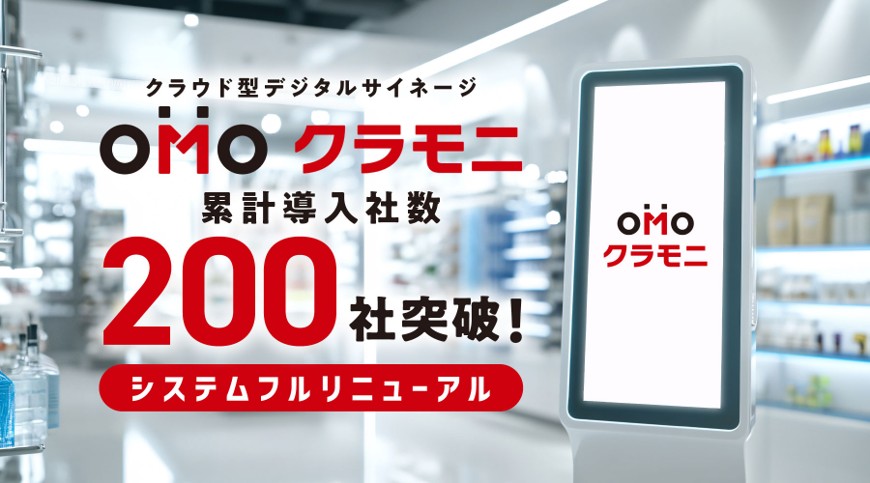
That's where this comes in handy: Cloud-based digital signage . BEEATS's offering clomoni This system allows for simultaneous distribution from a PC at headquarters to monitors nationwide, enabling flexible information dissemination as an alternative to physical notice boards.
Unlike standalone types that require manual updates on-site, a major advantage of the cloud type is that you can switch information in a timely manner via remote control.
Features include being able to switch content according to the day of the week or time of day, and easily creating images using templates, allowing you to deliver the "content you want to convey now" without placing a burden on the site. Companies that have introduced Clomoni for internal notices can operate it according to the season and situation, such as displaying alerts and reminders regarding heatstroke prevention in the summer.
When rethinking the "how to convey" for messages you want to communicate in the workplace, such as hydration reminders and alerts, a cloud-based digital signage system like "Clomoni" is an effective option for delivering information efficiently and reliably.
▼ The difference between standalone and cloud types is explained in this document (free).
Changing how you communicate is the first step to protecting the workplace
Amidst the progress of "mandatory" heatstroke countermeasures, no matter how much you prepare, "if it isn't communicated, it's meaningless"... this is a challenge felt at many sites. That is why reviewing how to communicate information is the first step of countermeasures and the foundation of continuous safety management. The use of digital signage such as "Clomoni" is attracting attention as a method of conveying information that is difficult to reach with just posters or verbal alerts, in a way that is easier to see, easier to understand, and continuous. Why don't you add "ingenuity in communication" to heatstroke countermeasures and proceed with creating a workplace environment where you can work with peace of mind?
For those who want to know more about "Clomoni"
"Clomoni" is a cloud-based digital signage service that allows you to easily switch distributed content and manage displays by location. It can also be used for sharing information in offices and on-site, such as internal announcements and safety awareness campaigns. You can check the detailed information on "Clomoni" below.
We also have a white paper available that summarizes how to utilize digital signage within your company. If you want to streamline information sharing in your workplace, please check this out as well.
Click the image to go to the download page.
FAQ. Frequently Asked Questions
Q1. Are corporate heatstroke countermeasures mandatory?
A1. Yes, due to the revision of the Industrial Safety and Health Regulations in June 2025, heatstroke countermeasures for companies performing work under certain heat environments have changed from "duty to make efforts" to "duty". Risk evaluation and work management using the heat stress index (WBGT value) are required, and there are cases where penalties are subject to violation.
Q2. Why is posting posters alone insufficient for heatstroke countermeasures?
A2. This is because posters often just end up being something "that is there," and are often overlooked in workplaces where people are busy with daily tasks. Even if you intend to convey information, it is difficult to connect it to employee behavior or awareness, and there is a risk that the measures will become formalistic, so it is necessary to rethink "how you convey" the information.
Q3. What are the benefits of using digital signage for workplace heatstroke countermeasures?
A3. It is that you can create an environment where employees' eyes are drawn by videos and animations, and they notice the message naturally. By switching and repeatedly displaying content such as "Don't forget to hydrate" according to the time of day and weather, you can continuously improve the effectiveness of alerts.
Q4. What are the features of the cloud-based digital signage system "Clomoni"?
A4. It is characterized by being able to perform batch distribution from the headquarters' PC to monitors nationwide and switch information in a timely manner by remote operation. It is possible to output content according to the day of the week and time of day, and even companies with multiple bases can reliably deliver the latest information they want to communicate now without burdening the site.