How can we communicate the appeal of our brand or products so that they are supported by people for a long time? Many companies are agonizing over this question.
Now that social media and advertising have become the norm, just delivering information won't move people's hearts. What is gaining attention there is Fandom Marketing. By connecting with passionate fans and creating a mechanism to get excited with the brand, a "chain of support" is born that leads to purchases, visits, and the next promotion. In this article, we will introduce the basics of fandom, examples, and hints for utilizing it in promotions.
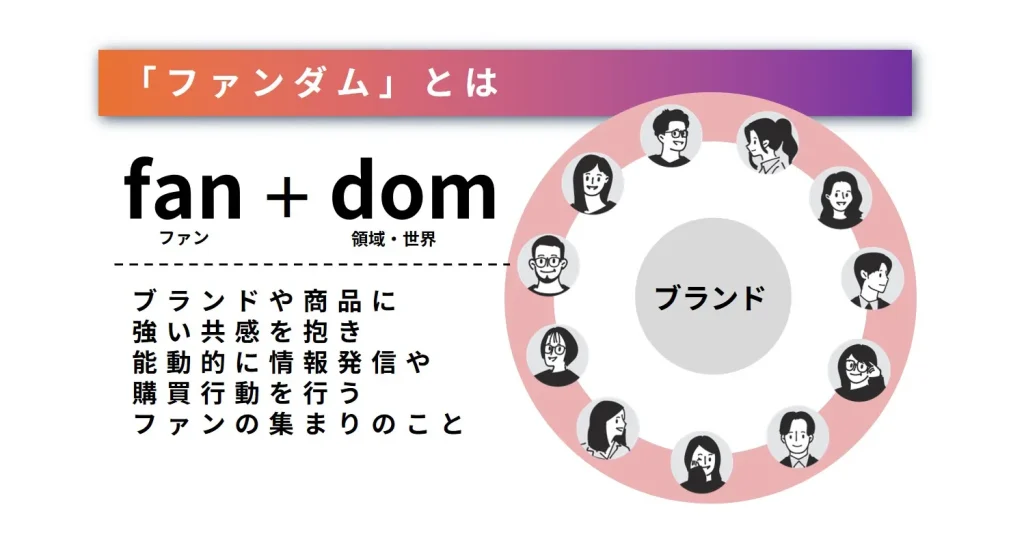
The word "fandom" is a coined word combining the English "fan" and "dom" (domain/world). Originally, it was used as a term referring to groups of enthusiastic fans in fields such as music, movies, and idols.
Especially in South Korea, this "fandom culture" is mature, and the movement where fans supporting K-POP idols post all at once on social media or launch support ads via crowdfunding is well-known. In Japan, along with the spread of K-POP popularity, the word "fandom" has come to be used generally.
When understood in a marketing context, isn't it easy to understand it as Fandom = a group of fans who hold strong empathy for a specific brand or product and actively engage in information dissemination and purchasing behavior?
As examples of concrete actions...
・Buying the "complete set" of collaboration products for one's favorite ・Sharing experiences related to one's favorite on social media and recommending it to friends ・Visiting pop-ups and exhibitions like a "pilgrimage" ・Participating in support ads or crowdfunding yourself
For example, in Japan, terms like "○○-kaiwai" are also often used on social media. "Cosme-kaiwai," "Cafe-kaiwai," etc., "kaiwai" refers to a "loose group connected by common interests," and fandom is an existence where fans with particularly high heat have gathered from among that. In other words, "the core layer that gives the brand the most power within the kaiwai" is fandom.
That is precisely why brands that have made fandom their allies can obtain greater diffusion power and continuous support than advertising.
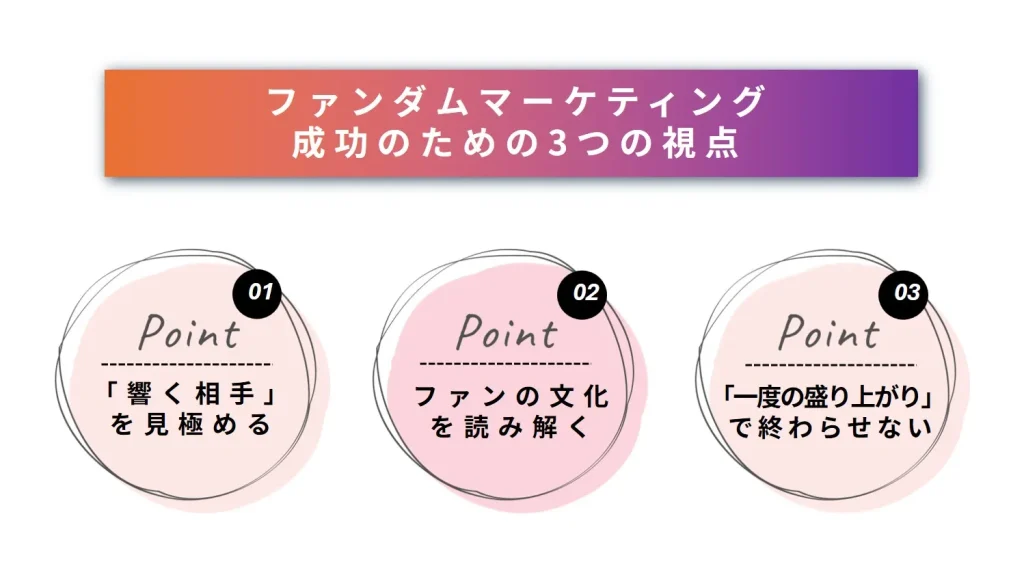
3 Perspectives for Success in Fandom Marketing
Fandom, as mentioned above, was originally a word that spread from music and idol culture, but now it is also being applied to corporate marketing strategies. The way of thinking born there is "Fandom Marketing."
Fandom marketing is a method that views highly enthusiastic fans as brand partners and utilizes their dissemination power and ability to act to lead to increased awareness, promotion of purchases, and cultivation of loyalty. The point of difference is that it does not treat them merely as consumers, but engages with them as entities that will help grow the brand together.
Building on that, the following three perspectives are indispensable when practicing fandom marketing.
Perspective 1
Identifying the "Audience that Resonates"
Fandom marketing does not aim to be liked by everyone, but starts with narrowing down the target audience who can feel that "this brand is for me." By gaining deep empathy rather than wide and shallow reach, it naturally leads to dissemination and store visits.
Perspective 2
Read the fan culture
To succeed in Fandom Marketing, it is essential to understand the fans' unique culture and rules. When you lean into the parts where fans cherish their own culture, such as hashtag activities or exchanges through merchandise, trust in your brand will increase significantly.
Perspective 3
Don't let it end with a "one-time buzz"
Fandom marketing does not aim for short-term buzz, but the essence is to create a mechanism to maintain the heat. By connecting the heat of campaigns and events to community operations and the next real experience, the distance to the brand will shrink further.
◆◆◆Summary What is important in advancing Fandom Marketing is:
① Identify the "audience that will resonate" rather than reaching everyone ② Understand and naturally lean into the fans' unique culture ③ Foster a continuous relationship rather than a one-time thing
By being conscious of these three things, Fandom Marketing becomes not just a campaign, but a "mechanism" to grow the brand.
Reference | Relationship between Fandom Marketing and Co-creation Marketing
The term "fandom marketing" is relatively new, but the roots of that way of thinking already existed in Japan. Examples include "co-creation marketing" and "ambassador marketing." Activities such as incorporating user voices into product development and welcoming enthusiastic fans as brand cheerleaders have been carried out for a long time at many companies. The difference between these movements and fandom marketing is whether the "heat" of fans is placed at the center. The mechanisms of co-creation and ambassadors had an emphasis on creating a framework for fan participation, but fandom marketing focuses on "how to generate and maintain heat" beyond that. In other words, it can be said that fandom marketing is a redefinition of traditional methods from the perspective of "heat." If you organize from this viewpoint while looking back at past initiatives, you can see the possibilities of marketing in this day and age.
Learning Fandom Marketing from Case Studies
I will introduce examples so that you can imagine the concrete picture of fandom marketing.
Case 1
Klairs: A Skincare Brand from South Korea
The South Korean skincare brand "Klairs" is garnering attention for its development leveraging fandoms. Through initiatives that engage fans' interest, such as pre-sales on MUSINSA, appointing professional baseball players as ambassadors, and collaborations with beauty influencers, it has spread awareness through its community. This movement is also spreading in the Japanese market, and in addition to influencer measures on Qoo10, an offline event gathering approximately 250 influencers was held in May 2025. The workshops where visitors experienced new products were immediately fully booked, making the fans' fervor visible. Through such initiatives, Klairs shows a movement to form a fandom with influencers as the starting point and spread that heat to general consumers.
Case 2
Workman: Ambassador system that involves fans
Workman, which started as a workwear brand, has recently expanded its market into outdoor and casual wear. Behind this is a mechanism of Fandom Marketing that actively involves fans. The company introduced an ambassador system, providing lovers of the brand and influencers with an official place for communication. By entrusting dissemination as a member of the brand, more real information than corporate advertising spreads, and natural support expands. Furthermore, they reflect opinions gathered on social media in product development, providing an experience where fans can feel that "my voice took shape." The attitude of fans engaging with the brand as co-creators is gathering a lot of support.
Case 3
Asahi Breweries: Creating Touchpoints with Culture Fandoms
Asahi Breweries is developing an approach that leverages the heat of sports and music culture fandoms. Through limited-time immersive concept shops and collaboration events with artists, they are building contact points between existing cultural fandoms and their own brand, and various initiatives aimed at creating new customers are being conducted.
Initiatives by companies and brands with fandom as a keyword are steadily expanding, and I can't take my eyes off it as a new trend in marketing.
How to Incorporate Fandom Marketing
Fandom marketing tends to remind people of large-scale measures, but in reality, you can start with small ideas. The point is the perspective of treating fans as "friends to engage with" rather than "consumers."
◆Create a system to scoop up voices If there is a place where you can feel that "your opinion is heard" even with simple methods such as comment solicitation on social media or questionnaires, fans will naturally increase their participation consciousness. ◆Share empathy Just by introducing user posts and reviews on official social media or in stores, you can spread the feeling that "I am also a member of that." ◆Set up small real experiences If there are opportunities where even a small number of people can be directly involved with the brand, such as round-table discussions or workshops, the fandom's heat will rise at once.
You don't need any special mechanisms; everything can be incorporated as an extension of your daily activities. Stacking small steps leads to the great power that nurtures a fandom.
On the other hand, it is also important to deliver messages to the entire fandom. By cuddling up to existing cultures and communities and showing empathy, the brand is accepted as a "partner."
◆Create mechanisms to gather voices By sponsoring and collaborating with high-passion fandoms such as music, sports, and anime, you can naturally layer your brand onto them. ◆Provide experiences that resonate with the fandom Prepare events and product experiences that are easy for existing communities to join, and join in on the excitement among fans. ◆Share relatable stories Go beyond promoting product features and launch messages that resonate with the values of the fandom.
A step toward cuddling up to your own brand's fans, and a stance to deliver empathy to a wide fandom. By being conscious of both, the brand can naturally connect with the fandom and spread empathy.
Toward Brand Experiences that Leverage Fandom
Fandom Marketing is not just a trend word, but a new marketing flow that turns fans' passion into power. Because you can start with small efforts, it holds the potential for many brands to adopt.
We at BEEATS have worked on many promotions in real-world settings such as exhibitions, stores, and pop-ups. Building spaces where fans gather, empathy is generated, and brand experiences spread is our strength. Regardless of whether it is online or offline, please consult us if you are interested in spatial design or initiatives that leverage the heat of fandom. We will work with you to realize marketing that nurtures fandom, starting from real customer experiences.
Leave the creation of real-world spaces where fandoms gather to BEEATS
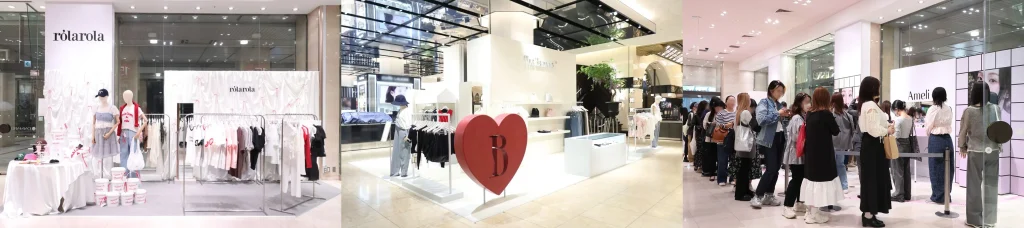
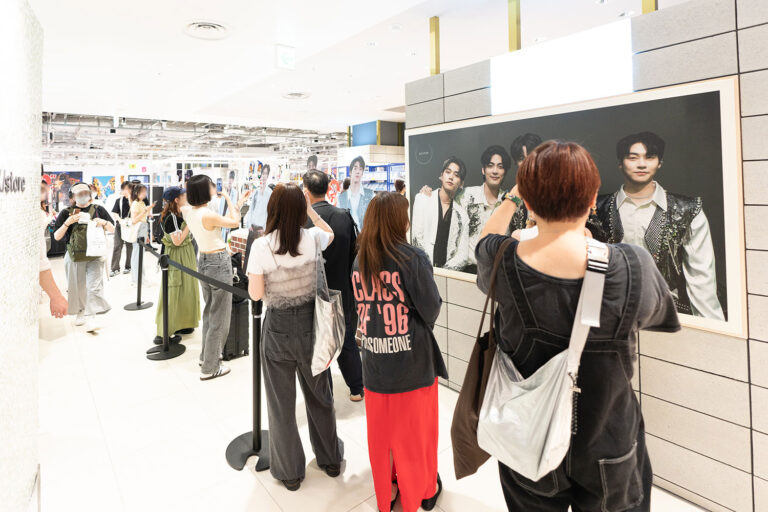
Pop-up stores and pop-up events are truly representative places where fans gather and share their passion. As fans who were connected on social media meet in real life and experience the brand's worldview, their empathy grows even stronger, turning into the power to disseminate information. If there is a space where they want to take photos or a production that generates empathy, fans will spontaneously share and convey the brand's worldview with their peers.
The "Lovely Runner" K-Drama Pop-up Store, which attracted many fans
BEEATS excels at creating spaces for such experiences. You can see various examples of store designs that make people want to visit and ideas that make them want to post on our website. When you want to raise the heat of fandom in the real world and spread that heat via social media, please consult BEEATS.
A1. Fandom marketing is a method that views highly enthusiastic fans as brand partners and utilizes their dissemination power and ability to act to lead to increased awareness and promotion of purchases. It is characterized by engaging with them as entities that will help grow the brand together with fans, rather than treating them merely as consumers.
Q2. What are the points for successful Fandom Marketing?
A2. There are 3 perspectives for success. The first is to identify the "audience that will resonate" rather than going wide and shallow, the second is to understand the fans' unique culture and rules and naturally lean into them, and the third is to create a mechanism that keeps the heat going without ending with a short-term buzz.
Q3. What is the difference between Co-creation Marketing and Fandom Marketing?
A3. The biggest difference is whether or not the fans' "passion" is placed at the center. Co-creation marketing focuses on creating a framework for fan participation, but Fandom Marketing goes beyond that framework and focuses on "how to generate and maintain passion."
Q4. How can I incorporate fandom marketing into daily work?
A4. It can be started with small ideas that treat fans as partners to engage with. Methods such as creating a system to scoop up voices via social media comments, sharing empathy by introducing user posts officially, and setting up real experiences where even a small number of people can be directly involved with the brand are effective.