Campaign Planning Techniques: Methods for Success to Attract Customers and Latest Trends
Are you worried about campaign planning to deliver products or services to more people and maximize sales?
With countless campaigns flooding the market, you may be lost as to which one is optimal for your company, whether legal regulations are okay, and how to incorporate the latest trends.
This article condenses the essence to lead campaign planning to success, from basic campaign purposes to main methods one should know and the latest trends tailored to today's consumer behavior.
We hope this guide will be a powerful help in your sales promotion activities. Please read until the end to find hints for the next campaign success.
Campaign purpose
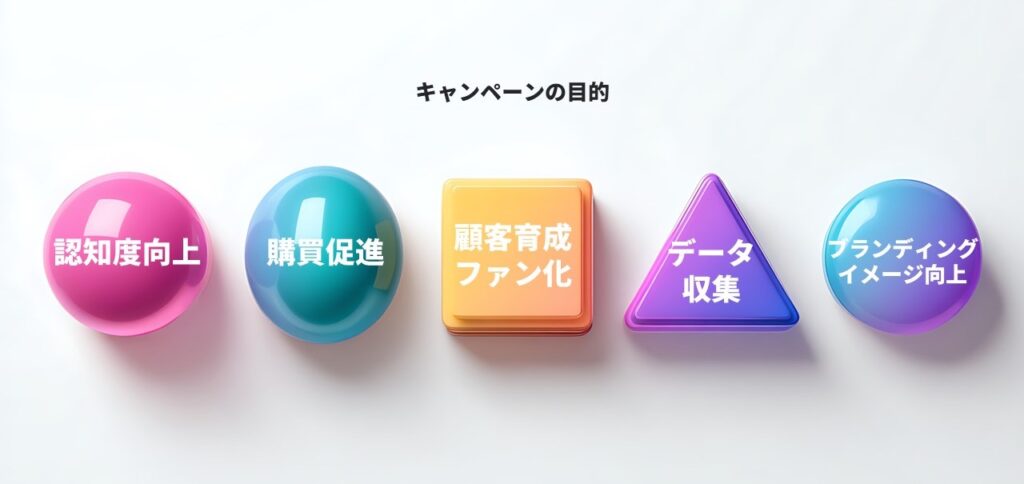
There are various purposes for implementing a campaign, but the main points are listed below.
Improvement of awareness
Announcing new products or services, rebranding, etc., to get more people to know about your existence.
Purchase promotion
Directly promote product purchases or service usage to increase sales.
Customer development/fan building
Deepen relationships with existing customers and build repeat purchases and long-term loyalty. Social media campaigns and mileage campaigns are effective.
Data collection
Collect user attribute information, interests, and purchase history to utilize for future marketing strategies.
Branding/Image improvement
Form a positive image of the company or brand and increase customer trust and favorability.
By clarifying these purposes, it becomes possible to choose appropriate campaign methods and establish effective campaign planning.
Open Campaign
This is a campaign that recruits applicants from the general public through TV commercials, websites, social media, etc., and awards prizes via lottery through quizzes or surveys. Conditions such as product purchases or service usage are not required, so anyone can participate easily.
Features:
Ease of participation: Anyone can easily apply via the campaign website or postcards.
No limit on prizes: In principle, it is not subject to the prize restrictions under the Act against Unjustifiable Premiums and Misleading Representations, so there is no practical limit on the value of prizes.
Ideal for increasing awareness: Often used for the purpose of increasing awareness of new products or services and establishing brand image.
Closed campaign
A campaign where entry is conditional on a specific transaction, such as a product purchase or service use. It is classified under the Act against Unjustifiable Premiums and Misleading Representations into three types: "General Prize Competition," "Joint Prize Competition," and "Total Prize Offering," each with different regulations regarding prize limits and total value.
Features:
Purchase promotion: Effects directly linked to product purchases or service usage can be expected.
Diverse deployment methods: A wide range of campaign planning is possible, such as instant win from QR codes (a format where you know if you won on the spot), later lotteries, or game formats.
Comparison of open campaigns and closed campaigns
These two campaigns are handled very differently under the Act against Unjustifiable Premiums and Misleading Representations.
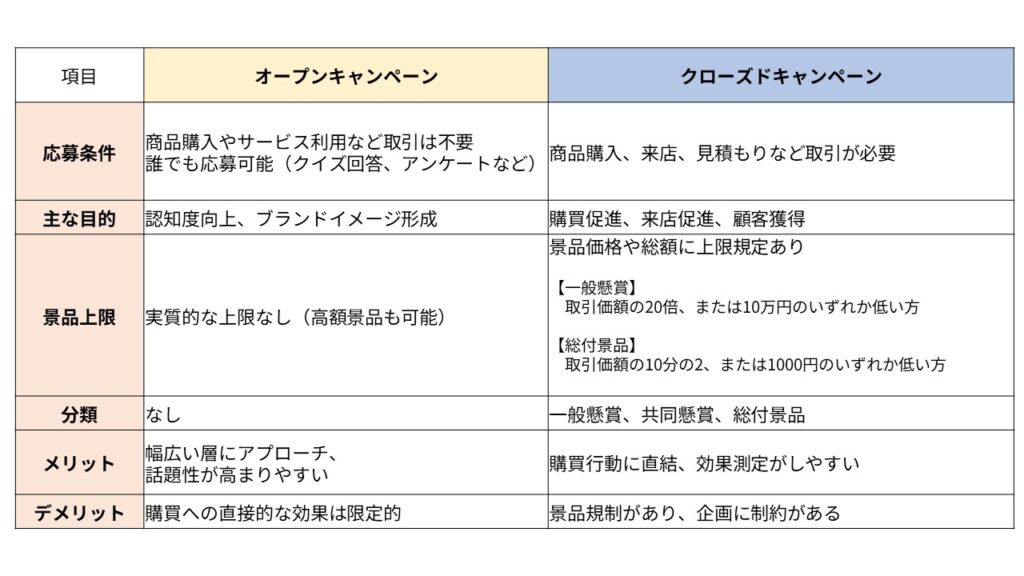
※ For [General Prize Competitions], the upper limit regulation for the total amount of prizes (2% of the planned total sales related to the prize competition) is also applied.
Other main campaign methods
Method 1
Web campaign
A campaign that conducts promotion and accepts applications mainly on a website. Its greatest strength is the ability to appeal to a wide range of audiences by utilizing the characteristics of the Internet.
Features:
Broad Appeal: By combining with various web advertisements, you can reach diverse target audiences.
Real-time situational awareness: Since application status is registered in a database, real-time data confirmation is possible, which is difficult with analog campaigns.
Data utilization: Application data can be utilized for future marketing measures.
Method ②
Social media campaign
A campaign developed utilizing various SNS platforms such as X (formerly Twitter), Instagram, Facebook, TikTok, and LINE. The main purpose is to increase fans of the company's SNS account and spread information within the target layer.
Features:
Diffusibility: Information is easily spread speedily through user sharing and reposting.
Improved Engagement: Through two-way communication with users, the effect of deepening attachment to the brand is expected.
Approach to young people: It is effective for approaching layers that actively use social media, centered on the young generation.
[Differences between Web campaigns and social media campaigns]
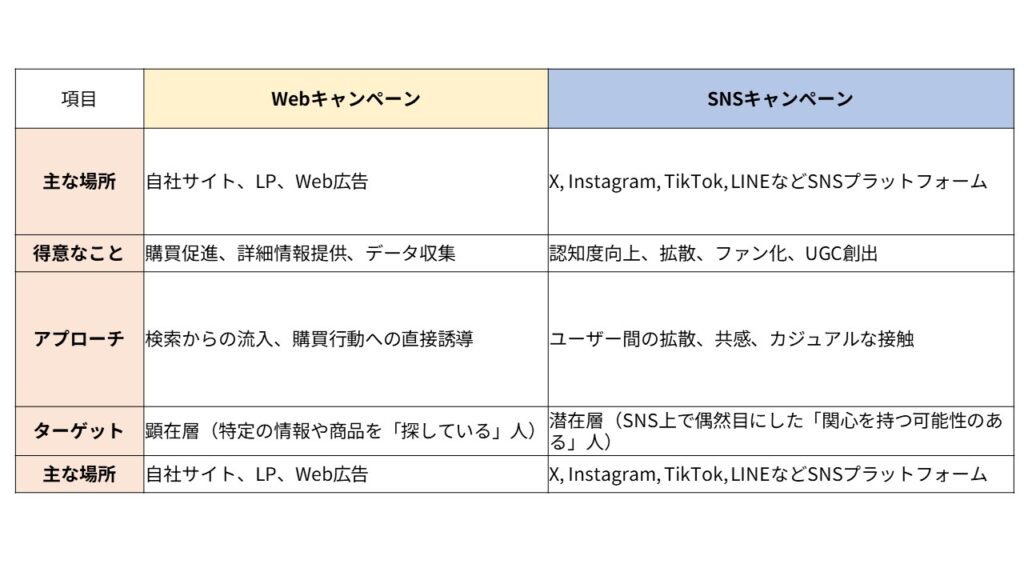
While both Web campaigns and social media campaigns are promotional activities conducted online, there are clear differences in their primary locations, approaches, and areas of strength.
While Web campaigns are good at encouraging active user behavior such as searches to lead to purchases or detailed information understanding, social media campaigns have strengths in spreading information instantly to many people from passive contact and increasing brand fans. In modern campaign planning, linking these creates even greater effects.
Method ③
Event-limited campaign
A limited-time, limited-location campaign held at specific event venues, etc. It is effective for those who want to achieve concentrated results in a short period, such as lottery events, games, rock-paper-scissors tournaments, or weekend-only gifts.
Features:
Immediate effect: You can boost the purchasing intent and engagement of event participants on the spot.
Providing experiential value: Through real-world experiences, you can carry out a memorable campaign.
Creating a sense of exclusivity: You can create a special feeling of "only now, only here" to encourage participation.
Method 4
Mileage Campaign
Like a stamp card, this is a campaign that awards prizes according to the purchase history of specific products. Since more attractive prizes can be provided the more the purchase amount or number of purchases increases, it leads to customer retention and repeat purchase promotion.
Features:
Repeat Promotion: Encourage continuous purchase and increase customer loyalty.
Customer Data Accumulation: Accumulate purchase history as data and utilize it for future marketing.
Compatible with high-unit-price products: Even for low-unit-price products, high-value prizes can be set for multiple purchases.
Method 5
Bulk Purchase Campaign
Similar to a mileage campaign, this is a campaign conditional on the purchase of multiple products. By broadening the scope of purchase, such as targeting all items of a specific brand, we aim to improve the average customer spend.
Features:
Improvement of average customer spend: By having them purchase many products at once, it contributes to sales growth.
Promotion of related purchases: It can encourage the purchase of related products.
Revitalization of sales floors: Synergistic effects can be expected by linking with in-store measures such as corner displays that promote bulk purchases.
Flow of campaign planning
To implement an effective campaign, it is important not just to plan it but to proceed in an organized manner. Here, we introduce six steps to move from campaign planning to implementation and subsequent connections.
Step ①
Clarify the purpose and goals of the campaign
"What is the purpose of running this campaign?" This is the most important part. Decide on concrete goals and metrics (KPIs) to measure them, such as "I want people to know about the new product!", "I want to increase sales at any cost!", or "I want to increase repeaters!"
Step 2
Decide who the campaign is aimed at
Next, let's concretely imagine "who we want to participate in the campaign." Age, gender, interests, what kind of actions they take... Once the target is clear, the prizes, messages, and notification methods will naturally become visible.
Step ③
Develop a strategy on how to spread the campaign
Even if you create a great plan, it is meaningless if no one knows about it. Let's develop a strategy to promote your campaign using the methods that resonate most with your target audience, such as Web advertising, social media, store posters, and Press Releases.
Step 4
Choose attractive prizes and promotional items
The "face" of the campaign is the prize. Selecting attractive prizes that make the target audience think "I want that!" provides great motivation for participation. While paying attention to rules such as the Act against Unjustifiable Premiums and Misleading Representations, prepare exciting prizes.
Step ⑤
Decide on an easy-to-understand way to participate in the campaign
Set up the participation method for "How do I participate in the campaign?" simply so that anyone can proceed smoothly without hesitation. Creating application forms and preparing systems to lower the hurdle to entry is the key to success.
Step ⑥
Thoroughly review the results of the campaign and apply them to the next one
A campaign isn't over just because it's finished. Make sure to review the results with numbers, such as how many applications there were, whether sales increased, and how the reaction on social media was. By analyzing what went well and what the challenges were, your next campaign will be even better!
By carefully executing these flows, you can dramatically increase the success probability of the campaign.
Latest Campaign Trends
In modern campaign planning, the following trends can be seen in accordance with the evolution of technology and changes in consumer behavior.
★Strengthening Personalization
Campaigns that provide optimized prizes and messages for each individual based on customer data are increasing. This is expected to improve customer engagement and conversion rates.
★Introduction of Gamification
By incorporating game elements (points, rankings, challenges, etc.) into the campaign, you increase the motivation of participants and encourage continuous participation.
★Collaboration with Influencer Marketing
By cooperating with influential influencers and spreading campaign information to their followers, you gain high reach and credibility.
★OMO (Online Merges Offline) Strategy
Campaigns that integrate online and offline shopping experiences are on the rise. For example, by combining in-store purchases with online entry through "receipt entry campaigns," or having users enter a lottery online before purchase and buying the product in-store if they win through a "pre-purchase lottery system (such as WinGo)," we aim to improve the overall customer experience.
★Data-driven Decision Making
The mainstream approach is to analyze the campaign's implementation status in real time and quickly judge the next measures and improvements based on that data.
For campaign planning, leave it to BEEATS!
So far, we have shared various perspectives to ensure the success of your campaign planning, from diverse campaign methods to the latest trends.
Some of you may be wondering, "Which campaign is best for my company?" or "How can I maximize impact while complying with legal regulations?" Expert knowledge and extensive experience are essential for effective campaign planning.
At BEEATS, we have provided solutions tailored to customer challenges, from campaign planning and production to secretariat operation. Utilizing that knowledge, we are also developing new campaign systems, such as the pre-purchase lottery system "WinGo" that meets today's needs.
▼We introduce successful campaign examples from BEEATS! Please take a look.

If you are interested in "WINGO," or if you are looking for new ideas, or have doubts about the significance or cost-effectiveness of running a campaign,
please feel free to contact us. Our staff will carefully explain and prepare proposals perfectly suited to your company.
FAQ. Frequently Asked Questions
Q1. What is the main purpose of implementing a campaign?
A1. There are five main purposes. First is to increase awareness of new products or services, second is to promote product purchases, third is customer development/fan building to deepen relationships with existing customers, fourth is data collection such as attribute information, and fifth is forming a positive image of the company or brand. By clarifying these, appropriate planning becomes possible.
Q2. What is the difference between an open campaign and a closed campaign?
A2. An open campaign has no conditions such as product purchase and can be participated in by anyone, making it ideal for increasing awareness. There are also no basic limits on prizes. On the other hand, a closed campaign requires a product purchase or service usage to apply and is directly linked to purchase promotion. This is subject to regulations such as prize limits under the Act against Unjustifiable Premiums and Misleading Representations.
Q3. What are the latest trends in campaign planning?
A3. There are 5 elements of latest trends. These are strengthening personalization based on customer data, gamification incorporating game elements, collaboration with influencers, OMO strategies that link stores and online, and data-driven decision-making that analyzes and utilizes data in real-time.
Q4. What is the flow of campaign planning?
A4. An effective plan follows 6 steps. By proceeding in the order of: ① clarify purpose and goals, ② decide on a target, ③ create a strategy including promotion methods, ④ choose attractive prizes, ⑤ set an easy-to-understand participation method, and ⑥ review results and apply them to the next, you can increase the probability of a campaign's success.