POP (point-of-purchase) has become an indispensable presence in various sales floors, such as supermarkets, electronics retailers, bookstores, and brand shops. For food and the like, a wide variety of POP is deployed in stores, such as those that appeal on price like "great value," those that invite empathy through handwriting, and for home appliances and cosmetics, those that enhance the charm of a brand with a luxurious texture or allow products to be demonstrated as one with the display stand. In recent years, it has become generalized as a method for explaining convenience using videos or proposing new lifestyles, and its role is extremely large. This time, for those in charge of marketing, we will convey the basics of POP and a professional perspective on planning and production. Please read until the end.
"POP (Point of Purchase)" is a collective term for advertisements and promotional tools used at the point of sale to stimulate consumer desire to purchase. In particular, because it exerts its effect at the moment the consumer sees the product or at the time of making a purchasing decision, it is often installed inside the store.
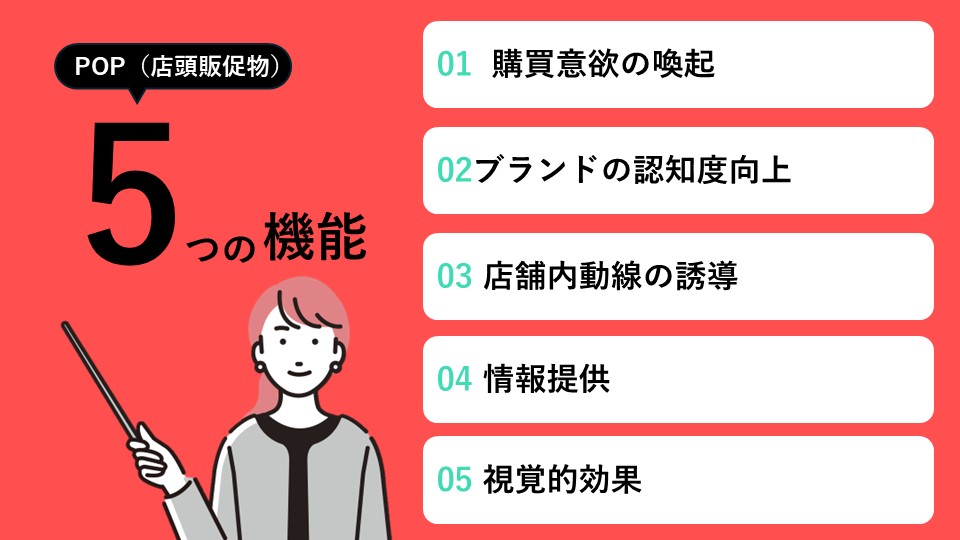
2. Main Functions of POP (Point of Purchase)
Function 1
Stimulation of purchasing desire
It promotes purchases by being directly in the consumer's line of sight inside the store. In particular, it plays a major role in encouraging impulse buys.
Function 2
Brand Awareness Improvement
By emphasizing new products and campaigns and increasing brand exposure, it makes it easier to remain in the consumer's memory.
Function 3
Guiding customer flow inside the store
By posting conspicuous displays and signage, you can guide consumers to specific products.
Function 4
Provision of Information
They function as a means to quickly convey product features, prices, campaign information, etc., to consumers.
Function 5
Visual Effects
By devising the color scheme and design, we make the product stand out and give the consumer a positive impression.
POP is an important marketing tool that directly influences consumer purchasing behavior. By installing it in appropriate locations and formats, you can expect an increase in sales.
3. Types of POP (Point of Purchase)
Store POP mainly includes the following types, each of which plays a different role.
POP 1
Printed materials (paper POP)
Printed POP is the most common form. It is placed on product shelves or near checkout counters and is used to convey product names, prices, sale information, and more. Small paper POP is often attached directly to products, while large ones are placed in prominent locations. They provide visual impact and create an opportunity for consumers to pick up the products. They are also effective for quickly conveying information such as sales and new products.
Handwritten POP also conveys the warmth of the person who wrote it and is utilized in sales industries, restaurants, service industries, etc., as an original and impactful promotional tool.
POP 2
Fixtures (3D POP)
This is where the display fixture itself used to display products is designed as POP. Ingenuity in shape and material is used to set it up to make the product stand out. It features a design where the display itself, such as a cart type or box type, leads to sales promotion. By installing fixtures along the consumer's traffic line, it naturally directs their eyes toward the products. In addition, displaying a large quantity of products on the fixture stimulates the desire to purchase and has the effect of encouraging bulk buying.
POP 3
Digital signage
POP displays that utilize digital technology to display information using videos and animations. Since the content on the screen can be changed frequently, it is possible to convey different messages according to the time of day or day of the week. Dynamic visuals catch the consumer's attention, and it is particularly effective for making products stand out in store aisles with many competitors. Another strength is the ability to provide promotions and new product information in real-time.
POP is an important tool that provides visual impact to consumers and conveys product or promotion information. It contributes to sales growth by promoting consumer purchasing behavior and supporting in-store promotional activities. It also plays an important role in increasing the presence of products and brands and stimulating consumer desire to purchase.
4. Professional POP (Point of Purchase) Planning and Production Procedures
While there are many types of POP displays, this time we will introduce the procedure for planning and producing POP for relatively high-priced products, such as those during the new product introduction phase.
Step 1
Store Survey & Analysis
The first step in POP production is to research and analyze the situation at the sales floor. Here, we focus on the following points.
Competitor deployment situation We grasp how competitors are deploying and analyze points where our own product can be differentiated. We work out strategies to make the difference from competitors stand out.
◆◆◆
Professional Perspective
Characteristics and display rules for each corporation and product group When displaying, it is necessary to understand the rules of each corporation and the characteristics of the product group. In particular, we grasp the restrictions on POP size (width/height) and display space regulations to make proposals that comply with the rules.
Specifications that make you want to set it up in a hotspot We think of attractive specifications that can be set up in "hotspots" that are easy for customers to notice. Designs and catchphrases that have high visibility and enhance the desire to purchase are required.
Based on the research and analysis, we proceed to specific POP design and production.
Design of deployment specifications Reflecting the store survey and the knowledge obtained, we determine what kind of POP is optimal. We consider details such as size, material, and installation method.
Design & copy production We create designs and catchphrases that resonate with customers. We think about the balance between visual and text, and produce creative works to maximize the appeal of product and brand characteristics.
Production Once the final specifications are determined, we shift to mass production. We thoroughly manage quality to ensure that the POP functions effectively.
Delivery The completed POP is delivered to each store. Even after delivery, we check the installation status at the store to maximize the effect.
◆◆◆
Professional Perspective
Trial production verification Before completion, we create prototypes to verify the image and effect of the installation at the store. At this stage, we identify problems and plan improvements.
Step 3
After-sales follow-up
Installation at stores We provide support to ensure that POP is correctly installed at each store. We offer advice on installation procedures and effective installation locations. Creation of installation request forms for store staff We create detailed request forms regarding installation for store staff. This ensures that the POP is installed appropriately and achieves the intended effect.
◆◆◆
Professional Perspective
Fixed-point survey after installation After the POP is installed, we conduct a survey to periodically check its effectiveness. We also check the reaction at the sales floor and the trends of competitors, and identify points for improvement.
Consideration of improvement specifications Based on the results of the fixed-point survey, we consider improvements to the POP or new appeal methods. This allows for the accumulation of "your company-only" knowledge that can be utilized for future measures, enabling even more effective development.
With BEEATS, we support not only POP (Point of Purchase) materials but also solving every challenge in your in-store deployment.
Founded 48 years ago, BEEATS supports the resolution of various in-store challenges based on our long-cultivated experience and abundant track record.
Number of projects completed per year Approximately 100 store fixtures and approximately 500 store POP displays.
Since its founding, BEEATS has supported over 1,000 clients in solving their in-store and sales promotion challenges. One of the reasons why BEEATS is continuously chosen by a wide range of clients, including major corporations, is its responsiveness. Its strength lies in providing ongoing support to help clients solve their problems.
Creating corners in 200 stores nationwide in just one week, etc. Installation to stores nationwide is also quick.
With a network of 1,000 production vendors, we achieve optimal creativity, speed, and cost. Beats' creative work has received much external recognition. We also provide prompt installation services to BEEATS nationwide, such as creating corners in 200 stores across the country in just one week.
Flyers, inserts, direct mail, etc. We have extensive experience in creating various graphic tools. We handle not only fixtures and POP displays, but also various types of direct mail and flyers, from production to delivery, ensuring security throughout the entire process. We will manage it for you. We can also handle the production of catalogs and brochures.
A network of overseas factories that enables high quality and low cost. BEEATS has formed a business partnership with ShanYoung Group, which has numerous global brand clients. This partnership will allow us to provide even lower prices and higher quality fixtures and LED products more quickly than ever before.
Please feel free to contact us regarding fixture manufacturing, LED displays, and signage.
A1. POP (point-of-purchase) is a collective term for advertisements and sales promotion tools used at the point of sale to stimulate consumer purchasing desire. Because they are effective at the moment consumers see a product or decide to purchase, they are often installed inside stores and become important marketing tools that have a direct impact on increasing sales.
Q2. What types of POP (Point of Purchase) are there?
A2. There are mainly 3 types of POP: general "printed material (paper POP)" that conveys product names and prices, "fixtures (3D POP)" where the display itself leads to sales promotion, and "digital signage" that uses video to disseminate information. Each has a different role, and by choosing the optimal format according to the characteristics and purpose of the product, you can increase the promotional effect.
Q3. What is the first step in POP planning and production practiced by professionals?
A3. Professional POP production begins with thorough store research and analysis. Specifically, we grasp the deployment status and appeal methods of competitors to clarify the differentiation points of our own products. Furthermore, after understanding the display rules and size restrictions for each corporation, we design attractive specifications that can be installed in hotspots where they are likely to catch the customer's eye.