Do you use navigation or map apps when heading to a place you are visiting for the first time?
Checking transport means to your destination on a navigation app, and walking while looking at Google Maps.
We take this convenient function for granted now, but if you forget your smartphone, you're in a big pinch! You might get lost not knowing which road to take, or you might be late for a promised time.
Actually, the same can be said for product development, sales promotion, and promotion. If you formulate a strategy without conducting marketing research, you cannot accurately grasp market trends and customer needs, making it difficult to launch effective measures.
The "research" that firmly captures market trends and accurately analyzes customer needs acts exactly like a navigator. Without this "navigator=research," it is difficult to reach the "destination=success," and the risk of getting lost increases. To clarify the path the business should follow, marketing research is essential.
This time, we introduce the basics of marketing research, concrete research methods, and application tips that are indispensable for the success of product planning and promotional planning in an easy-to-understand manner!
We, BEEATS, have contributed to numerous clients' sales promotion challenges through the development of sales promotion plans based on research. In particular, we will also introduce "storefront research," which is important when considering sales promotion tools (such as POP installed at the storefront) in detail. Please read to the end!
What is marketing research? Its purpose and importance
Marketing research is a crucial process that significantly contributes to the success of business strategies by understanding and analyzing customer needs and competitors.
For example, when introducing a new product to the market, if you proceed without understanding what customers truly want, it may become a product that does not sell. However, by conducting appropriate research in advance, you can reduce risk and greatly increase the probability of success.
◆◆◆
Marketing research basics
Marketing research refers to activities that investigate trends in the market, customers, and competitive situations in detail. By conducting research, you can clarify which direction business and promotional measures should head, and what kind of products or services are requested by customers.
◆◆◆
Why marketing research is important
As explained in the navigation example earlier, marketing research is essential for business success. Here, we will introduce its importance by summarizing it into three points.
1. Deepening of customer understanding By knowing what customers truly want, more appropriate product development and service improvement become possible. By listening directly to customer voices through questionnaires and interviews, you can discover hidden needs and issues.
2. Risk reduction By conducting research before starting new projects or marketing campaigns, you can reduce the risk of failure. By predicting market reactions in advance and formulating strategies based on them, you can prevent waste of cost and time.
3. Establishment of competitive advantage By understanding the trends of competitors, you can leverage your company's strengths and differentiate yourself from competitors. Through competitive analysis, it is important to identify in which fields your company can lead.
Difference between marketing research and marketing research
Now that we have understood the importance of marketing research, let's briefly confirm the difference between "marketing research" (marketing chousa) and "marketing research" (marketing risaachi). Although the terms are similar, their meanings are slightly different.
・Marketing research (marketing chousa): Refers to specific data collection activities. A process of actually collecting data, such as questionnaires, interviews, and observations.
・Marketing research: Refers to the overall concept including the entire research. It includes everything from data collection to analysis, and strategy formulation based on the results.
In other words, marketing research (marketing chousa) can be said to be a part of marketing research (marketing risaachi).
With this in mind, we will now take a closer look at the basic types of marketing research. Let's concretely confirm the characteristics of each research method.
Basic types of marketing research
There are various types of marketing research depending on the purpose. Here, we introduce three representative research methods.
type 1
Quantitative research
Quantitative research is a method that collects numerical data and analyzes it statistically. It collects a large amount of data through questionnaires or online surveys and derives objective conclusions. It is used, for example, for demand forecasting for new products and for investigating brand awareness.
[Research method examples]
Questionnaire survey, street survey, phone survey, mail survey
◆Open data research (a type of quantitative research)
Open data research is a method that utilizes data made public by government, public institutions, and research organizations. This research method allows for obtaining highly reliable data while keeping costs down. For example, you can use demographic data, economic indicators, and industry reports for market and competitive analysis. Combining multiple data sources also enables more comprehensive analysis.
type2
Qualitative Research
Qualitative research is research for deeply understanding consumer emotions and opinions, not numbers. Through interviews or group discussions, it explores potential customer needs and values. It is utilized, for example, in ad acceptance and new product concept testing.
[Research method examples]
・Group interview/discussion: A method where a moderator interviews multiple people ・Home Use Test (HUT): A method of having people use a product for a certain period and listening to their impressions ・Depth interview: A method of conducting a detailed 1-on-1 interview ・Visiting observation research (Ethnography research): A method of visiting a home and observing their life and product usage ・Visiting placement research: A method where a researcher visits a home in the target area and conducts a questionnaire survey
◆Mystery shopping (a type of qualitative research)
Mystery shopping is a method where investigators pose as general customers to experience actual stores or services and evaluate their quality and customer service. It is useful when investigating competitors' services or discovering areas for improvement in your own stores. For example, it is used when researching competitors' services or finding areas for improvement in your own store. Mystery shopping is an essential method for collecting realistic on-site information, and it involves creating detailed reports and proposing concrete improvements.
type3
Other Research Methods
In addition to quantitative research and qualitative research, there are various other research methods, such as observing and analyzing actual behavioral data and online activities.
[Research method examples]
・Observational research: A method to directly observe consumer behavior and grasp hidden needs and behavioral patterns ・Online behavior tracking research: Analyze user behavior data on websites and social media and use it for improving digital marketing strategies ・Experimental research (A/B testing): A method to compare different marketing measures and identify the optimal strategy
So far, we have introduced various types of marketing research. It is necessary to choose the type of research to conduct according to your objectives. Next, we will introduce research methods tailored to common business scenarios with a few examples.
Research for these situations! Basic examples of research applications
To utilize marketing research effectively, it is important to choose a method that matches your business issues and objectives. Here, we introduce three examples of utilizing research methods according to concrete business scenes.
1. When you want to grasp customer needs before launching a new product Optimal research method: Qualitative research (interviews or group discussions)
Before introducing a new product to the market, deeply understanding what target customers want is the key to success. By conducting qualitative research, you can delve into potential needs and emotions and clarify points for improving products or services.
[Concrete research application examples] ・Interview: Conduct 1-on-1 interviews with target customers to collect expectations and improvement requests for products. ・Focus group: Get feedback on new product concepts and functions through group discussions with several participants.
2. When you want to understand the trends of competitors and find your company's differentiation points Optimal research method: Mystery shopping
Mystery shopping is effective for understanding the strengths and weaknesses of competitors and differentiating your company. By visiting competitor stores as a customer and experiencing their services and customer service, you can specifically grasp the strengths and weaknesses of competitors and utilize them for your company's strategy.
[Concrete research application examples] ・Storefront research: Researchers visit competitor stores and evaluate product placement, staff customer service attitudes, promotional activities, etc. ・Service experience: Actually experience the competitor's service and clarify the strengths and weaknesses from a customer perspective.
3. When you want to measure the effectiveness of advertisements and promotions Optimal research method: Experimental research (A/B testing)
Experimental research is effective for measuring the effectiveness of advertisements and promotional campaigns in advance. By comparing and testing multiple variations, you can select the most effective measures and maximize your return on investment.
[Concrete application examples] ・A/B testing: Try different ad copy or designs on a small group of targets and measure which gets a higher reaction. ・Promotion effect measurement: Conduct a limited-time campaign and analyze sales and website visitors to confirm effectiveness.
To conduct marketing research effectively, it is important to manage not only the research itself but also the subsequent execution process. From here, we will explain the overall flow of marketing research and effective execution steps.
Marketing research flow and effective execution steps
To progress marketing research effectively, it is required to do it systematically. From here, we will explain the basic flow of marketing research step by step.
1. Objective setting and survey planning First, clarify the purpose of the survey, and set the survey method and schedule based on that. It is common to commission surveys to specialized research companies or agencies. We will work with the company that is our research partner to create a concrete plan.
2. Data collection In accordance with the plan, collect necessary information through questionnaires, interviews, and observations at stores. This data collection process is required to be performed accurately and thoroughly.
3. Data Analysis and Insight Extraction Analyze the collected data to derive important insights for your business. At this stage, you will identify which information is most useful for your strategy and draw conclusions.
4. Results sharing and strategy formulation Based on the survey results, formulate a concrete business strategy. Create a report and proceed to the next step while sharing it with related parties.
5. Strategy execution and evaluation Finally, execute the planned strategy and evaluate the results. Perform evaluation again after execution, extract the next points for improvement, and rotate the appropriate PDCA cycle.
In this way, through the entire flow of marketing research, you can develop a strategy for business success.
Up to this point, we have basically reviewed the knowledge, but next, we would like to delve deeper into marketing research related to the success of product sales promotion.
What is storefront research that is indispensable for sales promotion?
To succeed in sales promotion, it is essential to grasp the situation at the "storefront," the scene where customers actually pick up the product. "Storefront research," which confirms how products are displayed and how they are appealing to consumers, is an important method for building effective promotional strategies.
BEEATS mainly checks the following 7 points through in-store research to maximize the effectiveness of our clients' sales promotion tools.
1. Confirmation of product display situation Check if the product is properly displayed and if it is arranged in a visually appealing way.
2. Confirmation of the installation status of promotional materials/POP Check if promotional materials/POP are installed in the appropriate places and if they are properly appealing to consumers.
4. Status confirmation of competitor stores Check the promotional activities and product developments at competitor stores and utilize them for the target product strategy.
5. Confirmation of product position and occupied area in the sales floor Check where the target product is placed within the sales floor and whether the occupied area is appropriate.
5. Confirmation of product position and occupied area in the sales floor Check where the target product is placed within the sales floor and whether the occupied area is appropriate.
6. Evaluation of customer service talk Check how the staff introduces the product and use it to help improve customer service talk.
7. Observation of consumer behavior Observe which areas consumers gather in and which tools or products they show interest in.
Based on these survey results, we propose concrete measures to maximize the promotional effect at the storefront. For example, if the product POP is less noticeable compared to other companies, we will reconsider the shape or specifications of the POP, or design a new POP to counter the appeal of competitors.
The storefront is also where consumers finally decide whether or not to actually purchase a product, and information obtained through storefront research is very useful for planning improvement measures that lead directly to sales.
[Example introduction] SP tool proposal utilizing storefront research
BEEATS designs and proposes SP tools based on storefront research, producing many success stories.
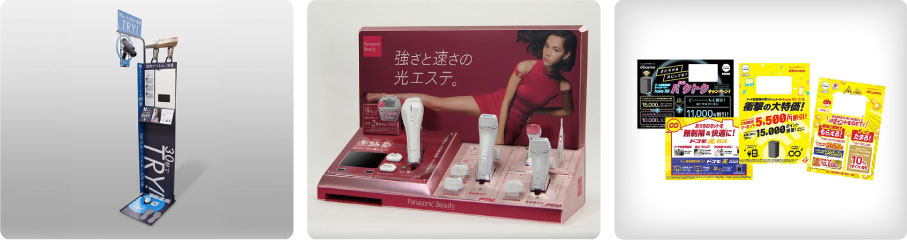
For example, when a client was considering the introduction of new in-store tools, BEEATS first conducted an in-store survey. We thoroughly analyzed the appeal content of competing products and the placement of promotional materials to confirm how the client's product strengths were being conveyed and what kind of sales talk the staff was using.
This survey revealed a discrepancy between the appeal points the client had assumed and the product features actually communicated in the customer service talk. To bridge this gap, BEEATS proposed POP and display tools that clarified appeal points so that sales staff could strengthen "selling" talk. As a result, we were able to build a storefront where product value is effectively communicated to target customers.
In this way, BEEATS makes proposals for SP tools based on concrete research results according to the client's needs and challenges, maximizing promotional effectiveness at the storefront.
Leave it to BEEATS for effective SP tool production based on research!
We, BEEATS, conduct planning and production of SP tools (sales promotion) based on thorough storefront research, and make optimal proposals to lead in-store promotions to success.
To maximize the effectiveness of sales promotion, it is essential to have a detailed grasp of the actual storefront situation. BEEATS not only performs data analysis but also goes to the actual site, observes and researches with our own eyes, and reflects the experienced information into the composition, design, and appeal content of SP tools to provide the optimal solution that matches the client's challenges and needs.
In addition, we support everything from planning and implementation of quantitative and qualitative research to creating analysis reports, not just storefront research. If you have challenges with sales promotion or marketing research, please feel free to contact us. We will fully support your promotion success!
TOPICS: Has the research-type pop-up store "with b8ta" appeared?
Products that don't sell; the news that "b8ta," which gathered attention as an experiential store, has entered into a business alliance with the marketing research company Macromill, Inc. to develop a research-type pop-up store service for research purposes has become a hot topic. (May 2024)
For the PoC (Proof of Concept) conducted prior to full-scale deployment, it appears that researchers from Macromill were dispatched to the pop-up store to conduct the research. As the importance of marketing research and in-store research utilizing the authentic voices and behavioral data of consumers obtained at physical stores is expected to increase even further, the Retail Voice editorial department is keeping a close eye on this.
A1. It is to understand and analyze customer needs and competitive situations to increase the probability of success for business strategies. It plays three important roles: grasping what customers truly want, reducing the risk of failure, and establishing a competitive advantage that utilizes the company's strengths.
Q2. What is the difference between marketing research and marketing research?
A2. Marketing research (marketing chousa) refers to specific activities that actually collect data using questionnaires, interviews, etc. On the other hand, marketing research (marketing risaachi) is a concept that encompasses the entire survey, including data collection, analysis, and strategy formulation.
Q3. What kind of types of marketing research are there?
A3. There are mainly three types: "Quantitative research" that collects numerical data and analyzes it statistically, "Qualitative research" that delves into consumer emotions and opinions, and "Other research methods (observational research, A/B testing, etc.)" that observe and analyze actual behavioral data and online activities.
Q4. What is storefront research in sales promotion?
A4. It is research to understand the in-store situation where customers actually pick up products. By checking product display status, POP installation status, competitor trends, and staff sales talk, it helps in implementing measures and creating tools that maximize in-store sales promotional effects.